
Most roof failures do not begin in the middle of the field. They begin at the edges — the eaves and the rakes — where wind finds its first opportunity to get under a shingle and lift it. The single component that decides whether those edges hold or peel is the one you can't see from the street: the starter strip. It is the first course installed, it carries no visible exposure, and it does more to keep an Atlanta roof on the house during a severe thunderstorm than almost any other detail.
Homeowners researching a new roof tend to focus on the field shingle — the color, the line, the warranty number printed on the bundle wrapper. That is reasonable, because the field shingle is what you see. But the field shingle's wind rating is only as good as the perimeter it is anchored to. A premium architectural shingle installed over a missing or improvised starter strip is a premium shingle with an unsealed edge, and the edge is where the wind goes to work.
This guide explains what a starter strip actually does, why cut-up field shingles are not a substitute, how the detail ties directly into your manufacturer wind warranty, and why the rake edges matter as much as the eaves. By the end, you will understand exactly what to look for in a roofing proposal — and how to recognize the difference between a roof built to specification and one that looks finished but is missing the detail that holds it together when the wind blows.
1. What a Starter Strip Actually Is
A starter strip is the first row of roofing material installed along the perimeter of the roof, beneath the first course of visible field shingles. It is a manufactured product — a continuous strip with a self-sealing asphalt adhesive bead positioned along the edge that meets the eave. When the first field shingle is laid over it, that adhesive bonds the bottom edge of the field shingle down tight to the deck. The starter has no granule-faced exposure tab of its own. It exists entirely to anchor and seal.
The geometry is the entire point. On a field shingle, the factory sealant strip sits up the face of the shingle so that it bonds the course above. At the very bottom edge of the roof, there is no course below to bond to — so the manufacturer makes a separate product whose sealant sits at the bottom, right at the roof edge. That places the bond within an inch or so of where the shingle overhangs the drip edge. Wind uplift is concentrated at exactly that overhanging edge, which is why the starter's sealant position is not a convenience. It is the engineering.
Starter strips also seal the long sealing joints between field shingles at the eave. The cutouts and seams in the first visible course would otherwise sit directly over the deck with nothing behind them. The starter strip closes those gaps, so wind-driven rain that gets past the first course hits a continuous sealed surface instead of an open joint above bare underlayment. This water-control function is just as important as the uplift function, and it is a function improvised material cannot reliably provide.
2. Why Roofs Fail at the Edges First
Wind does not lift a roof evenly. As air flows over a building, it accelerates and separates at the edges, creating zones of strong negative pressure — suction — along the eaves, rakes, and ridge. Building codes and wind-engineering standards recognize this directly: perimeter and corner zones of a roof are designed for substantially higher uplift loads than the field, because that is where the force concentrates. The edge is the weak point not by accident but by physics.
When a gust strikes a poorly sealed eave, it gets a fingerhold under the unbonded bottom edge of the first course and peels it upward. Once that first shingle lifts, the course above is exposed, then the next, and the failure unzips up the slope. This is the progression seen repeatedly after metro Atlanta's severe thunderstorm season: the damage starts as a few missing shingles at an eave or gable corner and, left unaddressed, becomes a field-wide failure that requires full replacement rather than a contained repair.
A correctly installed starter strip removes the fingerhold. The bottom edge of every perimeter shingle is bonded down, so the gust has nothing to grab. The same wind that would unzip an unsealed edge slides harmlessly over a sealed one. This is why the perimeter detail is the highest-leverage decision on the entire roof: it costs a fraction of the total project, and it governs whether the roof survives the storms that this region delivers every spring and summer.
3. The Adhesive Position Problem: Why Cut-Up Shingles Fail
For decades, some crews improvised a starter course by flipping or trimming three-tab field shingles and running them along the eave. It saved a few dollars on materials. It also put the sealant in the wrong place, and that single error undoes the entire purpose of the course.
Consider where the adhesive sits. On a three-tab shingle, the factory sealant runs across the face above the tabs. Flip that shingle over to use as starter, and the sealant ends up near the top of the strip — three to five inches up from the roof edge. The overhanging bottom edge of the first field shingle, the part the wind actually lifts, gets no bond at all. The improvised starter looks like a starter and even functions as one in calm weather, but it leaves the critical edge unsealed. The roof is one good gust away from the failure the starter was supposed to prevent.
| Detail | Dedicated Starter Strip | Cut-Up / Flipped Field Shingles |
|---|---|---|
| Sealant location | At the eave edge, ~1 in from overhang | 3–5 in up the strip, away from the edge |
| Bonds the overhanging edge | Yes — directly | No — edge left unbonded |
| Seals eave joints & cutouts | Continuous sealed surface | Inconsistent; open seams possible |
| Manufacturer warranty compliant | Yes, when installed to spec | Generally no — voids enhanced wind coverage |
| Engineered for high-wind zones | Yes, supports 110–130 mph ratings | No documented rating |
| Rake-edge protection | Available and specified | Rarely applied correctly |
Major manufacturers closed this gap years ago by producing dedicated starter products — GAF Pro-Start and WeatherBlocker, CertainTeed SwiftStart and Presidential Starter, and similar lines from other makers. These products place the sealant where it belongs and are explicitly required for the enhanced wind warranties homeowners pay a premium to obtain. A crew that still improvises starter from field shingles is either unaware of current standards or cutting a corner that the homeowner cannot see from the ground.
4. Eaves and Rakes: Both Edges Need a Starter
The eave — the horizontal bottom edge of the roof — is where most crews remember to install starter, because that is the traditional first course. The rakes, the sloped edges that run up the gable ends, are the detail that frequently gets skipped. That omission leaves a large portion of the perimeter unsealed on any home with prominent gables, which describes most of the two-story traditional and craftsman homes throughout metro Atlanta.
Wind striking a gable end gets under the rake edge of the field shingles and lifts them sideways, the same way it lifts an unsealed eave. Running starter strip up the rakes bonds those edge shingles down and gives the perimeter a single continuous seal rather than a sealed bottom with vulnerable sides. On exposed lots, hilltop properties, and homes with tall gable ends — common in the established neighborhoods of Marietta and Roswell — rake starter is not a luxury. It is the difference between a perimeter that holds and one that opens up in a straight-line wind event.
Some manufacturers offer rake-specific starter products with the sealant positioned for vertical edges; others approve their standard starter for rake use when installed to specification. Either way, the rake detail should appear explicitly in the written scope of work. A proposal that specifies starter only at the eaves is specifying a roof with half its perimeter unsealed, regardless of how good the field shingle is.
The starter strip is invisible once the roof is finished — which is exactly why it gets skipped. A homeowner cannot see whether the first course is a dedicated starter product or a flipped field shingle, and cannot see whether the rakes were sealed at all. A documented, photographed assessment is the only reliable way to verify the detail before it is buried under the field.
5. How Starter Works With Drip Edge and Underlayment
The starter strip does not work alone. It sits within a layered perimeter assembly — deck, underlayment, drip edge, and ice-and-water membrane — and the sequence in which those layers are installed determines whether the edge sheds water correctly. Getting the starter right while getting the sequence wrong still produces a vulnerable edge.
At the eave, the correct order in Georgia practice is generally: deck, then self-adhering ice-and-water membrane over the eave, then the metal drip edge on top of the membrane at the eave, then the starter strip set to overhang the drip edge slightly, then the first field course bonded to the starter. At the rake, the sequence shifts — drip edge goes over the underlayment — but the principle holds: each layer directs water onto the layer below it and ultimately off the edge, never behind it. The starter strip's overhang past the drip edge, roughly a quarter to three-quarters of an inch, lets water drip clear of the fascia instead of wicking back underneath.
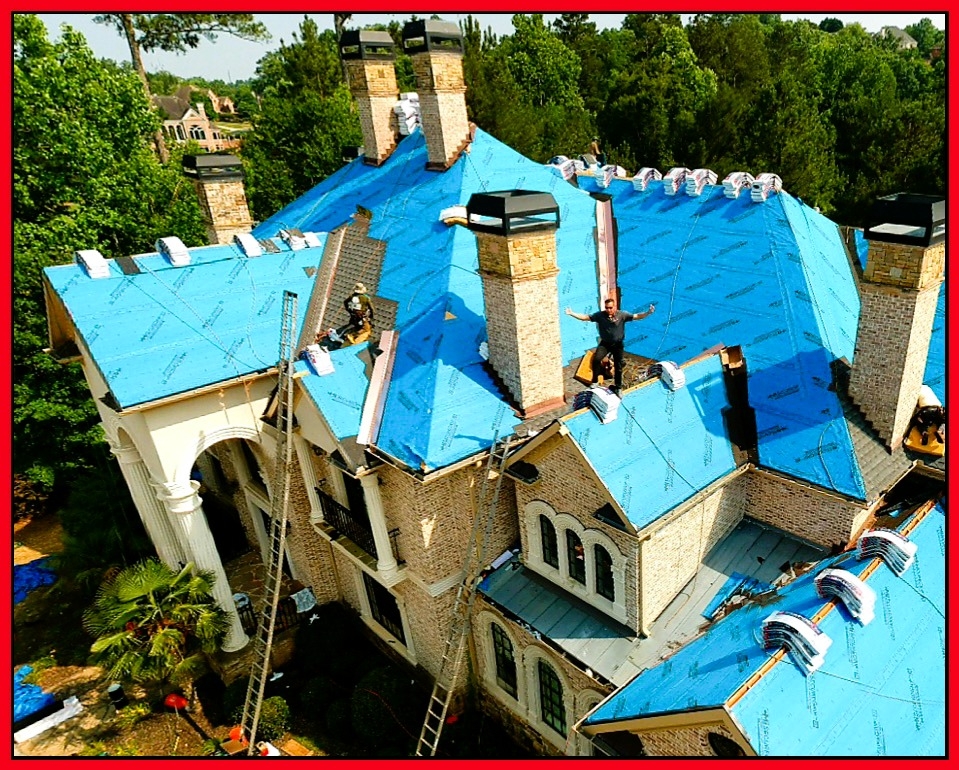
Drip edge is required by Georgia residential building code at both eaves and rakes, and the starter strip is installed in coordination with it. When a roof is built correctly, the membrane, drip edge, and starter form a sealed, water-shedding perimeter that handles the wind-driven rain Atlanta sees in nearly every storm. When any layer is out of sequence — drip edge under the membrane at the eave, or starter set flush instead of overhanging — water finds the gap. The detail is unforgiving, which is why it belongs to experienced crews working to a documented standard.
6. The Direct Link to Your Wind Warranty
The enhanced wind warranties that homeowners value — coverage in the 110 to 130 mph range, and in some product systems higher — are not granted automatically with the purchase of premium shingles. They are conditioned on the roof being installed to the manufacturer's published specification, and the starter strip is a named requirement in that specification. The same is true of the fastening pattern; correct six-nail fastening and a correct starter strip are the two perimeter conditions that most often determine whether enhanced coverage actually applies.
This matters most at the moment it is tested: a storm claim. After a wind event, the manufacturer or the insurance adjuster examines the failed area. If they find improvised starter material, a missing rake starter, or a perimeter that was never properly sealed, the enhanced wind warranty can be denied — and the homeowner who paid for a 130 mph rated system discovers they have, in effect, a standard installation. The premium was spent; the coverage was never earned. In a market that records frequent severe gusts every storm season, that is not a hypothetical risk.
This is also why the warranty discussion belongs in the proposal stage, not after the roof is on. The self-sealing technology in modern shingles, the fastening pattern, and the starter strip are the three elements that together earn the wind rating. A contractor who can show you, in writing, the specific starter product they will use and confirm rake application is a contractor building toward the warranty you are paying for. To understand how 1 Source documents these details on every project, see why homeowners choose 1 Source.
Is Your Roof's Perimeter Properly Sealed?
Free on-site assessment. We document the eave and rake detail with photographs and tell you exactly what is — and isn't — protecting your edges.
Call (404) 277-13777. Why the Detail Matters More in Georgia's Climate
Georgia does not get the sustained hurricane-force winds of the coast, but metro Atlanta sits in one of the more active severe-thunderstorm corridors in the Southeast. Spring and summer bring repeated rounds of straight-line winds, microbursts, and the occasional embedded tornado — events that deliver 60 to 90 mph gusts to inland neighborhoods that rarely make the national news. Those gusts find the same edges every time.
The combination of high wind and heavy rain is what makes the perimeter detail decisive here. A dry wind event might lift a few shingles; a wind-driven rain event lifts shingles and pushes water under them simultaneously. A sealed starter course resists both at once — it holds the edge down and closes the joints water would otherwise exploit. An unsealed edge fails on both counts, which is how a single storm produces both blow-off damage and an attic leak from the same eave.
Atlanta's humidity adds a second factor. Decking that gets repeatedly dampened at an unsealed edge deteriorates faster in a humid climate than in a dry one, so a perimeter that leaks even slightly accelerates the kind of deck damage that turns a routine reroof into a structural repair. The starter strip, by keeping the edge sealed, protects not just the shingles but the deck and framing beneath them. For homeowners weighing a storm-resilient build, the perimeter detail is a core part of the FORTIFIED approach to building beyond minimum code.
8. What Correct Installation Looks Like
A properly installed starter course follows a short list of standards that an experienced crew treats as non-negotiable. Understanding them lets a homeowner read a scope of work and recognize whether the perimeter is being built to specification or glossed over.
The starter runs continuously along every eave and, on a quality installation, up every rake. It is set to overhang the drip edge by roughly a quarter to three-quarters of an inch — enough to drip water clear, not so much that the edge sags or curls. It is fastened with the manufacturer's specified nail count and placement, with the nails positioned so they are covered by the first field course and never left exposed at the edge. The sealant bead faces the eave so it bonds the overhanging edge of the first field shingle, and the field shingles are offset from the starter joints so seams never stack.
On a finished roof, the evidence of correct work is subtle but visible: a clean, straight first course with a consistent overhang, no exposed nail heads at the perimeter, and no three-tab cutouts peeking out at the eave. The work is mostly hidden, which is precisely why it depends on the integrity and training of the crew. A manufacturer-certified contractor installs the starter to the standard whether or not anyone is watching, because the certification — and the warranty it backs — depends on it.
9. How to Tell If Your Existing Roof Has It Right
Most homeowners inherit their roof from a previous owner or a previous contractor and have no record of how the perimeter was built. There are a few things you can check from the ground, and a clear point at which you should bring in a professional.
From the ground, look closely at the bottom edge of the roof along the eaves. A correct starter course produces a clean, sealed first row with a consistent slight overhang past the drip edge and no nail heads showing. If you can see the three-tab cutouts of a flipped shingle at the very edge, or the first course is lifting, curling, or visibly loose in wind, the starter detail is likely wrong or absent. Check the rakes too — if the gable edges look identical to an unsealed field with no continuous starter behind them, the rake protection is probably missing.
The reliable answer comes from a professional inspection. A drone inspection can document the edge condition at close range without putting anyone on a steep roof, and a hands-on assessment can confirm whether the first course is bonded. If your home has experienced any blow-off at the edges, a perimeter check should be the first step before assuming the field shingle is at fault — because the field shingle usually isn't. Homeowners who have already had storm damage should also review the insurance claims process, since perimeter installation can affect both the claim and the warranty behind it.
10. The Right Time to Upgrade the Perimeter
The most cost-effective moment to get the starter detail right is during a full reroof, when the edges are already torn off and accessible. Adding a dedicated starter at both eaves and rakes during a planned roof replacement adds a modest amount to the material line and essentially nothing to the labor, because the crew is already working the perimeter. Trying to add rake starter to an existing roof later means disturbing the field shingles along the gable, which is far more disruptive and rarely worth doing in isolation.
For homeowners on exposed lots or in neighborhoods that take repeated storm hits — much of Alpharetta, Johns Creek, and the higher-elevation pockets of Sandy Springs — specifying the full perimeter upgrade at reroof time is one of the highest-value decisions in the entire project. It pairs naturally with other perimeter and edge details that determine storm performance: kickout flashing at roof-to-wall transitions, step flashing along walls, and upgraded hip and ridge caps at the top of the roof.
When 1 Source scopes a replacement, the starter detail is written into the proposal explicitly — the specific product, eave and rake application, fastening, and overhang — alongside the rest of the system. It is never a verbal assurance or an assumed inclusion. For estate homes in Buckhead and premium properties throughout metro Atlanta, the perimeter standard matches the investment the property warrants. To see completed work across the region, browse the project gallery.
An unsealed perimeter does not announce itself — until a storm finds it. The first sign is often missing shingles at an eave or a leak at a gable corner after a severe thunderstorm. By then the repair, and possibly an insurance dispute, costs far more than getting the detail right would have. Early assessment turns a hidden vulnerability into a documented, planned fix.
11. The Equivalent Principle on Low-Slope and Commercial Roofs
The starter-strip principle — seal and anchor the perimeter first — is not unique to steep-slope shingle roofs. On the low-slope and flat roofs common to commercial properties, the same logic governs the edge detailing of the membrane. Perimeter bars, securement strips, and edge-metal fastening on a single-ply membrane exist for the identical reason: wind uplift concentrates at the edges, and the edge has to be mechanically and adhesively secured before the field will hold.
The failure mode is the same as well. A commercial membrane that lifts at a poorly secured perimeter peels back into the field, and the resulting damage drives the kind of commercial roofing claims that property managers dread. Whether the surface is asphalt shingle or thermoplastic membrane, the edge is the first thing the wind tests and the first thing a quality installation reinforces.
For property managers maintaining a portfolio of buildings, the perimeter detail belongs in any roof condition assessment — it is one of the highest-consequence, lowest-visibility components on the roof. Folding it into a structured roof asset management program ensures the edges are documented and verified rather than assumed, on both new installations and existing roofs approaching the end of their service life.
12. The Bottom Line for Atlanta Homeowners
The starter strip is the clearest example of a roofing principle that experienced contractors understand and price-first contractors ignore: the parts you cannot see determine how long the parts you can see will last. A roof is a system, and its weakest point is the perimeter. Get the perimeter right and the field shingle delivers everything its warranty promises. Get it wrong and the best shingle on the market is one storm from a blow-off.
For Atlanta homeowners, the takeaways are concrete. Insist on a dedicated starter strip, not improvised field shingles. Require it at the rakes as well as the eaves. Confirm it is the manufacturer-specified product that supports your wind warranty. And put all of it in writing in the scope of work, because a perimeter detail that is only described verbally is a perimeter detail no one can verify after the field is laid. The starter strip costs a fraction of the project and protects the whole of it — which is exactly the kind of value that defines a roof built to last.
If you are planning a replacement, evaluating storm damage, or simply uncertain whether your current roof's edges are properly sealed, the right next step is a documented assessment. 1 Source examines the perimeter, photographs the condition, and explains in plain terms what is protecting your roof and what isn't. You can read more about our company and standards, explore related installation topics in the blog library, or simply call to schedule.
Schedule Your Free Roof Assessment
Perimeter inspection, photographed edge documentation, and a clear explanation of your roof's wind and water protection — before any commitment. Serving Atlanta, Buckhead, Alpharetta, and all of metro Atlanta.
(404) 277-1377 — No ObligationCertified by Industry-Leading Manufacturers