


When Atlanta residents talk about East Cobb, they rarely mean Marietta specifically — they mean the collection of established, school-zone-prestige neighborhoods that anchor Cobb County's most sought-after residential corridor. Walton High School zone. Lassiter High School zone. Pope High School zone. These school zones drive property values, attract long-term owner-occupants, and create a housing market where maintenance and curb appeal are taken seriously. The homeowners who buy into these zones invest in their properties — and they expect the contractors they invite onto those properties to meet the same standard.
The homes in these corridors were built primarily in the 1970s through the 1990s — traditional and ranch-style structures on wooded lots off Shallowford Road, Johnson Ferry Road, and the Bill Murdock Road corridor. Today, those original roofs are between 30 and 50 years old. Many are at or past the end of their functional lifespan. A home built in 1978 in the Walton school zone that has never had its roof replaced is carrying a 47-year-old asphalt shingle system through Georgia's summer UV exposure, spring hail season, and Cobb County's documented high-frequency storm pattern. That combination does not produce roofs that are aging gracefully.
East Cobb is 1 Source's most active service zone. We have completed dozens of roof replacements in neighborhoods off these corridors. We know these streets, we know the architectural styles, and we understand what East Cobb homeowners expect from a contractor they allow on their property: professional communication, honest assessment, certified materials, and a project that runs cleanly from first call to final warranty registration.
We also serve Historic Marietta Square, where Victorian and traditional structures in the downtown core require material sensitivity, and the Lost Mountain and Kennesaw Mountain perimeter communities, where larger lots and more complex rooflines demand premium system specifications. Wherever you are in the Marietta market, reach us at (404) 277-1377 for a free inspection.
Roofing Services for Marietta and East Cobb Homeowners
East Cobb's primary roofing needs — high-volume aged-stock replacement, storm damage response, tree canopy hazard management, and insurance claim coordination — are all services 1 Source provides from a single point of contact. No subcontracting hand-offs. No third-party tree crews we cannot stand behind.
Roof Replacement
High-volume replacement for East Cobb's 1970s–1990s home stock. Full system installation with GAF, CertainTeed certified materials. Manufacturer warranty on every project.
Service page coming soon.
Storm Damage Restoration
Cobb County hail and wind response. Kennesaw Mountain updraft storms intensify cell activity across East Cobb — our drone inspection documents damage invisible from the ground, and we provide the documentation and detailed estimate that support your insurance claim.
Tree Removal
Emergency and preventive tree removal for East Cobb's wooded residential corridors. Large tree canopy over aging roofs is one of the highest-risk conditions we see in this market.
Service page coming soon.
Insurance Claims Assistance
Documented hail claim support for Cobb County storm events. Full adjuster package: drone photography, written damage assessment, cost justification for quality materials. We thoroughly document the full extent of the damage for your insurer to review.
East Cobb Neighborhoods We Serve
East Cobb is not a single neighborhood — it is a collection of distinct school zone communities, each with its own character, housing vintage, and roofing profile. Here is how 1 Source approaches each one.
Walton High School Zone — Bill Murdock Road Corridor (30062, 30068)
Homes in the Walton school zone are consistently among Cobb County's most active for roof replacement. The school-zone premium keeps these properties well-maintained and trading at high values — buyers who pay for Walton zone access are not going to allow deferred maintenance to compound. Most of the housing stock here is 1970s–1980s traditional construction on wooded lots, with architectural details — dormers, complex valleys, extended overhangs — that require an experienced installation crew. 1 Source has completed multiple projects in this corridor and is familiar with the specific roofline patterns common to the area.
Lassiter High School Zone — Shallowford Road Corridor (30066)
The Shallowford Road corridor through the Lassiter school zone carries the same dynamic as the Walton zone: school-zone prestige, established 1980s–1990s homes, high owner-occupancy, and owners who have lived in the same property long enough that the original roof is now entering or past its functional end. We have completed multiple projects in this zone. Homeowners here consistently identify their neighbors' recent replacements as the prompt for their own inspection call — which is exactly the right instinct when you have a 40-year-old roof in a high-hail county.
Pope High School Zone — East Marietta / East Cobb
Slightly newer housing mix than Walton and Lassiter — still primarily pre-2000 stock, but with a higher proportion of late-1980s and 1990s builds that may be reaching their first replacement window rather than their second. Strong community identity; homeowners in this zone take neighborhood presentation seriously. Pope zone properties on wooded lots face the same tree-canopy storm exposure risk common across East Cobb.
Lost Mountain / Kennesaw Mountain Perimeter
Larger residential lots on the perimeter of Kennesaw Mountain National Battlefield Park — a different profile from the school zone corridors. These are mostly luxury builds from the 1990s through the 2010s, with more complex rooflines, higher pitch angles, and premium material requirements. Some of these properties have standing seam metal or designer-tier shingle systems original to the build. The Mountain's storm dynamics — described in detail below — create specific exposure risk for properties in this zone.
Historic Marietta Square
Victorian and traditional commercial and residential structures in Marietta's downtown core. Smaller in volume than the school zone replacement market, but distinct in character. Preservation sensitivity applies even where formal historic designation does not. Homeowners and property owners in the Square area can expect a contractor who understands the material considerations their structures require — not a standard shingle swap crew working from a materials list that does not account for the building's age or architecture.
Why Cobb County Has the Highest Hail Damage Volume in Georgia
Cobb County's position in Georgia's storm geography is not accidental — it is the product of three overlapping factors that combine to produce some of the highest hail impact frequency in the state.
The first factor is the storm track. Spring systems that develop over the Gulf of Mexico and track northeast toward the Appalachians pass directly over the Atlanta metro before gaining elevation. As these systems move through the Atlanta corridor, they retain low-altitude intensity — hail-producing cells that have not yet risen to break apart or dissipate.
The second factor is Kennesaw Mountain. At approximately 1,700 feet elevation, Kennesaw Mountain creates a significant updraft effect as storm systems move across its western face. That updraft — the same mechanism that creates turbulence for aircraft flying past mountain ridges — intensifies developing storm cells as they pass. NOAA storm data from the 2021 and 2022 hail seasons shows elevated ground-level impact reports in East Cobb zip codes (30062, 30066, 30068) relative to surrounding areas. The Mountain's updraft contribution to storm cell intensification is a specific East Cobb risk factor that does not apply to the same degree in Fulton County or DeKalb County neighborhoods at lower elevation.
The third factor is housing density. East Cobb's residential fabric is dense — tightly spaced subdivisions on relatively small lots mean that a single storm cell passing over the corridor affects a very high number of structures simultaneously. When Cobb County has a hail event, a large number of homes sustain damage in the same storm window.
East Cobb's tree canopy adds a second storm impact mechanism that is less common in southern Fulton County neighborhoods. The mature hardwood and pine cover over the school zone residential corridors is genuinely beautiful — and genuinely dangerous in a wind event. Large limbs, and in severe events entire trees, regularly deposit onto residential roofing. A 1975 ranch home with an original 50-year-old roof, under a 60-foot pine on the Bill Murdock Road corridor, is among the highest composite risk profiles we see in the metro area: aged materials, elevated hail frequency, and overhead canopy exposure all compounding simultaneously.
1 Source's free post-storm drone inspections are designed for exactly this risk profile. Our drone can survey a full East Cobb residential roof in under 30 minutes and produce photographic documentation that is ready for an insurance adjuster the same day. Hail damage on asphalt shingles is typically invisible from the ground — granule loss from hail impact appears as darkened patches that can only be clearly identified from above. We have found active damage on East Cobb homes where the homeowner had no indication from ground-level observation that anything had happened.
East Cobb Storm Inspection — Free, Same Week.
Hail damage is invisible from the ground. Our drone finds what you can't see. No cost, no obligation.
The East Cobb Replacement Window — 30–50 Year Old Homes, New-Roof Demand
The math on East Cobb's housing stock is straightforward, and it is not alarming — it is simply a function of when the neighborhood was built. A home constructed in 1975 in the Walton school zone is now 51 years old. If its original asphalt shingle roof was never replaced, that roof has long exceeded its functional lifespan. If it was replaced once — around 1995 or 2000, which would be the typical timing for a 20-year-old original system in that climate — that replacement is itself now 25 to 30 years old and entering its own replacement window.
Georgia's climate is not kind to aged roofing materials. UV exposure at Atlanta's latitude degrades the asphalt binder in shingles steadily across the system's life. By year 25, granule adhesion is noticeably reduced; by year 30–35, shingles in full sun exposure are typically showing brittleness, cupping, or cracking. Heavy spring rainfall — Cobb County averages over 50 inches of precipitation annually — cycles seam stress and valley flashing on a system that is progressively losing its material integrity. Thermal expansion and contraction through Georgia's hot summers and cold winters compounds that stress over time.
The result is that a large proportion of East Cobb's existing housing stock is currently in an active replacement window. Not all of it — some homes were built later, some were reroofed with higher-quality materials that are holding up — but the majority of the 1970s and 1980s housing in the Walton and Lassiter corridors falls into this category.
1 Source offers free inspections to assess remaining roof life honestly. We provide a written condition report documenting granule coverage, shingle flexibility, valley flashing condition, ridge cap integrity, and any active leak indicators. We include a remaining-life estimate based on the observed conditions and a replacement proposal when the assessment warrants one. If the roof has 5–7 good years left, we will tell you that. If it is showing active deterioration that will cause interior damage within the next season or two, we will tell you that with equal clarity. No ambiguity, no manufactured urgency.
Pre-Sale Roof Inspection in East Cobb — A Strategic Advantage
School zone homes sell frequently. East Cobb is one of the most active residential real estate markets in the Atlanta metro — buyers are competitive, timelines are compressed, and inspection objections can cost sellers meaningfully in negotiation. A deferred maintenance item on a roof inspection report — granule loss, valley failure, soft decking, aging flashing — is one of the most common triggers for a buyer's price reduction request or repair credit demand.
The buyers who compete for homes in the Walton and Lassiter school zone corridors are, by and large, educated professional households with the resources to have their inspection report reviewed carefully. They will notice a 40-year-old original roof. Their inspector will flag it. And if the seller has not addressed it proactively, it becomes a negotiating point that the seller is reacting to under time pressure — never the best position.
A documented roof replacement with a transferable manufacturer warranty changes that dynamic entirely. The buyer's inspector still examines the roof — but what they find is a recently installed, warranty-backed system with a clean inspection record. That removes the most common structural objection from the transaction and positions the seller as a property owner who has maintained the home correctly.
For East Cobb homeowners preparing to list, 1 Source's pre-sale inspection identifies whether a replacement, targeted repairs, or certification of remaining roof life will best position the home. We provide a written assessment that can be shared directly with a listing agent. In many cases, a pre-listing replacement pays for itself in reduced buyer concessions and faster transaction timelines.
Why 1 Source Roofing Is East Cobb's Preferred Contractor
East Cobb is not a market where homeowners accept mediocre contractor experiences. The homeowners in the Walton, Lassiter, and Pope school zone corridors have options — they receive mailer solicitations from multiple contractors after every significant storm event. What distinguishes 1 Source is not a lower price point. It is the quality of the project experience and the backing of manufacturer certifications that create accountability beyond the contractor's own word.
We have completed more projects in East Cobb than any other zone in our service area. The Bill Murdock Road corridor, the Shallowford Road corridor, Johnson Ferry Road — these are not unfamiliar territory. We know the neighborhood patterns, the common roofline configurations, and the specific challenges that wooded East Cobb lots create for a roofing project: debris management, protecting landscape beds during material delivery, staging on narrow driveways, and coordinating with neighbors whose driveways may be affected by equipment positioning.
Our certifications — GAF Certified, CertainTeed certified Preferred Contractor — provide manufacturer warranty backing that non-certified contractors cannot match. Every replacement project produces a documented warranty registration, a final inspection photograph record, and a project summary that the homeowner can keep with their home's maintenance file. For pre-sale purposes, for insurance documentation, or simply for personal records, that documentation package has real value.
We offer free drone inspections for all East Cobb homeowners following significant storm events. Our drone inspection produces a complete photographic record of the roof surface — ridge, field, valleys, penetrations, and flashing — without any ladder or foot traffic on the roof itself. That record is the starting point for an insurance claim and gives the homeowner an honest picture of their roof's actual condition before they engage with an adjuster. Reach us at (404) 277-1377.
A Recent East Cobb Project
A homeowner in the Lassiter school zone on Shallowford Road contacted us after a neighbor's roof replacement caught their attention. Their own home was a 1983 traditional two-story on a wooded lot — original architectural shingles, now 42 years old. The homeowner had noticed some granule accumulation in the gutters but had no other visible indication of deterioration from the ground.
Our drone inspection told a different story. We found granule loss across approximately 60% of the field area, with the south-facing slope showing the most UV-related degradation. Two areas of soft decking were visible from the deflection pattern in the shingles — moisture intrusion that had compromised the underlying OSB without yet penetrating to the interior ceiling. And the east-facing valley flashing — an original galvanized metal installation — had failed at its upslope seam, creating an active water channel that was directing rainfall along the fascia rather than into the gutter system.
We provided the homeowner with a written inspection report with drone photographs documenting each finding. The assessment recommended full replacement: the decking soft spots required board replacement, and replacing a 42-year-old field while leaving the failed valley would have been false economy. The homeowner also had an active storm damage claim from a 2022 hail event — our documentation confirmed granule impact consistent with hail damage on the north-facing slope, which had been missed in the initial adjuster visit.
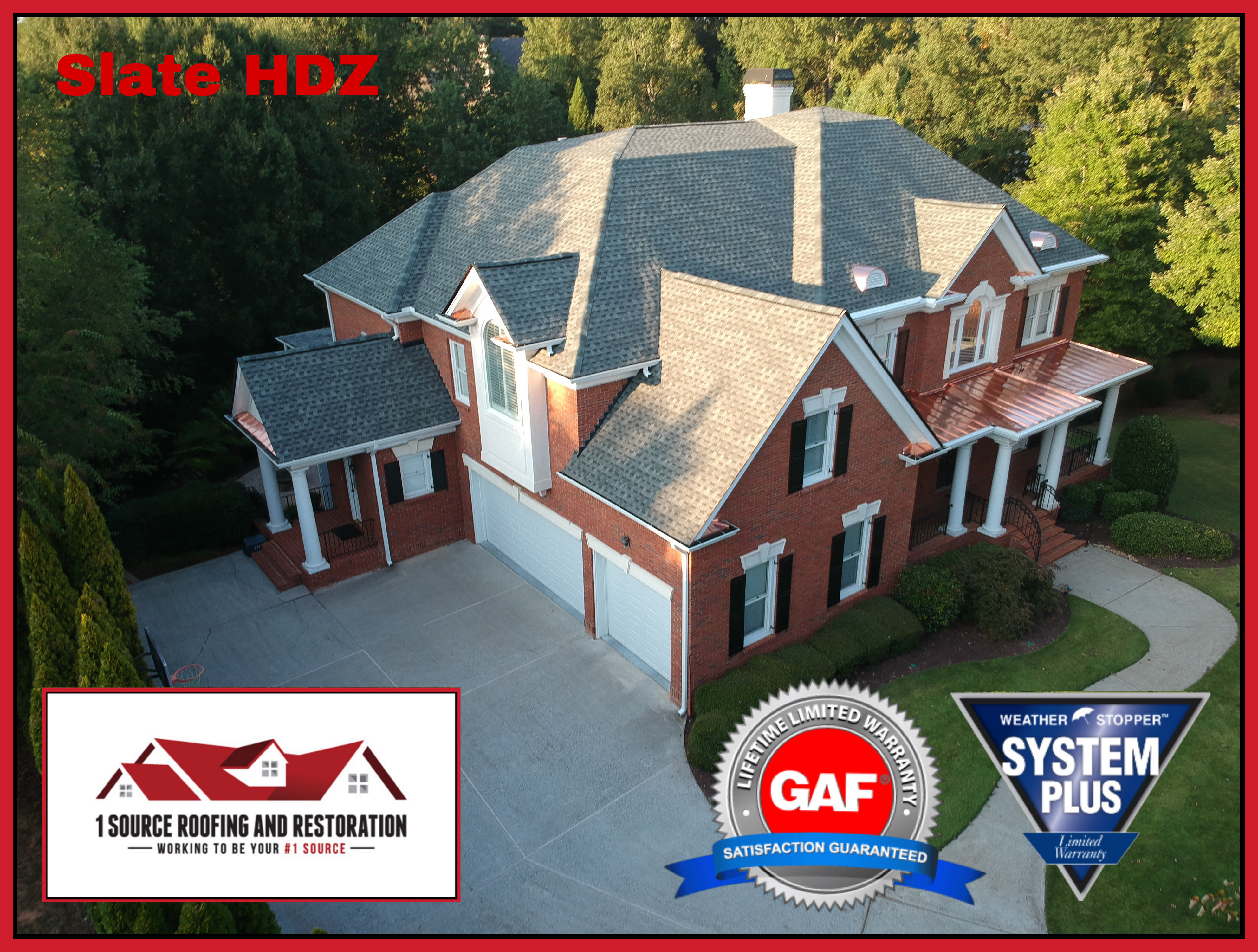
We documented the overlooked storm-related damage and submitted that supplemental documentation for the insurer to review. The resulting supplemental coverage paid for a meaningful portion of the project cost. The full replacement used GAF Timberline HDZ shingles — an appropriate mid-premium specification for a Lassiter zone home at this price tier — with new OSB decking at the two deteriorated panels, full synthetic underlayment across the field, and new standing seam metal valley flashing in both valley runs. The project completed in three days. Final inspection was documented by drone on day four. Warranty registered with GAF that week.
The homeowner has since referred two neighbors on the same street, both of whom had original or near-original roofs at similar age. That pattern — one project creating visible street-level quality that prompts neighbor calls — is how 1 Source built its presence in the East Cobb market in the first place.
What East Cobb Homeowners Say
"Our house is in the Walton school zone and we've been here 28 years. The roof was original. 1 Source found problems we didn't know were there and handled everything professionally. Would absolutely recommend to any neighbor in the area."
— P. Cunningham, East Cobb, Marietta
"We were preparing to list our home on Shallowford Road and wanted the roof addressed before inspection. 1 Source assessed it honestly, gave us a clear proposal, and completed the replacement on schedule. Our listing agent said it was the cleanest pre-sale roof situation she had seen in years."
— R. Holloway, Lassiter School Zone, Marietta
Certifications East Cobb Homeowners Expect
The homeowners who live in Walton, Lassiter, and Pope school zone neighborhoods have made significant investments in their properties. They research contractors. They check credentials. And they understand that a GAF Certified or Preferred designation is not a cosmetic label — it is a manufacturer relationship that produces warranty tiers a non-certified contractor cannot offer, regardless of the materials they install.
GAF Certified: Every replacement project we complete with GAF materials qualifies for the System Plus warranty — a 50-year non-prorated material and workmanship warranty that transfers to a new owner once. For East Cobb homeowners preparing to sell, a transferable GAF System Plus warranty is a documented asset in the transaction.
CertainTeed Certified: Access to CertainTeed's SureStart PLUS warranty on qualifying systems. CertainTeed's Landmark and Landmark Premium lines are common specifications for Marietta's mid-to-upper residential market.
: Provides access to's Total Protection Roofing System warranty. The Duration shingle series —'s primary replacement product — is backed at the preferred level only when installed by a credentialed contractor.
Frequently Asked Questions — Marietta and East Cobb Roofing
Yes — East Cobb is our most active service zone. We have completed projects in neighborhoods throughout the Walton, Lassiter, and Pope school zone corridors, including areas off Shallowford Road, Johnson Ferry Road, and Bill Murdock Road. We know these neighborhoods well and understand the expectations of homeowners here.
Cobb County sits in a storm corridor where multiple factors combine: spring systems tracking northeast off the Gulf, the updraft effect created by Kennesaw Mountain, and high residential density. NOAA records show significant hail events in East Cobb zip codes in 2021, 2022, and multiple prior years. If you experienced a significant storm in the past few years, a free drone inspection is worthwhile — hail damage is often invisible from the ground.
In most cases, yes — or at least get an honest inspection first. A 1980s original roof showing end-of-life signs will appear in a buyer's inspection report and typically triggers price negotiation or a repair credit. A documented replacement with a transferable manufacturer warranty removes that objection and can strengthen your sale price. We offer pre-sale inspections for East Cobb homeowners and can advise on whether replacement or targeted repair is the right strategy.
Yes. East Cobb's wooded residential corridors make tree-on-roof events common after wind events. We provide emergency tarping, structural damage assessment, insurance documentation, and full roof repair or replacement as required. We also provide preventive tree removal services for branches that pose risk to roofing before a storm arrives.
Also Serving Nearby Communities
1 Source Roofing serves Marietta and East Cobb as part of a broader North Atlanta service area. We also serve homeowners in nearby Kennesaw and Smyrna.