When a windstorm peels a roof off a house, the failure rarely starts with the shingles. It starts deeper, at a connection most homeowners never see: the joint where the wood deck meets the rafters and trusses below it. That joint was nailed once, decades ago, to whatever standard was common at the time — and on a great many metro Atlanta homes built in the 1980s and 1990s, that standard was a row of smooth-shank nails spaced far wider than today's wind science would allow.
Re-nailing the roof deck during a full replacement fixes that. With the old roofing stripped away, the sheathing is exposed and every panel can be refastened to a modern, tightened pattern with ring-shank nails engineered to resist pull-out. It is invisible once the new shingles go down, it adds a modest amount to a replacement project, and it is one of the most consequential structural upgrades a Georgia homeowner can make to a roof. The shingles you can see protect against water. The fasteners you cannot see decide whether the roof stays on the house at all.
This guide explains what deck re-nailing is, why it matters in Atlanta's specific storm climate, what Georgia building code now requires when a roof is torn off, and how the work fits into a properly scoped roof replacement. By the end you will understand exactly what to look for in a written scope — and why a contractor who never mentions the deck is leaving the most important part of the roof to chance.
1. What Roof Deck Re-Nailing Actually Means
The roof deck — also called sheathing or decking — is the continuous wood surface that covers the rafters and trusses. On most Atlanta homes it is half-inch plywood or oriented strand board (OSB), laid in panels and nailed down so it forms the rigid platform that everything else attaches to. Underlayment, ice-and-water shield, and shingles all bond to the deck. The deck, in turn, is nailed to the framing. That nail connection is the load path that transfers wind forces from the roof surface down into the structure of the house.
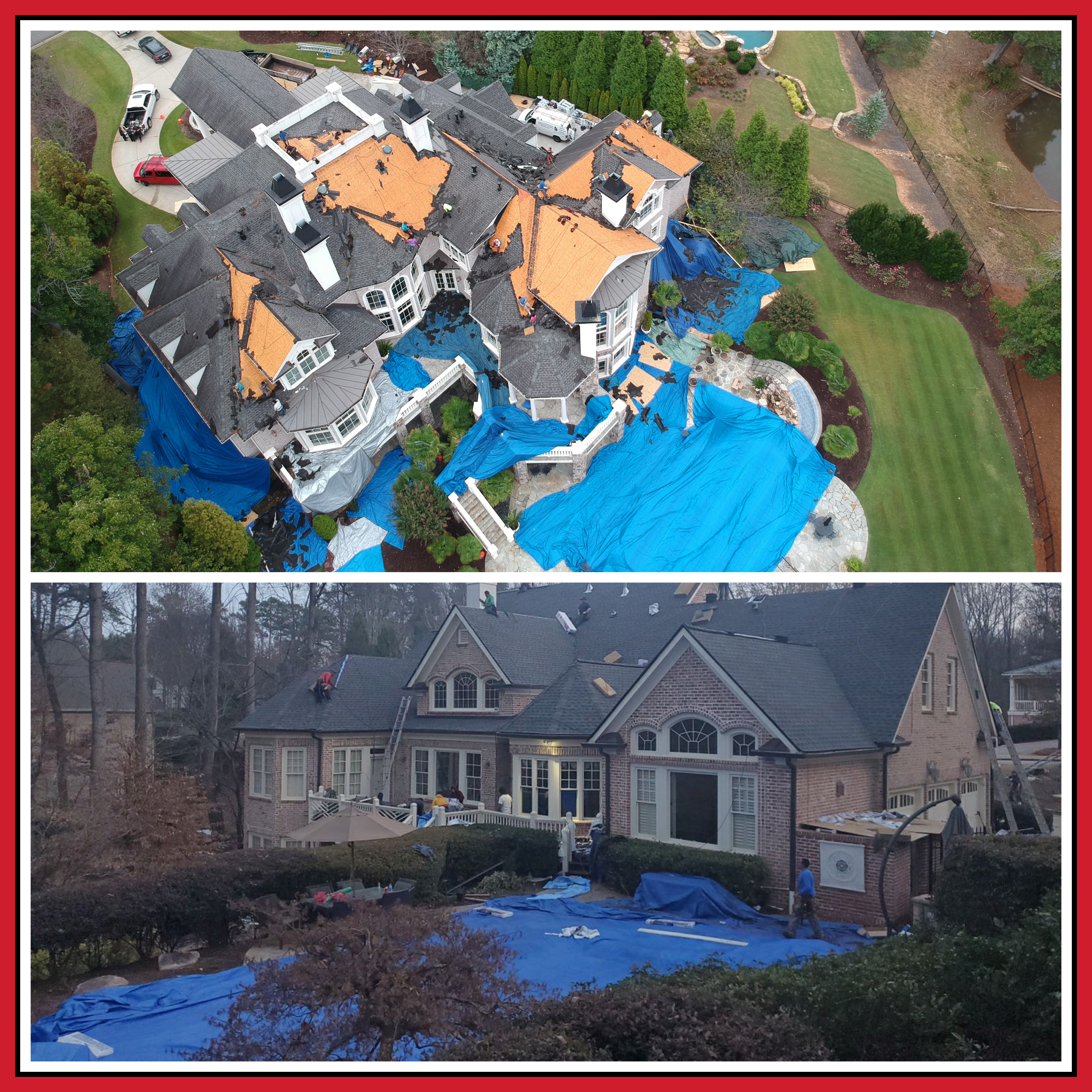
Re-nailing is the act of refastening that deck to the framing during a tear-off, before any new material goes on. A crew works systematically across the exposed sheathing, driving additional ring-shank nails along every rafter and truss line to bring the panel attachment up to a current high-wind schedule. Panels that were originally fastened with six or seven nails along a stud line are brought to the modern count and spacing. Loose, backed-out, or corroded original fasteners are addressed in the same pass.
This work is only possible during a full tear-off. A roof-over — installing new shingles on top of an existing layer — leaves the original deck attachment buried and untouched. That is one of several structural reasons we treat layovers as a false economy in Georgia's wind climate, and it is covered in our guide to roof repair versus replacement. If you want the deck strengthened, it has to be done while the sheathing is bare. There is no second chance until the next tear-off, which may be twenty-five years away.
2. Why Atlanta's Storm Climate Makes This Critical
Metro Atlanta does not sit on the coast, and homeowners sometimes assume wind uplift is a problem for Florida and the Gulf, not Georgia. The data says otherwise. North Georgia averages dozens of severe thunderstorm warnings a year, and the same fronts that drop hail across Gwinnett, Cobb, and Fulton produce straight-line winds that regularly exceed 60 miles per hour. The region also lies within reach of tornado activity — the metro area has recorded multiple EF-rated tornadoes in the past decade, and the remnants of Gulf and Atlantic systems push tropical-strength gusts inland several times each storm season.
Wind does not push a roof off — it lifts it. As air accelerates over the ridge and across the field of the roof, it creates a pressure drop above the surface, the same aerodynamic effect that lifts an airplane wing. The highest suction occurs at the edges, eaves, and corners, exactly where older homes tend to have the sparsest deck fastening. When that uplift exceeds the holding power of the nails connecting the deck to the framing, panels begin to lift, peel, and detach. Once a single panel goes, the wind gets underneath the adjacent ones and the failure cascades. Many of the catastrophic roof losses documented after Atlanta windstorms began as a deck-attachment failure, not a shingle failure.
Georgia's humidity compounds the problem over time. Smooth-shank nails driven into OSB in 1990 do not stay as tight as the day they went in. Decades of thermal cycling, moisture absorption around the nail shank, and seasonal expansion and contraction loosen the grip. A roof that met its original fastening standard can quietly lose holding power for thirty years, which is why a deck that has never been re-nailed is often weaker than the design intended — long before any storm arrives.
3. What Georgia Building Code Requires on a Tear-Off
Georgia adopts the International Residential Code with state amendments, and the fastening provisions for roof sheathing have tightened substantially over the code cycles. When a roof is fully torn off to the deck, the exposed sheathing becomes work that must satisfy the current code — not the standard in force when the house was framed. This is the legal and practical basis for re-nailing: once the deck is bare, leaving an obsolete fastening pattern in place is not code-compliant work.
The current standard centers on 8d common or ring-shank nails installed on a tightened schedule. In the higher-wind portions of the code that apply across much of metro Atlanta, that schedule calls for nails spaced 6 inches on center along panel edges and 6 inches on center in the field of the panel — closer than the 12-inch field spacing many older homes received. Ring-shank nails are specified because the annular rings along the shank dig into the wood fibers and resist withdrawal far better than a smooth nail, which is precisely the force wind uplift applies.
Many metro counties verify deck attachment during the re-roof inspection. An inspector who pulls the permit file expects to see the sheathing refastened before underlayment goes down, and the permitting and inspection process exists to protect the homeowner with an independent code check. Our overview of Georgia building codes and the related technical standards hub walk through how these requirements apply to a roof replacement, and why a contractor who proposes to skip the permit is also proposing to skip the inspection that confirms the deck was done right.
A torn-off deck must meet today's fastening code, not the standard from when your home was built. That is the homeowner's leverage: a full replacement is the one time the law and the physics both point to strengthening the deck. A scope that does not mention re-nailing is silent on the most important structural step of the project.
4. Nailing Patterns: What Changed and Why It Matters
The difference between an old fastening pattern and a current one is not a small refinement — it roughly doubles or triples the panel's resistance to being pulled off the framing. Two variables drive that gain: the spacing of the nails and the type of nail. Tighter spacing puts more fasteners into the load path. Ring-shank geometry makes each fastener hold dramatically harder against withdrawal.
The comparison below shows how typical historical fastening on Atlanta homes stacks up against the current high-wind schedule used on a properly executed tear-off.
| Attribute | Typical 1980s–90s Fastening | Current High-Wind Re-Nail |
|---|---|---|
| Nail type | 6d or 8d smooth-shank | 8d ring-shank (annular) |
| Panel edge spacing | 6 in. on center | 6 in. on center |
| Field (interior) spacing | 12 in. on center | 6 in. on center |
| Withdrawal resistance | Baseline | Roughly 2–3x baseline |
| Edge and corner uplift performance | Weakest zone, often under-nailed | Fully fastened to schedule |
| Long-term grip in humid climate | Loosens with thermal cycling | Rings maintain bite over time |
The field spacing line is where most of the structural gain lives. Cutting the interior spacing from 12 inches to 6 inches doubles the number of fasteners across the broad center of every panel, and that center is where uplift pressure accumulates before it reaches the edges. Combined with ring-shank withdrawal resistance, the upgraded panel behaves like a fundamentally different component under load. This is the same fastening philosophy that drives six-nail shingle fastening at the surface — more attachment points, placed where wind concentrates its force.
5. The Structural Science of Wind Uplift
To understand why deck attachment matters more than almost any other single factor, it helps to follow the load. Wind striking and flowing over a house generates uplift pressure measured in pounds per square foot across the roof surface. Under a 90-mile-per-hour design event — the level much of metro Atlanta is built to — corner and edge zones can see uplift pressures several times higher than the broad field of the roof. Those pressures act on the entire deck simultaneously, and they have to be resisted somewhere.
The load travels from the shingles, through the deck, into the nails, and down into the rafters and trusses. Each link must hold for the next to matter. Premium shingles fastened with six nails are worthless if the deck they are nailed to lifts off the framing. This is the principle behind continuous-load-path construction and the FORTIFIED roof standard: a roof survives a storm only as well as its weakest connection survives, and on older homes that weakest connection is almost always the deck-to-framing nail.
Re-nailing closes that gap. By bringing the deck attachment up to a schedule designed for the region's wind loads, the upgrade restores the continuous path the rest of the system depends on. It is also why deck attachment is evaluated alongside related uplift details during a thorough structural assessment — the deck, the framing connections, and the surface fastening function as one system, and strengthening only the visible parts leaves the hidden weak link in place.
Have Your Deck Evaluated Before Your Next Roof
Free on-site assessment. No obligation. Our inspectors document deck condition, fastening, and uplift risk before any replacement is scoped.
Call (404) 277-13776. OSB, Plywood, and Aging Decks in Atlanta Homes
The material under your shingles affects how well a re-nail performs. Plywood and OSB both hold ring-shank nails well when sound, but they age differently in Georgia's humidity. OSB, common on homes built from the mid-1980s onward, is engineered wood strand bonded with resin. When it stays dry it performs reliably for decades. When it absorbs moisture — from a failed flashing detail, an ice-and-water gap, or chronic attic ventilation problems — it swells, softens at the edges, and loses its grip on fasteners. A re-nail into degraded OSB does not hold, which is why the deck must be inspected for soundness before it is refastened.
This is where deck re-nailing and water damage remediation intersect. A tear-off frequently reveals panels that are delaminated, spongy, or stained from past leaks. Those panels cannot be re-nailed back into service; they must be replaced before the deck is brought to its fastening schedule. A responsible contractor documents the condition with photographs, replaces the compromised sheathing, and then re-nails the entire deck — old sound panels and new alike — to the current high-wind pattern. Re-nailing a deck that should have been partially replaced is one of the more common corner-cuts we see on other contractors' work.
Older homes with true plywood decks tend to hold fasteners well into their fifth and sixth decade, provided they stayed dry. The connection between deck health and the layers above it runs both ways: a sound, well-fastened deck protects the system, and a well-detailed system with proper synthetic underlayment and flashing keeps the deck dry enough to keep holding. The two depend on each other.
7. How 1Source Re-Nails a Roof Deck
On a 1Source replacement, deck evaluation is built into the process rather than treated as an afterthought discovered mid-project. Once the existing roofing is fully torn off and the debris is cleared, the crew walks the entire exposed deck before any new material is staged. Each panel is checked for soundness, fastener condition, and signs of past moisture intrusion. Panels that fail inspection are marked for replacement.
With the deck confirmed sound — or made sound through targeted sheathing replacement — the crew re-nails systematically. Working along marked framing lines so every nail lands in a rafter or truss rather than the gap between them, they bring the field and edge spacing up to the current high-wind schedule with 8d ring-shank nails. Nailing into the framing rather than the air between members is the detail that separates a structural re-nail from cosmetic surface nailing, and it is verified visually before the next layer goes down.
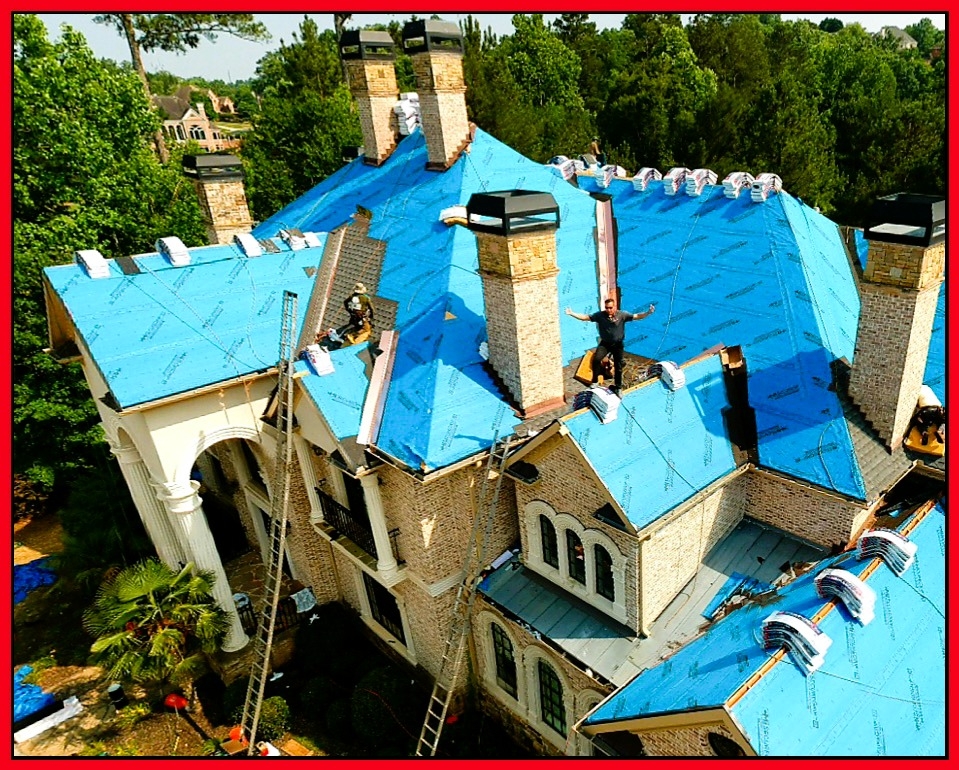
Only after the deck passes does the system go on: drip edge, ice-and-water shield at eaves and valleys, synthetic underlayment, and the chosen shingle. Because the deck work is documented with photographs at each stage, the homeowner receives a record of exactly what was done beneath the surface — useful for a future insurance claim, a wind-mitigation file, or a property sale. This is the same documented standard we hold on every project, from a residential replacement in Marietta to an estate roof in Buckhead.
8. Re-Nailing, Insurance, and Wind Mitigation
A documented deck-attachment upgrade is a recognized wind-mitigation feature, and it carries weight beyond the day of installation. Insurers and resilience programs that evaluate a home's storm exposure credit improved sheathing fastening because the math is straightforward: a roof that stays attached prevents the cascade of interior water damage, structural loss, and contents destruction that follows a roof failure. The deck re-nail is one of the upgrades that reduces the probability of a total loss.
Georgia's premium-credit landscape is not as formalized as the coastal wind-mitigation programs in Florida or the Carolinas, but the documentation principle holds. An 8d ring-shank deck re-nail, photographed and recorded, strengthens any wind-mitigation file and supports both resilience programs that reference the FORTIFIED standard and claims that hinge on whether a roof was built to resist the event. Our guide to wind mitigation upgrades covers how these features fit together, and the broader insurance claims hub explains how documentation drives claim outcomes after an Atlanta storm.
The window to strengthen your deck is open only during a tear-off. Skip it, and the original fastening stays buried under the new roof for the next two to three decades — through every storm season in between. The incremental cost is small; the structural difference is the roof staying on the house.
9. When Re-Nailing Is Most Important
Every tear-off is an opportunity to re-nail, but certain homes gain the most from it. Houses built in metro Atlanta between roughly 1980 and 2000 are the highest-priority candidates: they predate the tightened fastening schedules, they were often built with smooth-shank nails at wide field spacing, and they are now three to four decades into the moisture cycling that loosens fasteners. If your home falls in that window and is approaching a replacement, the deck almost certainly does not meet current code.
Homes with complex rooflines also benefit disproportionately. Every additional hip, valley, dormer, and corner creates more of the edge and corner zones where uplift pressure concentrates. A simple gable roof has a few high-suction edges; a traditional two-story with multiple dormers and intersecting planes has many. The more edges a roof has, the more the deck attachment at those edges matters. The same homes that need careful valley detailing and flashing work are the ones where deck re-nailing pays the largest structural dividend.
Homes in higher-exposure locations — on ridgelines, at the edge of open fields, or above tree-cleared lots — face stronger sustained wind than sheltered homes in dense subdivisions. Wind exposure category is part of how design loads are calculated, and a home with little upwind obstruction sees the full force of a passing front. For those properties, bringing the deck up to the high-wind schedule is less an upgrade and more a baseline. Across Alpharetta, Johns Creek, and Roswell, we routinely find homes whose exposure warrants exactly this attention.
10. The Cost and Long-Term Value of Re-Nailing
Re-nailing a deck is labor-driven work. The material — ring-shank nails — is a minor line item; the cost is the crew time to systematically refasten every panel along the framing lines. On a standard metro Atlanta home, that typically adds $400 to $1,200 to a replacement project, scaling with roof area, pitch, and complexity. A steep, cut-up roof takes longer to re-nail than a simple low-slope gable, and the figure reflects that.
Set against what it protects, that figure is one of the highest-value items in any replacement scope. A roof failure in a windstorm is rarely just a roof — it is the roof, plus interior water damage, plus damaged contents, plus the displacement and disruption of living through a major loss and claim. Preventing the deck from detaching is preventing that entire chain of consequences. Viewed as an investment in the durability of the whole structure, deck re-nailing returns far more than its cost, and it pairs naturally with the other longevity habits covered in our guide on extending roof lifespan.
There is also a resale dimension. Documented structural upgrades increasingly factor into how buyers and inspectors evaluate a home, particularly in storm-prone regions. A roof with a recorded deck re-nail to the current high-wind standard is a stronger asset than an identical-looking roof whose deck was never touched. The work is invisible from the curb, but its documentation is a tangible part of the home's record.
11. What to Ask Your Roofing Contractor
The clearest way to tell whether a contractor takes the deck seriously is to read the written scope of work and ask direct questions. A proposal that lists shingles, underlayment, and flashing but says nothing about the deck is silent on the structural foundation of the project. That silence usually means the original fastening will be left as-is and the new roof simply laid on top of an unverified deck.
Ask whether the scope includes re-nailing the deck to the current high-wind schedule, what nail type and spacing will be used, and how panels that fail inspection will be handled. A contractor who answers with specifics — 8d ring-shank, 6-inch field and edge spacing, photographed condition reporting, sheathing replacement for compromised panels — is doing the work properly. Vague answers, or pushback that re-nailing is unnecessary, are a meaningful signal about the rest of the installation you cannot see. The same scrutiny applies to related details like drip edge and starter strip, which separate a code-compliant system from a price-first one.
Finally, confirm the project will be permitted and inspected. The re-roof inspection is the independent verification that the deck was refastened before the new system went on. A contractor who proposes to skip the permit is proposing to remove the one check that confirms the most important structural step was actually performed. On a project of this consequence, the inspection is not an inconvenience — it is protection. You can review our full approach to quality and reach our team anytime through our contact page.
Schedule Your Free Roof Assessment
Deck condition, fastening evaluation, and uplift-risk documentation — before any commitment. Serving Atlanta, Sandy Springs, Alpharetta, and all of metro Atlanta.
(404) 277-1377 — No ObligationCertified by Industry-Leading Manufacturers