
Roof Insurance Claims: Inspection, Documentation, and Restoration
You file and control your claim. We document the damage and restore your roof to code.
Certified by Industry-Leading Manufacturers
Why Thorough Documentation Decides a Roof Claim
Your insurance company evaluates a roof claim based on what is documented and visible. An adjuster writes a scope of loss from what they can see and confirm on the day they visit. When storm damage is recorded clearly and completely, the scope tends to reflect the real condition of the roof. When it is not, line items get left off, and the homeowner often never knows what was missed.
Most homeowners file a roofing insurance claim only once or twice in a lifetime. You are looking at a damaged roof after a storm, trying to understand what is covered and what to do next. A certified roofing contractor who inspects and documents that damage every week brings the detail and the photographs that an accurate evaluation depends on.
Here is what tends to get overlooked when roof damage is not documented thoroughly before the adjuster arrives:
- Incomplete scopes. A scope of loss may capture only part of the actual damage. Commonly missed items include drip edge, pipe boot replacement, ice and water shield in valleys, and starter strip — each a line item worth $200 to $1,500 that goes unrecorded if no one points it out.
- Cosmetic-versus-functional questions. Hail that cracks the shingle mat layer is functional damage, even when the surface still looks intact. That distinction is technical, and it depends on close-up photographs to document it accurately.
- Statutory timelines. Georgia law requires insurers to acknowledge a claim within 15 days and pay or deny within 30 days of receiving documentation. Homeowners who do not know these timelines have a harder time keeping a claim moving.
- Depreciation on newer roofs. An ACV payment reflects depreciation. A 12-year-old architectural shingle with a 30-year rating has more remaining life than an older three-tab, and that is worth documenting accurately.
- Back-slope and interior damage. Damage on slopes that face away from the street, or water that has already reached the attic and ceilings, is easy to miss without a full inspection inside and out.
That is where 1 Source comes in — as your roofing contractor. We inspect your roof, document the storm damage in detail, and give you a clear written repair estimate you can provide to your insurer. You file and control your claim, and your insurance company determines what your policy covers. We are a licensed roofing contractor, not a public insurance adjuster: we do not negotiate, adjust, or settle claims on your behalf. What we do is make sure the condition of your roof is documented accurately and restored properly. We have restored more than 500 roofs across Alpharetta, Buckhead, Johns Creek, Roswell, Sandy Springs, and Marietta.
Our 5-Step Roof Claim Process
From your first call to the day your new roof is installed, here is exactly how we support your claim as your roofing contractor:
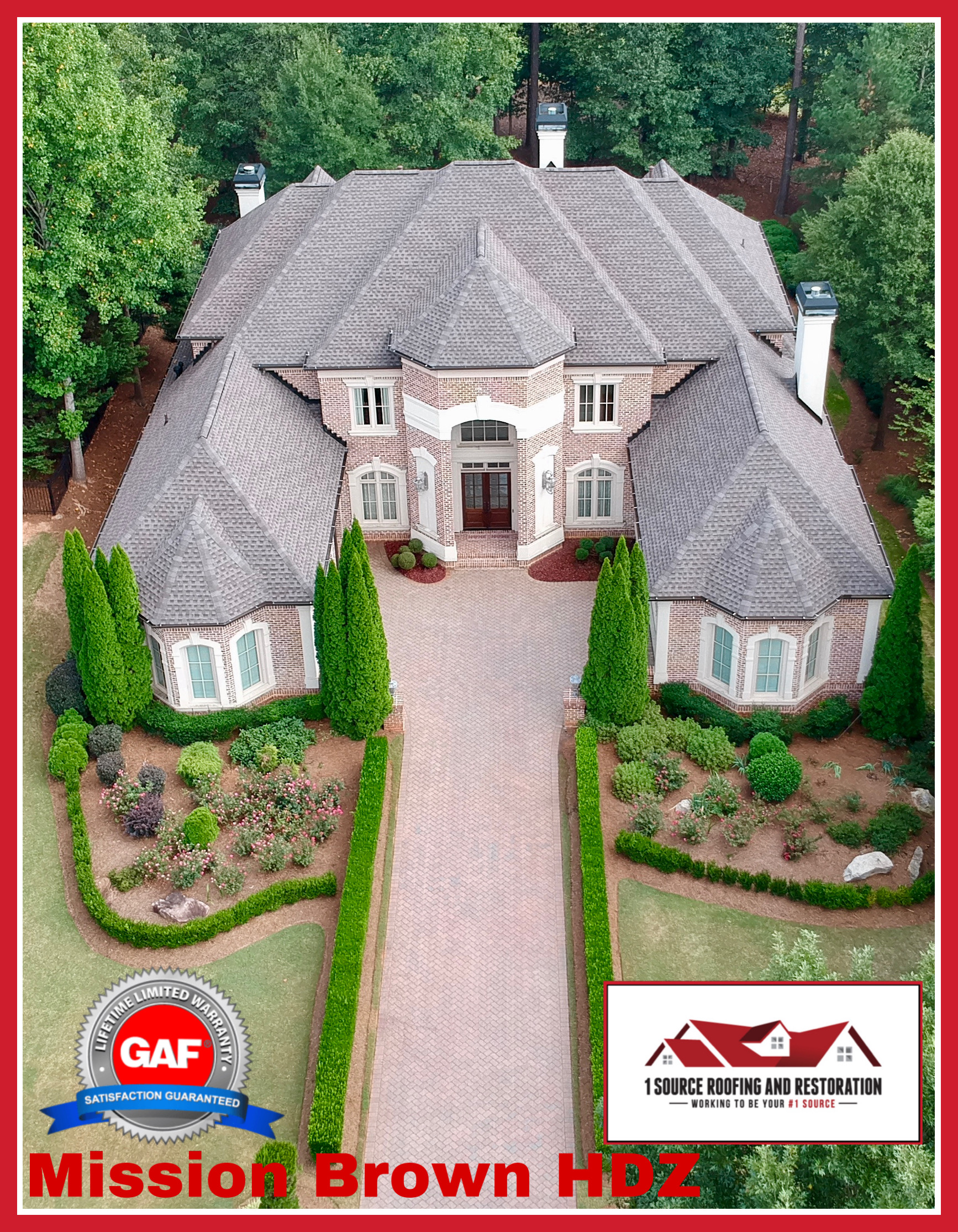
- Free Roof Inspection We send a trained inspector to your property within 24 to 48 hours of your call. They walk every slope and photograph every shingle, flashing, vent, pipe boot, ridge cap, and valley. They document granule loss, hail impact marks, wind-lifted tabs, and cracked mat layers, and they check the drip edge, gutter apron, and every penetration. If there is interior damage — water stains on ceilings, damaged attic insulation, wet decking — they document that too. This is a 45- to 90-minute inspection that produces a formal damage report with photos, measurements, and a written assessment. You pay nothing for it. If we find no insurable damage, we tell you. If we find damage worth filing a claim for, we move to Step 2.
- We Document the Damage We review your policy's declarations page with you to confirm coverage type (RCV vs. ACV), deductible amount, and any exclusions, so you understand your own policy before you file. We pull NOAA storm data — hail size, wind speed, storm path, and timestamp — for the event that caused the damage, which helps establish that the damage is storm-related. We compile everything into an adjuster-ready report: dated photos organized by roof section, measurements, and material specifications, along with a written repair estimate. You file the claim with your insurer; we provide the documentation and estimate that support it. We are glad to walk you through exactly how to file.
- We Meet Your Adjuster on the Roof When your insurance adjuster arrives, our inspector meets them at your property and they walk the roof together, slope by slope. Our inspector shows the adjuster the damage points recorded in our report — the hail impacts on the back slopes, the flashing failures at penetrations, the ridge cap condition — so nothing physical goes unseen. This is showing the adjuster the actual condition of the roof, not negotiating a settlement. The adjuster and your insurer determine what your policy covers, but a roof that has been inspected and documented by a certified contractor gives them a complete picture to evaluate.
- We Document Any Overlooked Items The first scope of loss sometimes leaves out items — code-required upgrades such as ice and water shield and current-code drip edge, steep-pitch labor, full flashing replacement, starter strip, or material waste. When that happens, we prepare additional documentation: photos, manufacturer specifications, local building-code references, and a revised written estimate, prepared in the same Xactimate format your insurer uses so it is easy to compare. We submit that documentation for your insurer's review; your insurance company decides whether to revise the scope. We provide the evidence — the coverage decision is theirs.
- We Install Your New Roof Once your claim is settled and you approve the scope, we coordinate everything: material ordering from our manufacturer partners (GAF, CertainTeed), crew scheduling, permits if required, and project management from tear-off through the final nail. Our crews are in-house, not subcontracted day labor, and the installation follows manufacturer specifications to the letter, which is required to activate extended warranty coverage. When the job is complete, we submit the final invoice and completion documentation to your insurer so any remaining funds, including your depreciation holdback, can be released. You approve. That is it.
.jpg)
How We Support Your Roof Insurance Claim
Most roofing contractors hand you an estimate and disappear until installation day. We stay involved at every stage of the roofing work. Here is what our team does to support your claim — and where your insurer's role begins:
Damage Documentation
- Drone and ground-level photography of every roof section, slope, and penetration point
- Close-up documentation of hail impacts, wind damage, cracked flashings, and lifted shingles
- Interior damage assessment — ceiling stains, attic insulation damage, wet decking
- NOAA storm record correlation — hail size, wind speed, storm path, and exact timestamps matched to your damage
- A written damage report and repair estimate formatted for insurance adjuster review
Claim Support
- Policy review with you — coverage type, deductible, exclusions, and endorsements, so you understand your own policy
- Guidance on how to file your claim with your insurer
- Meeting your adjuster at the property and walking the roof to show the documented damage
- Scope-of-loss review — comparing the adjuster's findings to our documented report
- Supplemental documentation in Xactimate format with photos, code references, and manufacturer specs for items that were overlooked
- Submitting that documentation for your insurer to review and decide on
Construction and Close-Out
- Material selection and ordering from GAF or CertainTeed
- In-house crew scheduling — no subcontracted labor
- Project management from tear-off through final inspection
- Final invoice submission to your insurance company
- Guidance on the depreciation holdback your policy releases once repairs are complete
- Warranty registration with the shingle manufacturer
If you have experienced storm damage, need a full roof replacement, or are dealing with water damage alongside your roof, every one of these services applies. Your insurer evaluates and decides the claim; we provide the inspection, documentation, and restoration.
Not Sure If You Should File a Claim?
Call us. We will inspect your roof at no cost and tell you exactly what we find. If there is insurable damage, we will document it and walk you through your options. If there is not, you will know — and you will not owe us anything.
Call (404) 277-1377Why Roof Claims Get Underpaid — and How Documentation Prevents It
We see the same patterns on claims across Alpharetta, Buckhead, Johns Creek, Marietta, Roswell, and Sandy Springs. These are not rare edge cases. They are what tends to happen when roof damage is not documented thoroughly:
The narrow scope. An adjuster inspects two of six roof slopes and writes a scope for partial replacement. The back slopes — where hail damage is often heaviest because of wind direction — go unexamined. A homeowner may not know to ask for a full inspection; a contractor who documented all six slopes can show what is there.
Cosmetic questions on functional damage. Georgia policies increasingly include cosmetic-damage exclusions. The distinction between cosmetic and functional hail damage is technical — it depends on close-up photography of cracked mat layers and, sometimes, a shingle sample for independent testing. Thorough documentation is what makes that condition clear.
Missing code-required upgrades. Georgia building code has changed several times in the last 15 years. A replacement on an older home must include upgrades — ice and water shield in valleys, current drip edge profiles, enhanced underlayment — that are required by code and covered by most policies. Each code item that is not documented can add $500 to $3,000 that goes unrecorded.
Below-market pricing in Xactimate. Xactimate prices claims on regional averages that can lag actual market pricing, especially after a major storm when demand spikes. A contractor who works in Xactimate daily can document the gap with manufacturer price sheets and local labor data so the estimate reflects real costs.
Overlooked interior damage. An adjuster inspects the roof but does not check the attic, where water has already saturated insulation and stained ceilings. A roofing contractor who understands interior water damage knows to document it so it is part of the record from the start.
Each of these comes down to the same thing: what is documented gets evaluated, and what is not tends to get left off. That is why we inspect thoroughly, photograph everything, attend the adjuster meeting to show the damage, and document any overlooked items for your insurer to review. The coverage decision is always your insurer's — our job is to make sure they are looking at a complete and accurate record of your roof.
Certifications Behind Every Roof We Install
Insurance adjusters work with hundreds of contractors, and most are general contractors or handymen who dabble in roofing. When an adjuster sees our credentials, they know they are working with a contractor who installs to manufacturer specifications and documents to industry standards. That credibility helps a claim move on the facts.
GAF Certified. Only a small share of roofing contractors in North America hold this designation. It requires verification of proper licensing, adequate insurance, a proven reputation in the community, and ongoing professional training. GAF Certified status gives us access to the highest warranty tier in the industry — the Golden Pledge warranty, which covers materials and workmanship for 25 years with no dollar limit. It tells an adjuster the installation will meet or exceed every specification.
CertainTeed Certified. This credential requires factory training, verified installation proficiency, and adherence to CertainTeed's quality standards. CertainTeed Certified contractors can offer the SureStart PLUS warranty, with coverage for material and labor costs. For your roof, it signals that the replacement will be installed correctly and backed by the manufacturer.
These are not marketing badges. They are professional credentials that take years to earn and require ongoing renewal. They give us standing when we walk a roof with an adjuster, and they give you a roof backed by some of the strongest warranties in the industry — installed by a contractor who meets the manufacturer's highest standard.
Your Situation. Our Expertise.
Every roof claim has its own set of challenges. Find the guide that matches where you are right now:
Claim Denied?
A denial is not the end. Learn your options for re-inspection, appraisal, and review under Georgia law.
Storm Damage?
Hail and wind damage claims have specific documentation requirements. Here is how to get them right from the start.
Filing a Claim?
A step-by-step walkthrough for Georgia homeowners filing a roofing insurance claim for the first time.
Adjuster Meeting Coming Up?
What to expect, what to prepare, and why having your contractor present to show the damage helps.
First Check Wasn't Enough?
How overlooked line items get documented and submitted for your insurer to review.
Not Sure If You Should File?
When filing a claim makes financial sense and when paying out of pocket is the smarter move.
We are a roofing contractor, not a public adjuster. 1 Source Roofing and Restoration is a licensed Georgia roofing contractor. We inspect roofs, document damage, provide repair estimates, and perform roof restoration. We do not adjust, negotiate, or settle insurance claims on a homeowner's behalf — under Georgia law (O.C.G.A. § 33-23), only a licensed public adjuster may do that for compensation. You file and control your own claim, and your insurer determines coverage. If your claim calls for professional adjusting or formal dispute resolution, we are glad to refer you to a licensed Georgia public adjuster.
Insurance Claim Questions — Answered
Straight answers to the questions Atlanta homeowners ask most
What does 1 Source charge to inspect a roof for an insurance claim?
The roof inspection is free. If your claim is approved and you hire us, we install the roof and bill the approved scope to your insurance company; you pay your deductible, which is your responsibility under your policy. If we inspect your roof and find no insurable damage, you owe us nothing. We do not charge consultation, inspection, or documentation fees. As a roofing contractor, we are paid to restore your roof, the same as any roofing project.
Can my contractor be at the adjuster meeting?
Yes. We can meet your insurance adjuster at your home to walk the roof and point out the storm damage we documented during our inspection. We recommend you be present too, since the adjuster may have questions about interior damage or when you first noticed the problem, and you should hear the conversation firsthand. Showing the adjuster the physical damage on the roof is part of our work as your contractor; the adjuster and your insurer determine what your policy covers.
What if my insurance company says the damage is cosmetic?
The cosmetic-versus-functional distinction is one of the most common points of discussion in roofing claims. Hail impacts that crack the mat layer of a shingle compromise its waterproofing ability — that is functional damage, regardless of how the surface looks. We document the damage with close-up photography so the functional impact is clearly recorded. Whether the damage is covered is a decision for your insurer; our role is to make sure the condition of your roof is thoroughly and accurately documented.
How do I know if I have replacement cost or actual cash value coverage?
Check your declarations page — the summary page of your homeowner's policy. It will specify either RCV (Replacement Cost Value) or ACV (Actual Cash Value). RCV policies pay the cost to replace your roof with equivalent materials, minus your deductible. ACV policies deduct depreciation based on roof age, which can significantly reduce the payout on older roofs. Most homes in Alpharetta, Buckhead, Johns Creek, and other Atlanta suburbs carry RCV policies. We are glad to look at your declarations page with you so you understand your coverage before you file.
Can I choose my own roofing contractor?
Yes. You always have the right to choose your own roofing contractor. Your insurer may suggest a preferred vendor, but it cannot require you to use one. Choosing your own contractor, especially one experienced with the documentation insurers expect, means your roof is inspected thoroughly and the damage is recorded accurately before any decision is made on your claim.
What if the approved scope leaves out damage we documented?
If the approved scope leaves out damage we documented or code-required items, we prepare additional documentation, photos, and a revised written estimate for your insurer to review. We provide the documentation; your insurance company decides whether to revise the scope. If your claim reaches a point that calls for formal dispute resolution, you have the right to invoke your policy's appraisal clause, and we can refer you to a licensed public adjuster, who is the professional permitted under Georgia law to negotiate a claim on your behalf.
How long does the whole process take?
A straightforward claim — from inspection to installed roof — typically takes 6 to 10 weeks. The adjuster visit usually happens within about 2 weeks of filing. Additional documentation, if needed, can add 2 to 4 weeks. The actual roof installation takes 1 to 3 days depending on size and complexity. Georgia law requires insurers to acknowledge claims within 15 days and pay or deny within 30 days of receiving all documentation. The biggest variable is adjuster scheduling, which slows during storm season across the Atlanta metro.
What if I already got a check but haven't started repairs?
That first check is usually your ACV payment — the depreciated value of the damage — with the depreciation holdback released once repairs are completed. Call us for a free inspection. We will compare the adjuster's scope against the documented condition of your roof. If items were overlooked, we document them for your insurer to review before any work begins. Accepting the initial check does not waive your right to have additional items considered, but do not wait too long, since most Georgia policies require repairs to start within a reasonable timeframe after payment.
Storm-Damaged Roof? Start With a Free Inspection.
One call gets you a free roof inspection, a clear assessment of the damage, and a certified contractor who will document the condition of your roof and restore it the right way. No cost for the inspection. No obligation. No pressure.
Call (404) 277-1377 — Free InspectionRoof Storm Damage Help Across Metro Atlanta
We provide roof inspections, damage documentation, and storm-damage restoration for homeowners filing insurance claims throughout the Atlanta metropolitan area. Find your city below: