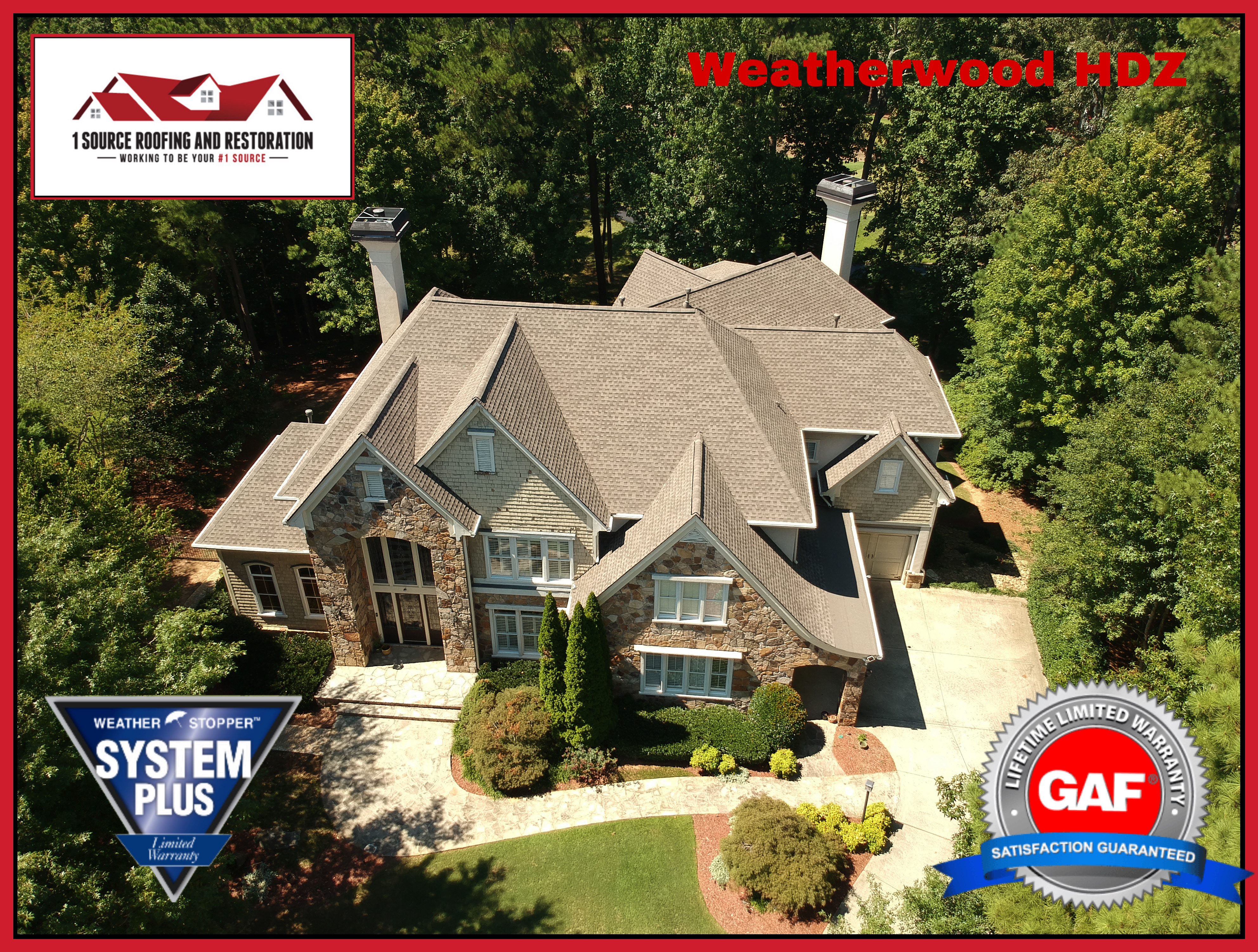
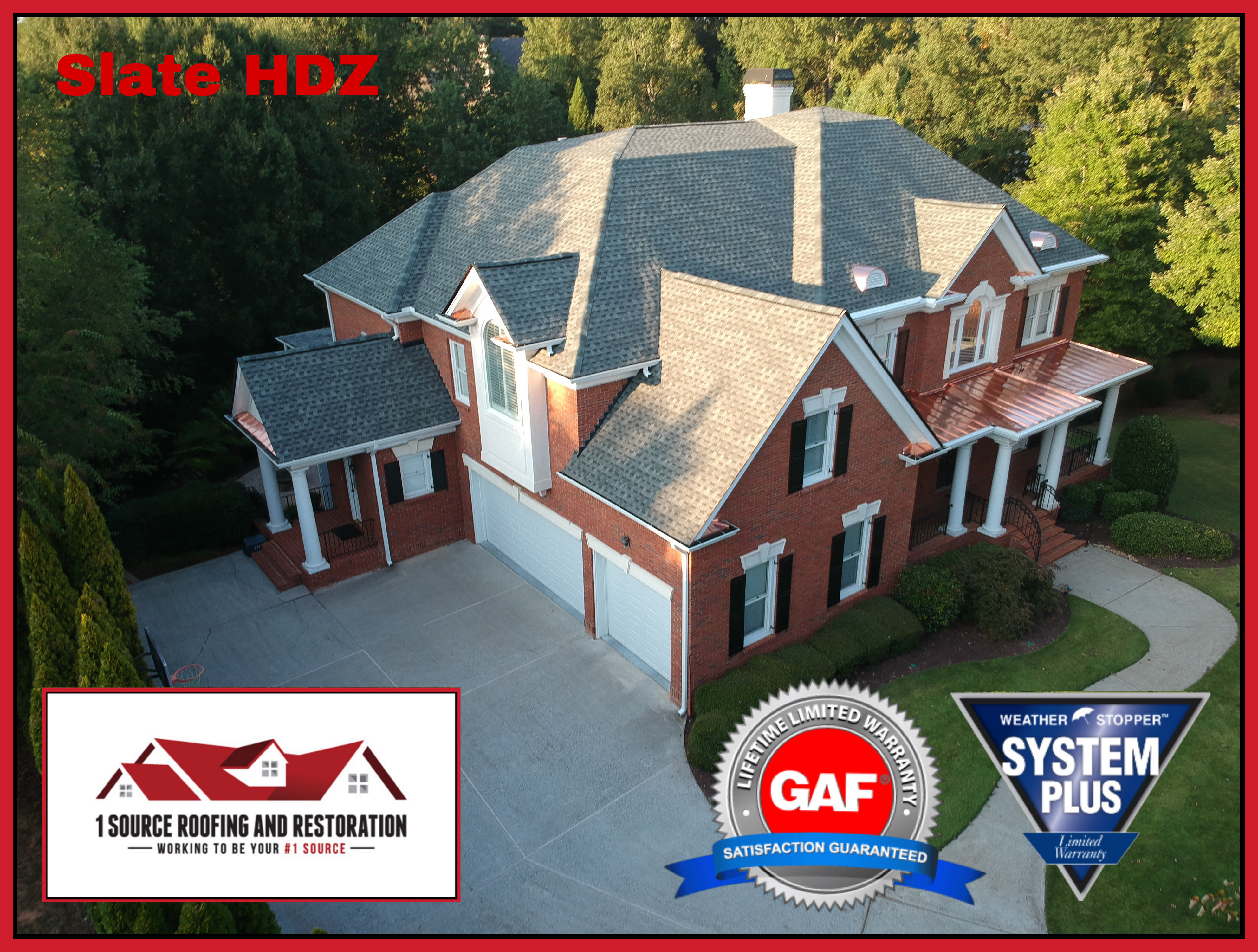
Walk any complex roofline in metro Atlanta and you will find valleys — the angled channels formed wherever two roof planes meet. On a simple gable home there may be none. On the traditional two-story and craftsman homes that fill neighborhoods from Roswell to Buckhead, there can be six, eight, or more. Each one is a seam in the waterproofing, and each one carries the runoff of two roof planes funneled into a single line. That makes the valley the single most demanding detail on a sloped roof, and the method used to build it determines whether the roof sheds water for thirty years or starts leaking in five.
There are three established ways to construct a shingle roof valley: the open metal valley, the closed-cut valley, and the woven valley. All three can be watertight when executed correctly. All three can fail when they are not. The differences between them are not cosmetic preferences — they involve real tradeoffs in water-handling capacity, debris tolerance, longevity, and how forgiving each method is of the wind-driven rain that defines Georgia's storm seasons.
This guide explains how each method is built, how it handles water, where it tends to fail, and which method we specify for the conditions Atlanta roofs actually face. By the end you will understand what to look for in a contractor's written scope and why the valley detail is one of the clearest signals of installation quality on the entire roof.
1. Why the Valley Is the Most Demanding Detail on Your Roof
A roof sheds water by giving it the shortest, fastest path to the gutter. Across an open field of shingles, rain spreads thin and travels slowly. In a valley, the geometry changes completely. Two planes pitch toward a single line, and everything that lands on both planes above the valley converges there. The water depth increases, the velocity increases, and on a steep roof the flow can move with surprising force during a heavy Atlanta downpour.
That concentration is what makes valleys leak. Water that would never penetrate a field shingle finds its way under a poorly built valley because the volume and pressure are simply higher. Add wind, and the problem compounds. Wind-driven rain does not fall straight down — it drives sideways and can push water uphill against the lap of a shingle. In a valley, that lateral force is directed straight at the seam where two planes meet, exactly where the waterproofing is most complex.
This is why valley construction separates competent roofers from the rest. A field shingle is forgiving. A valley is not. The membrane beneath it, the nail placement around it, and the way the surface layer is integrated into it all have to be correct, because the valley is where the roof is tested hardest every time it rains. When we perform a roof repair on a leak, the valley is one of the first details we inspect, and it is the source far more often than its share of the roof area would suggest.
2. What Lives Beneath Every Valley: The Membrane Layer
Before any of the three surface methods is discussed, the most important part of the valley has to be understood: what goes underneath. The surface — metal, cut shingle, or woven shingle — is the visible layer, but it is not the layer that ultimately keeps water out when conditions turn extreme. That job belongs to the underlayment, and specifically to the self-adhering membrane that should line every valley on a quality installation.
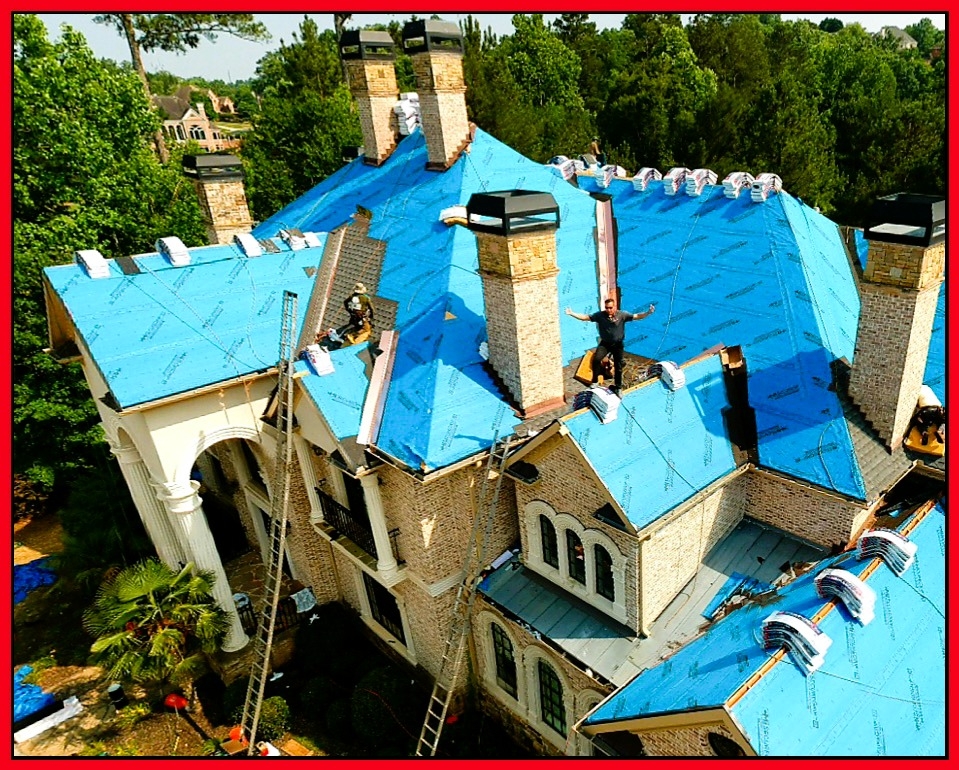
A self-adhering ice and water shield membrane bonds directly to the roof deck and seals around the nails driven through it. Unlike standard underlayment, which sheds water but is not adhered, this membrane creates a continuous waterproof base that does not rely on gravity alone. In the valley, where water concentrates and wind can drive it uphill, a fully bonded membrane is the difference between a temporary surface problem and water reaching the deck. We line every valley with this membrane as standard practice, running it the full length of the valley and extending it well onto both adjoining planes. Our guide to self-adhering ice and water shield covers where this material matters most on a Georgia roof.
Some older roofs were built with nothing more than a strip of rolled roofing or felt in the valley, relying entirely on the surface metal or shingle weave to keep water out. When that surface layer is eventually compromised — by debris damage, a lifted shingle, or a corroded metal channel — there is nothing behind it, and the leak goes straight to the deck. This is why a valley failure on an older roof so often comes with rotted decking beneath it. The membrane is the layer that buys the roof time and protects the structure, and skipping it is one of the most consequential corners a low-bid contractor can cut.
3. The Open Metal Valley: Maximum Water Handling
In an open metal valley, a formed metal channel runs the full length of the valley and remains exposed. Shingles from both planes stop short of the centerline, trimmed back in a straight line on each side, leaving a visible band of metal down the middle of the valley. Water lands on the shingles, runs onto the exposed metal, and is carried down the smooth channel to the gutter.
The open valley moves water faster than any other method, and that is its central advantage. Metal is smoother than asphalt shingle granules, so water accelerates rather than dragging. Debris that would lodge in a textured shingle surface tends to wash through a metal channel instead of accumulating. On a steep roof or a roof with a large drainage area converging on a single valley, the open metal valley is the most forgiving choice, which is why it is the method we most often specify for high-runoff conditions in metro Atlanta.
The metal itself matters. We use either pre-finished aluminum or galvanized steel valley metal, formed with a center rib or W-profile. The center rib is not decorative — it acts as a baffle that stops water sheeting across the valley from one plane and driving up under the shingles on the opposite side during heavy, wind-driven rain. A flat valley sheet without a center rib allows that cross-flow, and it is a meaningful difference in a climate where intense downpours are routine. The metal is also chosen to be compatible with the roof's other components, because dissimilar metals in contact can drive galvanic corrosion over time.
The tradeoffs are real. An open metal valley is more labor-intensive to install correctly, the cut lines on both sides must be straight and consistent to look right, and the exposed metal is a visible design element that not every homeowner wants on a prominent front-facing valley. It also requires correct fastening — the metal is clipped or nailed only at its outer edges, never through the center channel, so that no fastener penetrates the path the water travels. Done correctly, the open metal valley is the highest-performing of the three methods and the one best matched to Georgia's rainfall.
4. The Closed-Cut Valley: The Residential Standard
The closed-cut valley is the most common method on residential asphalt shingle roofs in metro Atlanta, and for good reason. It combines clean appearance with solid performance and is faster to install than an open metal valley. In this method, shingles from the first roof plane are run completely across the valley and up onto the second plane by at least twelve inches. Then shingles from the second plane are laid over them and trimmed back along a chalk line set roughly two inches off the valley centerline. The result is a crisp diagonal line with no exposed metal — hence "closed."
The critical details in a closed-cut valley are the underlying shingle layer, the cut offset, and the nailing. The first plane's shingles must run fully through the valley and continue up the second plane, creating an unbroken shingle layer beneath the cut. If that underlying course is cut short or stops in the valley, the watertight base is broken at the worst possible location. The cut line on the second plane is set back from the centerline — about two inches is standard — so the trimmed edge sits clear of the fastest-moving water rather than directly in it. And no nail is ever driven within the valley's central band; fasteners must keep a setback so they never sit in the water path.
A correctly executed closed-cut valley depends on three things being right at once:
- Continuous underlying course. The first plane's shingles run all the way through the valley and up the opposite plane, with no break or short cut inside the channel.
- Proper cut offset. The overlying shingles are trimmed roughly two inches off the centerline, keeping the cut edge out of the highest-velocity flow.
- Nail setback. No fastener penetrates the central band of the valley, so the water path is never compromised by a nail head or hole.
The closed-cut valley performs well on the great majority of residential rooflines and is the method most homeowners will encounter on a quality roof replacement. Its limitations show up on the steepest, highest-runoff valleys, where the asphalt surface drags water and the cut edge — however well placed — sits in the flow. On those specific valleys, an open metal valley is the stronger choice, and a thoughtful installation may use closed-cut on most valleys and open metal on the one or two that carry the heaviest load.
The valley detail is one of the clearest indicators of installation quality on the entire roof. Ask any contractor's written scope to specify the valley method, the membrane beneath it, and the nail setback. A scope that addresses these directly reflects a crew that understands where roofs actually leak.
5. The Woven Valley: Continuous but Increasingly Outdated
In a woven valley, shingles from both planes are laced over the valley alternately. A course from the first plane runs across and up the second plane; then a course from the second plane runs across and up the first; and so on, course by course, so the two planes interlace continuously through the valley with no cut line and no exposed metal. When new, a properly woven valley is fully watertight and presents an unbroken shingle surface.
Weaving was a sensible method in the era of thin, flexible three-tab shingles. Those shingles laid flat and conformed easily to the compound curve at the bottom of a valley. Today's architectural shingles are thicker, stiffer, and laminated in multiple layers. Forcing them to lace through a valley fights the material — the shingles want to bridge rather than seat, leaving voids beneath them at the valley center where water can collect and back up. Achieving a clean, fully seated weave with modern architectural shingles is genuinely difficult, and many manufacturers no longer recommend weaving for their laminated products.
Beyond the installation difficulty, the woven valley is the least debris-tolerant of the three methods in Georgia's tree-heavy suburbs. The textured, multi-layer shingle surface running through the valley catches leaves, pine straw, and granule sediment more readily than a smooth metal channel. As debris accumulates, water backs up behind it, and on a roof shaded by mature oaks and pines — the norm across much of metro Atlanta — that accumulation happens fast. For these reasons we rarely specify a woven valley on a new installation. It remains common on older roofs, and when we encounter one during a repair, the woven valley is frequently part of the problem rather than an incidental detail.
6. Open vs Closed-Cut vs Woven: A Direct Comparison
The table below summarizes how the three methods compare on the factors that matter most for a Georgia roof. No single method is correct for every valley — the right choice depends on the valley's pitch, the drainage area it serves, the shingle product, the surrounding tree cover, and the homeowner's appearance preferences.
| Factor | Open Metal Valley | Closed-Cut Valley | Woven Valley |
|---|---|---|---|
| Water-handling capacity | Highest — smooth metal channel | Strong on typical valleys | Adequate when new, declines with debris |
| Debris tolerance | Best — debris washes through | Good | Lowest — catches leaves and straw |
| Works with architectural shingles | Yes | Yes — ideal pairing | Difficult; often not recommended |
| Appearance | Visible metal band | Clean diagonal line, no metal | Continuous shingle, no line |
| Installation labor | Highest | Moderate | High and exacting |
| Best suited for | Steep, high-runoff valleys; heavy tree cover | Most residential valleys | Legacy three-tab roofs only |
The practical takeaway for most Atlanta homeowners: a quality replacement will use closed-cut valleys across the bulk of the roof and open metal valleys on the steepest, highest-volume valleys or those buried under tree cover. Woven valleys belong to the era of three-tab shingles and rarely make sense on a new architectural shingle roof.
7. How Atlanta's Climate Shapes the Right Valley Choice
Valley method is not a one-size decision, and Georgia's specific conditions push it in particular directions. Metro Atlanta averages roughly fifty inches of rain a year, delivered in part through intense, short-duration thunderstorms that dump high volumes in minutes. Those bursts are exactly the conditions that overwhelm a marginal valley. The faster a valley can move concentrated water, the better it tolerates a storm that drops two inches of rain in an hour.
Wind is the second factor. The same storm systems that bring heavy rain bring gusts that drive that rain sideways. Wind-driven rain in a valley pushes water across the channel and attempts to force it up under the shingles on the far plane. This is where the center rib of an open metal valley earns its place, and where the nail setback and cut offset of a closed-cut valley matter most. Our coverage of wind-resistant shingle fastening explains how the same wind-driven forces shape fastening choices across the whole roof.
Tree cover is the third, and it is easy to underestimate. Much of metro Atlanta sits under mature hardwood and pine canopy. Oak leaves, pine straw, and the constant rain of organic debris settle into valleys and accumulate where water slows. A smooth open metal valley flushes most of that debris through; a woven valley traps it. For a home under heavy canopy in Roswell, Sandy Springs, or the older sections of Marietta, debris tolerance is not a minor consideration — it is one of the main reasons to favor open metal on the valleys that collect the most leaf litter. Keeping those valleys clear is also why we emphasize seasonal roof maintenance for homes surrounded by trees.
Concerned About a Valley Leak?
Free on-site assessment. No obligation. Our inspectors examine the valley membrane, nailing, and cut lines — and present a written scope before any commitment.
Call (404) 277-13778. The Most Common Valley Failures We Find
Across thousands of inspections in metro Atlanta, valley leaks follow a short list of recurring causes. None of them are exotic. Nearly all of them trace to shortcuts during the original installation, and recognizing them helps homeowners understand why the valley detail deserves scrutiny in any contractor's scope.
Nails driven too close to the centerline. This is the single most frequent cause. A fastener placed within the valley's central band puts a hole directly in the water path. Every drop of concentrated runoff passes over it, and eventually water works through the nail penetration to the deck. The standard setback exists precisely to keep fasteners out of the flow, and ignoring it is the most common installation error we document.
Missing or undersized membrane. A valley built over felt alone, or with a membrane strip too narrow to cover the working width of the valley, has no waterproof backup. When the surface layer is ever compromised, water reaches the deck immediately. We frequently find rotted decking beneath valleys that were never properly membraned.
Cut line set too tight. On a closed-cut valley, trimming the overlying shingles right at the centerline rather than offset from it places the cut edge in the fastest water. Capillary action and wind-driven rain then pull water under that edge. The two-inch offset is not arbitrary — it moves the vulnerable cut edge out of the worst of the flow.
Corroded or incompatible valley metal. On older open valleys, the metal channel can corrode through, especially where dissimilar metals were placed in contact and drove galvanic corrosion. Once the metal perforates, the valley leaks regardless of how well the shingles are laid.
Debris dams on woven valleys. On shaded roofs, accumulated leaves and pine straw back water up behind the dam, and the woven surface gives that backed-up water more opportunity to find its way beneath the laced shingles. This is a maintenance-and-method problem combined.
A valley leak rarely stays small. Concentrated water that reaches the deck spreads along the framing and into insulation before it ever shows on a ceiling. By the time a stain appears indoors, the decking beneath the valley is often already compromised — addressing a valley early is far less involved than repairing the water damage that follows.
9. Repairing a Valley Versus Replacing the Roof
When a valley leaks, the question every homeowner asks is whether it can be fixed without replacing the whole roof. The honest answer depends on the condition of the surrounding shingles. A valley does not exist in isolation — repairing it means removing and reinstalling the shingles that flank it on both planes, and that is only practical if those shingles can be handled without breaking.
On a roof with meaningful service life remaining, a valley-only repair is often the right call. An experienced crew removes the shingles along both sides of the valley, strips out the old membrane and metal, installs new self-adhering membrane and new valley metal or recuts a closed-cut valley, and reintegrates the surrounding shingles. When matching material is available and the shingles are still pliable, this restores the valley to full performance at a fraction of a full replacement. Our broader discussion of roof repair versus replacement walks through how to weigh that decision across the whole roof.
On an aging roof, the calculus changes. Shingles that have spent fifteen or twenty Georgia summers under UV exposure become brittle, and disturbing them to access the valley cracks adjacent courses and creates new leak paths. At that point, a valley repair can cause more damage than it resolves, and a full roof replacement is the sounder investment — particularly if storm activity is involved and the damage may be covered. If the leak follows a documented wind or hail event, our storm damage restoration team can assess whether the valley failure is part of a covered claim, and our insurance claims assistance helps homeowners document the scope properly.
10. Valleys on Metal and Specialty Roofs
The three-method framework applies to asphalt shingle roofs, which make up the majority of residential work in metro Atlanta. Metal and specialty roofs handle valleys differently, and it is worth understanding the distinction for homeowners considering an upgrade.
Standing seam metal roofs use an open metal valley exclusively — there is no closed-cut or woven equivalent, because the panels themselves are formed metal. The valley on a standing seam roof is a formed metal pan that the panels are cut and hemmed into, with concealed clips and careful flashing at the transition. Executed well, a standing seam valley is among the most durable details in residential roofing. Our guide to standing seam metal roofing covers how these systems handle water across the whole roof. Synthetic slate and composite roofs, covered in our synthetic slate guide, typically use an open metal valley as well, since the individual tiles are too rigid to weave or cut cleanly across a valley.
What unites all of these is the same principle that governs shingle valleys: the membrane beneath the surface is the layer that ultimately protects the deck, and the surface method exists to carry concentrated water away quickly and keep the membrane intact. Whatever the roofing material, a valley is still the point where the most water converges, and it still deserves the most attention.
11. How to Evaluate a Contractor's Valley Workmanship
Because the valley is hidden in plain sight — most homeowners never look closely at one — it is also where corner-cutting is easiest to hide. A few specific questions and observations let any homeowner gauge whether a contractor treats the valley with the care it requires.
Start with the written scope. A scope that simply says "install new shingles" tells you nothing about the valley. A scope that specifies the valley method, names the underlayment membrane, and addresses flashing at valley terminations reflects a crew that thinks about where roofs leak. This is the same level of detail that separates a thorough proposal from a price-first one across the entire project, the way our guide to drip edge installation and our coverage of step versus reglet flashing describe for other critical roof details.
On a finished roof, the valley itself shows the work. A closed-cut valley should present a straight, consistent cut line with the offset clearly off the centerline — not a wandering line cut right down the middle. An open valley should show clean, parallel shingle edges on both sides and metal fastened only at its margins. And in any valley, there should be no nail heads visible within the central channel. These are details an experienced eye can read in seconds, and they tell you whether the rest of the roof was built to the same standard. The roofing teams featured throughout our photo gallery document this level of detail on every project, and our company background reflects why we treat the valley as a quality benchmark.
12. How 1 Source Builds Valleys That Last
Our valley standard reflects what Georgia roofs actually face. Every valley, on every replacement, is lined full-length with a self-adhering ice and water shield membrane that bonds to the deck and seals around fasteners, extending well onto both adjoining planes. That membrane is non-negotiable regardless of the surface method, because it is the layer that protects the structure when conditions turn extreme.
Above the membrane, we match the method to the valley. Most residential valleys receive a closed-cut treatment with a continuous underlying course, a proper offset cut, and strict nail setback from the centerline. The steepest, highest-runoff valleys — and any valley buried under heavy tree cover — receive an open metal valley with a center-rib profile and compatible, corrosion-resistant metal fastened only at its edges. We size the metal to the drainage area it serves, not to a single default width, because a valley carrying the runoff of two large planes needs more channel than a short valley between two dormers.
This is the same discipline we bring to every detail of a 1 Source installation, from the valley to the ridge. For homeowners across Atlanta — in Alpharetta, Buckhead, Sandy Springs, Johns Creek, Roswell, and Marietta — the free on-site assessment is where it begins. We inspect every valley, document membrane and nailing condition, and present a written scope before any commitment, so you know exactly how the most demanding detail on your roof will be built.
Schedule Your Free Roof Assessment
We inspect every valley, membrane, and flashing detail, then present a written scope before any commitment. Serving Atlanta, Buckhead, Alpharetta, and all of metro Atlanta.
(404) 277-1377 — No ObligationCertified by Industry-Leading Manufacturers