Most homeowners never think about attic ventilation until something goes wrong — a ceiling stain that appears with no roof leak to explain it, shingles that curl and fail a decade early, an upstairs bedroom that never cools no matter how hard the air conditioner runs, or a manufacturer warranty claim that gets denied. Almost every one of those problems traces back to the same overlooked system: the airflow that moves through your attic.
Ventilation is the least visible part of a roof and the most misunderstood. People see the shingles, the flashing, the gutters. They never see the quiet exchange of air that determines whether those shingles last 25 years or 14. In Georgia's climate — long, humid summers, attic temperatures that routinely exceed 130°F, and the moisture load that comes with sustained heat — ventilation is not a finishing detail. It is structural to how long the entire roof assembly survives.
This guide explains how balanced ventilation actually works, why ridge vents and soffit vents only perform as a matched pair, what happens when the balance is wrong, and how the airflow in your attic connects directly to shingle life, energy costs, and the warranty you paid for. By the end, you will understand why a roof is an air system as much as it is a water system.
1. Why Attic Ventilation Matters More in Georgia Than Almost Anywhere
Attic ventilation is often explained using cold-climate logic — ice dams, frost in the rafters, condensation in February. That framing made sense for the Northeast, where ventilation codes were first written. It does very little to explain why a roof in Marietta or Sandy Springs needs airflow. Georgia's ventilation problem is the opposite: not freezing, but cooking.
On a sunny July afternoon in metro Atlanta, surface temperatures on dark asphalt shingles reach 160–175°F. That heat conducts straight through the shingles and decking into the attic below. In an attic with no functioning airflow, the trapped air climbs to 130–160°F and stays there for hours. That superheated air does two destructive things at once. It radiates downward into the living space, forcing the air conditioner to fight a heat source directly above the ceiling. And it bakes the underside of the roof deck and shingles, accelerating the chemical breakdown of the asphalt binder that holds shingles together.
Georgia's humidity compounds the problem. Warm air holds more moisture, and the daily heating and cooling cycle inside an unventilated attic drives condensation against cold surfaces — ductwork, nail tips, the underside of the decking. Over a few seasons that moisture rots sheathing, corrodes fasteners, and feeds mold growth, all without a single drop of water entering from outside. Homeowners frequently call us about a "roof leak" that turns out to be condensation from a starved ventilation system. Understanding that your attic and roof function as one system is the starting point for every healthy roof in this climate.
2. How a Balanced Ventilation System Actually Works
A working attic ventilation system is not a collection of vents. It is a single, continuous airflow loop driven by two natural forces: the stack effect and the wind. Hot air rises. As it rises and exits at the highest point of the roof, it creates a slight negative pressure below that draws fresh, cooler outside air in at the lowest point. Air enters low, sweeps up the underside of the roof deck carrying heat and moisture with it, and exits high. That loop only exists when there is both an intake and an exhaust, sized to work together.
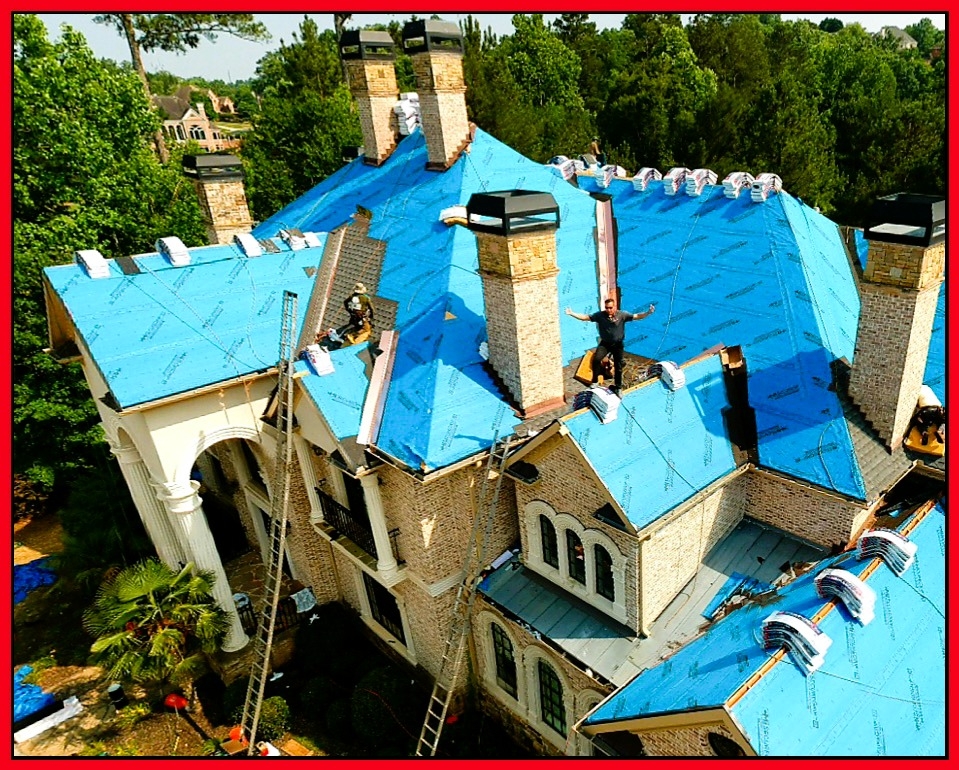
The intake comes from the soffit vents — the perforated or slotted panels tucked under the roof's overhang at the eaves. The exhaust comes from the ridge vent — a continuous opening cut along the peak of the roof and covered with a baffled vent that lets air out while keeping rain and wind-driven water and pests out. Intake low, exhaust high. That geometry is the entire principle. Cool air is pulled in at the eaves across the full length of the roof, rises up both slopes, and escapes through the ridge.
The word that matters most is balanced. The two openings have to be roughly matched in capacity, with a slight bias toward intake. When intake and exhaust are balanced, the air loop is stable and predictable. When they are mismatched, the system either stalls or starts pulling air from places it should never touch — including the conditioned air inside your house. Balance is not a luxury upgrade. It is the difference between a ventilation system that works and a set of vents that merely exists.
3. Soffit Vents: The Intake Half Everyone Forgets
If we had to name the single most common ventilation failure on metro Atlanta homes, it would be inadequate or blocked soffit intake. Homeowners think about the exhaust because they can see the ridge vent or the box vents on the back slope. Almost nobody inspects the soffits, and that is exactly where the system breaks down.
Soffit vents are the intake. They sit under the eave, drawing outside air into the lowest point of the attic. For the system to breathe, that intake has to be open, continuous, and unobstructed across the length of both eaves. Three things routinely block it. First, paint — when a home is repainted, soffit perforations get filled with paint and sealed shut, sometimes across the entire eave. Second, insulation — when attic insulation is added or shifted, it slides down the rafter bays and buries the intake openings at the eave. Third, the original build — many Atlanta homes from the 1980s and 1990s were built with token soffit venting that never met the air volume the roof needed.
The fix for the insulation problem is baffles, also called rafter vents or insulation chutes. These are rigid channels stapled into each rafter bay at the eave that hold the insulation back and preserve a clear air path from the soffit into the attic. Without baffles, a well-meaning insulation upgrade can completely strangle the intake side of the system. When we evaluate a roof during a roof replacement assessment, confirming clear, baffled soffit intake is one of the first things our crew verifies — because adding a beautiful new ridge vent above a blocked soffit accomplishes nothing.
4. Ridge Vents: The Exhaust That Needs Something to Pull
The ridge vent is the exhaust half of the system, and it is the most effective exhaust method available for sloped residential roofs. A continuous ridge vent runs the entire length of the peak, providing exhaust evenly across the whole roof rather than at isolated points. That even distribution is its advantage — it draws air uniformly up both slopes, so no section of the attic stagnates.
A properly installed ridge vent involves more than nailing a cap over the peak. The roofer cuts a continuous slot in the decking along the ridge — typically leaving a few inches of solid deck at each end and at hips — then installs a baffled ridge vent product over that slot. The baffle is the critical engineering detail: it uses the geometry of the airflow over the peak to create suction that actively pulls attic air out, while its external wind baffle deflects driving rain and prevents weather intrusion. Low-grade, unbaffled ridge vents do not generate that suction and are far more prone to letting Georgia's wind-driven rain inside.
Here is the point that catches most homeowners off guard: a ridge vent alone does almost nothing. We are called constantly by people who added ridge vents and saw no improvement in attic temperature. The reason is always the same — the intake side was never addressed. A ridge vent is a chimney. A chimney with no air feeding the firebox does not draw. The ridge vent's exhaust capacity is only realized when matched soffit intake supplies it. This is why selling a homeowner "more ridge vent" without verifying intake is one of the clearest signs of a contractor who does not understand the system.
5. The Balance Math: The 1/300 and 1/150 Rules
Georgia residential code, following the International Residential Code, defines ventilation requirements in terms of net free ventilation area — the actual open area through which air can pass, not the physical size of the vent. A vent's gross size and its net free area differ because screens, baffles, and louvers reduce the open path. Reputable vent manufacturers publish net free area per linear foot, and proper design uses those published figures.
The baseline requirement is the 1/150 rule: one square foot of net free ventilation area for every 150 square feet of attic floor. That requirement is cut in half — to the 1/300 rule — when two conditions are met: the ventilation is balanced between intake and exhaust (with at least 40% and no more than 50% of the required area provided as exhaust near the ridge, and the balance as intake in the lower half), and a vapor retarder is present on the warm-in-winter side of the ceiling. Most modern balanced systems are designed to the 1/300 standard.
| Attic Floor Area | 1/300 Total NFA Required | Intake (Soffit) Target | Exhaust (Ridge) Target |
|---|---|---|---|
| 1,200 sq ft | ~576 sq in (4.0 sq ft) | ~300 sq in | ~276 sq in |
| 1,600 sq ft | ~768 sq in (5.3 sq ft) | ~400 sq in | ~368 sq in |
| 2,000 sq ft | ~960 sq in (6.7 sq ft) | ~500 sq in | ~460 sq in |
| 2,800 sq ft | ~1,344 sq in (9.3 sq ft) | ~700 sq in | ~644 sq in |
The single most important takeaway from this table is the relationship between the last two columns: intake should always equal or slightly exceed exhaust. A system biased toward intake — say 55% intake, 45% exhaust — performs reliably. A system biased the other way creates the dangerous condition described in the next section. These figures are design targets; the exact vent products and linear footage are determined during an on-site assessment of your specific roof geometry. For the code framework behind these numbers, our building codes resource center covers Georgia's residential requirements in depth.
Balance beats quantity every time. A modest, balanced system — equal intake and exhaust — outperforms a roof packed with exhaust vents and starved for intake. Adding more ridge vent to an intake-starved attic does not improve airflow; it can make the system pull conditioned air out of your home instead.
6. The Short-Circuit Problem: Why Mixing Vent Types Fails
One of the most damaging ventilation mistakes is mixing exhaust types on a single attic — combining a ridge vent with box vents, turbines, or a powered attic fan. It looks like "more ventilation." It actually breaks the system through a phenomenon called short-circuiting.
When two different exhaust points exist on the same attic, the stronger or higher one stops pulling air from the soffits and instead pulls air from the nearest other opening. A powered attic fan, for example, moves so much air that it cannot draw enough through the soffits to satisfy its appetite — so it starts pulling air down through the ridge vent. The ridge vent, designed as an exhaust, becomes an intake. Now the system is pulling outside air — and the rain and snow riding on a storm wind — in through the ridge and dumping it into the attic. The lower part of the attic, near the soffits, gets no airflow at all and continues to stagnate.
The professional standard, specified by every major shingle manufacturer, is one continuous exhaust type matched to continuous intake. If a home has a ridge vent, it should not also have box vents on the same attic plane. If older box vents exist when we install a new ridge-vent system, they are removed and decked over, and the slot is sealed. This is not an upsell — it is the only way the new ridge vent can perform. Powered attic fans deserve particular scrutiny in Georgia: they consume electricity, frequently depressurize the attic enough to pull conditioned air up out of the house through ceiling gaps, and a passive balanced system usually outperforms them at zero operating cost.
Is Your Attic Breathing or Suffocating?
Our free on-site assessment measures your intake and exhaust, checks for short-circuiting, and tells you exactly where your ventilation stands — before any commitment.
Call (404) 277-13777. How Ventilation Decides Whether Your Shingles Reach Their Rated Life
Asphalt shingles are rated for 25, 30, or 50 years under controlled conditions. The single biggest factor that prevents them from reaching that life in Georgia is heat — specifically, heat from below. A shingle takes its punishment from two directions: solar UV on top and trapped attic heat underneath. The top side is unavoidable. The bottom side is entirely a function of ventilation.
When attic air sits at 150°F for hours every summer day, the asphalt binder in the shingle volatilizes and hardens faster than the manufacturer's testing assumed. The shingle loses the flexible oils that keep it pliable, and it begins to curl, crack, and shed granules years ahead of schedule. We routinely inspect 14- and 16-year-old roofs in metro Atlanta that look like they have weathered 25 years, and almost without exception the attic underneath is a sealed oven with painted-over soffits and no functioning intake. The shingles did not fail because they were poor products. They failed because they cooked.
This is why ventilation is not separate from your roofing investment — it protects it. The decision to install premium reflective shingles or upgraded materials only pays off if the attic beneath them can shed heat. Pairing the right shingle with balanced ventilation is the combination that actually delivers the rated lifespan. For homeowners weighing the broader question of timing, our guide on extending roof lifespan covers how ventilation fits alongside maintenance and material choices.
8. The Hidden Threat: Moisture, Mold, and Phantom Leaks
Heat is the obvious enemy in Georgia, but moisture is the quiet one. A home's daily activities — cooking, showering, laundry, even breathing — release enormous amounts of water vapor. That vapor migrates upward and, if the attic cannot exhaust it, condenses on the first cool surface it finds: the underside of the roof deck overnight, the metal ductwork, the heads of roofing nails.
The damage from chronic attic moisture mimics a roof leak almost perfectly. Homeowners see water stains on the ceiling, droplets falling from nail tips in the morning, dark blotches spreading across the decking, and they assume the roof is leaking from outside. Our inspectors climb up and find a bone-dry roof surface with a saturated attic — a phantom leak driven entirely by condensation from inadequate ventilation. Left unaddressed, this moisture delaminates plywood decking, corrodes fasteners until they lose holding power, and grows mold that becomes a health and disclosure problem at resale.
A "leak" with no leak is almost always a ventilation problem. If your ceiling stains, your decking darkens, or nail tips drip with no storm to explain it, the cause is trapped moisture — and it will rot your deck from the inside while you keep looking for a hole in the roof.
Balanced ventilation is the defense. By continuously sweeping humid air out of the attic before it can condense, a working ridge-and-soffit system keeps the deck dry and the framing sound. This is why we treat ventilation correction as part of any serious moisture investigation — patching shingles on a roof that is actually suffering condensation damage solves nothing. Our water damage resource center covers how to distinguish true roof leaks from ventilation-driven moisture, and when each requires intervention.
9. The Warranty Connection Most Homeowners Never Hear About
Here is a fact that should change how every homeowner thinks about ventilation: inadequate attic ventilation can void your shingle warranty. The major manufacturers — GAF, CertainTeed, Owens Corning — all build minimum balanced ventilation requirements directly into their warranty terms, because they know unventilated heat destroys their product faster than any defect would.
When a homeowner files a premature-failure claim and the manufacturer sends an inspector, ventilation is one of the first things examined. If the attic is found to be undersized or unbalanced on intake and exhaust, the claim can be denied on the grounds that excessive heat — not a material defect — caused the failure. The homeowner is left with a failed roof and no coverage, having technically operated outside the warranty conditions without ever being told those conditions existed.
Enhanced system warranties raise the stakes further. The GAF Golden Pledge and similar top-tier warranties require installation by a manufacturer-certified contractor who verifies that ventilation meets specification as part of the installation. As a GAF and CertainTeed certified contractor, 1 Source Roofing documents ventilation compliance on every system we install — which is precisely what makes those enhanced warranties valid and enforceable. Choosing a certified contractor is not a marketing detail. It is how the protection you are paying for stays in force.
10. Ventilation and Your Energy Bills in Georgia's Climate
In a cooling-dominated climate like metro Atlanta, the attic is the hottest zone of the house and sits directly above your conditioned space. The temperature of that attic has a measurable effect on how hard the air conditioning works from late spring through early fall.
A balanced ridge-and-soffit system holds attic temperatures 20–40°F lower than a stagnant attic on a summer afternoon. That reduction matters because heat moves from hot to cold — a 150°F attic radiates far more heat down through the ceiling insulation into the bedrooms below than a 110°F attic does. Lowering the attic temperature reduces that downward heat transfer, which means the air conditioner cycles less and the upstairs rooms become livable instead of being the part of the house everyone avoids in July.
Ventilation is not a substitute for insulation or air sealing — it is the third leg of the same stool. Insulation slows heat transfer through the ceiling, air sealing stops conditioned air from leaking into the attic, and ventilation removes the heat and moisture that do accumulate. The three work together, which is why we evaluate all three during an assessment. For the full picture of how these elements combine — and where radiant barriers fit into the equation — the relationships between attic systems are worth understanding before any single upgrade.
11. Warning Signs Your Ventilation Is Failing
Ventilation problems announce themselves, but only if you know what to look for. Most of the signs are visible from inside the attic or from the ground, which means a homeowner can spot trouble long before it becomes a roof replacement. These are the indicators our inspectors check on every assessment.
- Upstairs rooms that never cool. A second floor or bonus room that stays hot despite a hard-working air conditioner is a classic symptom of a superheated attic radiating downward.
- Shingles aging faster than their rated life. Curling, cracking, or heavy granule loss on a roof that should still be young points to heat damage from below.
- Ceiling stains or moisture with no storm. Phantom leaks — water marks that appear in dry weather — almost always mean attic condensation.
- Visible daylight blocked at the soffits. If you cannot see light through the soffit vents from inside the attic, the intake is blocked.
- Hot, stuffy attic air even in the morning. A healthy attic recovers overnight. One that stays oppressive at dawn is not exhausting heat.
- Rusty nail tips or frost lines in the decking. Corrosion and seasonal frost on fasteners are unmistakable signs of trapped moisture.
If you recognize several of these, the ventilation system is the place to start — not another box vent or a powered fan, which often make matters worse. A proper diagnosis comes from someone evaluating intake and exhaust together. You can perform a basic check yourself using our guide on safely inspecting your roof from the ground, then bring in a professional to measure the system.
12. Correcting Ventilation: New Roofs and Existing Roofs
The ideal moment to get ventilation right is during a roof replacement, when the entire assembly is open and the ridge slot, baffles, and soffit intake can all be designed as one balanced system. On a new installation, our crew calculates the required net free area for the specific attic, cuts a continuous ridge slot, installs a baffled ridge vent, confirms or upgrades soffit intake, and adds rafter baffles to keep insulation from blocking the eaves. Ventilation is engineered into the project rather than bolted on afterward.
Existing roofs in good condition can often be corrected without a full replacement. A targeted roof repair can add or unblock soffit intake, install rafter baffles where insulation has buried the eaves, cut and install a ridge vent if the roof lacks one, and remove and deck over mismatched box vents that are short-circuiting the system. The right correction depends on what is already there — which is why diagnosis precedes recommendation in every case.
What we will not do is the common shortcut: adding exhaust without confirming intake. That approach sells vents and solves nothing. Whether your roof needs a complete ventilation redesign during replacement or a focused intake correction on an otherwise sound roof, the goal is the same balanced air loop. Homeowners across Alpharetta, Marietta, and the surrounding metro come to us because we treat ventilation as the engineered system it is — not an afterthought. Our full range of roofing services is built around getting the whole assembly right.
Schedule Your Free Ventilation Assessment
Intake measurement, exhaust evaluation, short-circuit check, and a written recommendation — before any commitment. Serving Atlanta, Buckhead, Sandy Springs, and all of metro Atlanta.
(404) 277-1377 — No ObligationCertified by Industry-Leading Manufacturers