Almost every homeowner who finds a stain on the ceiling or a missing shingle in the yard arrives at the same fork in the road: fix the problem, or replace the whole roof. It is one of the more consequential decisions a homeowner makes for the property, and it is rarely as simple as a contractor declaring one answer or the other. The right call depends on a handful of measurable factors — the age of the system, how much of the roof is actually affected, whether water has reached the structure underneath, and what the home is worth to you over the years you plan to own it.
This guide lays out exactly how an experienced roofer weighs that decision in the metro Atlanta market. Georgia's climate — heavy summer rainfall, sustained humidity, periodic hail, and the wind events that move through the region every spring — puts a specific kind of stress on roofing systems, and that context shapes the repair-versus-replace math in ways a national rule of thumb cannot. By the end, you will be able to look at your own situation with the same framework a qualified inspector uses, and you will know which questions to ask before you sign anything.
The goal here is not to push you toward the larger project. A sound repair on a roof with years of life left is the responsible recommendation, and we make it often. The goal is to give you the reasoning so the decision is yours, made on evidence rather than guesswork.
1. The Core Question Behind Every Roofing Decision
Strip away the variables and the repair-versus-replace decision reduces to one question: will spending money on this roof now protect the home reliably, or will it simply delay a replacement that is coming regardless? A repair is the right answer when it restores the roof to dependable performance for years to come. A replacement is the right answer when patching only buys months before the next failure — or when the structure underneath has already begun to fail.
The mistake homeowners make in both directions is treating the visible shingles as the whole story. The shingle surface is one layer of a system that also includes underlayment, flashing at every transition, the decking the shingles are nailed to, and the attic ventilation that governs how the whole assembly ages. A repair that addresses the surface while ignoring a compromised deck or a ventilation problem solves nothing. A full roof replacement on a roof with one isolated wind-lifted section is money spent before it needed to be. The skill in this decision lies in reading the entire system, not the part you can see from the driveway.
Throughout this guide we will keep returning to four levers that move the decision: age, extent of damage, deck condition, and your ownership horizon. When you understand how each one pulls, the right call usually becomes clear on its own.
2. Roof Age: The First Number That Matters
Age is the single most reliable predictor of whether repair or replacement is the sound choice, and it is the first thing an experienced inspector asks about. Architectural asphalt shingles — the standard on most metro Atlanta homes — carry manufacturer ratings of 30 to 50 years, but those ratings assume ideal conditions. In Georgia's reality of 50-plus inches of annual rainfall, summer heat indexes that push past 110 degrees, and the thermal cycling that comes with sharp temperature swings, the practical service life is closer to 22 to 28 years for a quality architectural shingle properly installed and ventilated.
Here is why age dominates the decision. Shingles age as a unit. Every shingle on a roof installed in the same week has absorbed the same UV exposure, the same heat, and the same number of freeze-thaw cycles. When one section fails on a 20-year-old roof, the rest of the roof is not far behind — it is simply failing more quietly. Repairing one slope of a roof that has reached 80 percent of its rated life is like replacing one worn tire on a car whose other three are bald. The repair holds for a while, then the next section gives out, and the homeowner pays repeatedly for the same problem.
A useful rule of thumb: a roof under 12 to 15 years old with localized damage is almost always a repair candidate. A roof past 18 to 20 years with anything beyond truly minor, isolated damage usually warrants replacement evaluation. The middle zone — 15 to 18 years — is where the other factors in this guide do the deciding. If you do not know your roof's age, the installation date often appears on a permit record with the county, and a qualified inspector can estimate age from granule loss, shingle flexibility, and wear patterns.
3. Reading the Extent of the Damage
After age, the percentage of the roof actually affected is the next decisive factor. Roofing professionals lean on what is commonly called the 25 to 30 percent rule: when damage involves more than roughly a quarter to a third of the total roof surface, the cost of repairing those areas begins to approach the cost of full replacement — without delivering a new, fully warranted system in return. At that point, replacement simply offers better value per dollar.
The challenge is that homeowners almost always underestimate the affected area, because damage that looks like a small problem from the ground frequently extends well beyond the obvious spot. A few missing shingles after a windstorm may be the visible edge of a much larger area where the adhesive seal strips have broken loose and shingles are no longer bonded — a condition that only shows up under hands-on inspection. Hail rarely strikes one corner of a roof; it peppers the whole surface, and the bruising that compromises shingle integrity may be invisible to an untrained eye. This is why a proper roof repair assessment maps the full extent of compromise before anyone quotes a fix.
Isolated, well-defined damage points strongly toward repair: a single failed pipe boot, a length of damaged valley, one slope where a fallen limb tore through, or flashing failure at one chimney. Diffuse damage spread across multiple slopes — widespread granule loss, hail bruising across the field, shingles that lift and crack across large areas — points toward replacement. The dividing line is not just how dramatic the damage looks, but how concentrated or distributed it is across the system.
4. What the Decking Tells You
The decking — the plywood or OSB sheathing the shingles are nailed to — is the structural foundation of the roof, and its condition often settles the repair-versus-replace question more decisively than the shingles do. A roof can have a tired but intact shingle surface over perfectly sound decking, in which case targeted repairs make sense. A roof can also have a reasonable-looking surface hiding decking that moisture has been quietly destroying for years.
Water reaches the deck whenever the waterproofing above it fails — a leak at flashing, a cracked pipe boot, a wind-lifted shingle. In Georgia's humidity, decking that stays damp delaminates and rots faster than it would in a drier climate, and the damage spreads outward from the entry point along the grain of the wood. A small, contained area of soft decking — two to four sheets — is a routine finding during a repair and does not change the calculus. Widespread deck deterioration across multiple sections is a different matter entirely: patching the surface over a failing deck leaves a compromised structure that will keep failing, and the repair money is wasted.
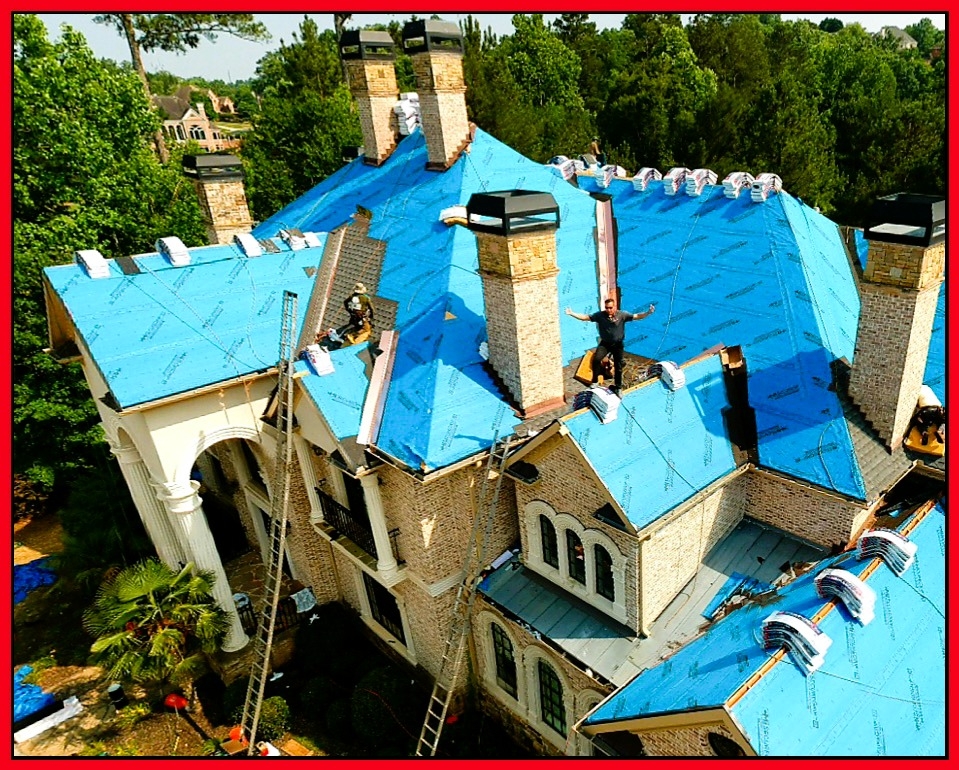
The only way to know the true deck condition is to look. A surface-level repair quote that never mentions the decking has skipped the question that matters most. Our assessment includes evaluation of accessible deck sections and an honest report on what we find — because recommending a repair over a failing deck would only set the homeowner up for a larger problem later.
The shingles you can see are one layer of a five-part system. Underlayment, flashing, decking, and attic ventilation all determine whether a repair will hold. A genuine repair-or-replace recommendation comes from inspecting the whole assembly — not from a glance at the slope facing the street.
5. Repair or Replace: A Side-by-Side Comparison
The table below distills the decision into the conditions that typically favor each path. No single row decides the matter on its own — the call comes from how the factors stack up together. But the pattern is consistent across thousands of Atlanta roofs: repair when the system is young and the damage is contained, replace when age, extent, and deck condition converge.
| Factor | Points Toward Repair | Points Toward Replacement |
|---|---|---|
| Roof Age | Under 12–15 years | Over 18–20 years |
| Damaged Area | Less than ~25% of surface | More than ~30% of surface |
| Decking Condition | Sound, with isolated soft spots | Widespread moisture or rot |
| Leak History | First occurrence, single location | Recurring or multiple locations |
| Damage Type | Localized: one boot, one slope, one valley | Diffuse: hail bruising or granule loss across the field |
| Ownership Horizon | Selling within a few years | Long-term hold; want a new warranty |
| Energy Performance | Acceptable; ventilation adequate | Outdated system; ventilation or efficiency upgrade desired |
Read across the rows that apply to your home. If most of your situation lands in the left column, a repair is likely the sound and economical choice. If your circumstances cluster in the right column — particularly if age and deck condition appear there together — replacement is almost certainly the better long-term decision. Mixed results are exactly what the on-site assessment is designed to resolve.
6. The Warning Sign of Recurring Leaks
One pattern overrides almost every other consideration: a leak that comes back. When water returns to the same area after a repair, it is telling you that the first repair treated a symptom rather than the source, or that the underlying failure is broader than anyone realized. Water is deceptive on a roof — it travels along the underside of decking and down rafters before it drops into the attic and finally appears as a stain on the ceiling, often several feet from where it actually entered the system.
Recurring leaks frequently signal a systemic problem rather than a point failure. Failing valley flashing, an attic that is poorly ventilated and generating condensation, deteriorated underlayment across a slope, or shingles that have reached the brittle end of their service life — these are conditions that no amount of localized patching will resolve. Each patch holds briefly, the next storm finds the next weak point, and the homeowner chases leaks year after year while interior damage accumulates. For homeowners who suspect a hidden source, infrared and thermal leak detection can trace moisture through the assembly that the eye cannot see.
If you have paid for a roof repair and the leak has returned, treat it as a signal that the system needs a comprehensive evaluation rather than another patch. At that stage, the cumulative cost of repeated repairs frequently exceeds what a single decisive solution would have cost — and the interior damage from ongoing infiltration adds expense that has nothing to do with the roof itself.
Not Sure Which Way to Go?
Our inspectors measure the damage, check the decking, and give you an honest recommendation in writing — repair or replace, with the reasoning behind it.
Call (404) 277-13777. Comparing the Real Cost of Each Path
The cost conversation is where homeowners often anchor on the wrong number. The relevant comparison is not the repair figure against the replacement figure in isolation — it is the total cost of ownership over the years you intend to keep the home, including the likelihood of repeated repairs on an aging system.
A single targeted repair on a sound, mid-life roof is a sensible investment that buys real years of performance. The math turns against repair when the roof is old enough that the repair only postpones the inevitable. Consider a 19-year-old architectural shingle roof with damage across two slopes. A repair might restore those slopes, but the remaining slopes are within a few years of failure, and new shingles will not match the weathered ones. Within three or four years, the homeowner is likely facing full replacement anyway — having spent the repair money first. In that scenario, the repair is not the lower-cost path; it is an additional cost layered on top of the replacement that was coming regardless.
There is also a value dimension beyond the immediate dollars. A new roof carries a fresh manufacturer warranty, resets the clock on the home's most weather-exposed system, and is a tangible asset at resale — buyers and their inspectors look hard at roof age. A patchwork of repairs on a visibly aged roof does the opposite, often surfacing as a negotiating point that costs more at the closing table than a replacement would have. When you weigh the options, frame the roof as a long-term investment in the home rather than a line item to minimize today.
A small leak addressed today is a few hundred dollars. The same leak ignored through one Georgia rainy season can multiply three to five times as water reaches decking, insulation, and interior finishes. Early assessment is the least expensive decision you can make.
8. When Storm Damage Changes the Equation
Storm damage introduces a factor that pure wear and tear does not: insurance. Metro Atlanta sits in an active weather corridor — the spring and summer months bring the wind and hail events that drive the majority of roof claims in the region. When a covered storm causes the damage, the financial logic of repair versus replacement shifts, because the cost may be borne in part or in whole by your policy rather than out of pocket.
The critical move after a storm is proper documentation. Wind and hail damage is frequently under-recognized by homeowners because the most consequential damage is not always dramatic from the ground — hail bruising that fractures the shingle mat and breaks the adhesive seal can compromise an entire roof while looking nearly intact. A qualified contractor experienced with storm damage restoration documents the full scope with photographs and a written damage report that ties the damage to the weather event, which is what an insurance adjuster needs to authorize the correct scope of work. The difference between a repair-scoped claim and a full-replacement claim often comes down to how thoroughly the storm damage was documented at the outset.
If your policy covers the loss, the decision frequently resolves in favor of the more durable solution, because the insurer funds the work that restores the property to its pre-loss condition. Our team works alongside homeowners through the insurance claims process, ensuring the documented scope reflects the true extent of the damage rather than the minimum a quick estimate might suggest.
9. What You Can Assess Yourself — and What You Cannot
There is value in a homeowner doing an initial read of the situation before calling anyone, and several indicators are visible from the ground or from inside the home. After a storm, walk the perimeter and look for shingle pieces in the yard, granules collecting in downspout splash zones, and any shingles that are visibly lifted, curled, or missing. Inside, check ceilings and the attic for stains, daylight visible through the deck, or a musty smell that signals trapped moisture. You can do this safely without ever leaving the ground — there is a sound method for a ground-level roof inspection that catches the obvious problems.
What you cannot assess from the ground is the part that actually decides the repair-versus-replace question. Hail bruising, broken adhesive seals, the true extent of decking moisture, flashing condition at transitions, and the integrity of the underlayment all require hands-on inspection by someone who knows what failure looks like at close range. Walking a roof safely is itself a skilled task — Georgia's steep-pitch traditional homes are genuinely dangerous to traverse without proper equipment and training, and a homeowner attempting it risks both injury and further damage to fragile aged shingles.
Treat your own observation as a screening step, not a diagnosis. If you spot warning signs, the next move is a professional assessment that examines what you cannot reach. If everything looks sound from the ground and there is no leak, regular seasonal maintenance is often all an in-service roof needs to reach its full lifespan.
10. How Georgia's Climate Shapes the Decision
The repair-versus-replace math in metro Atlanta is not the same as it would be in Arizona or Minnesota, and the difference is climate. Georgia subjects roofs to a specific combination of stresses that accelerate aging and influence which materials and repairs make sense. Understanding that context sharpens the decision for a local homeowner.
The dominant factor is moisture combined with heat. Atlanta's 50-plus inches of annual rainfall, paired with sustained summer humidity and attic temperatures that can exceed 140 degrees, drives the breakdown of asphalt shingle compounds and creates the conditions for the algae streaking visible on so many area roofs. That same heat-and-moisture cycle is unforgiving toward marginal repairs — a patch that might last a decade in a dry climate is tested far harder here. It also makes attic ventilation a central concern: an under-ventilated attic traps heat and moisture that cook the shingles from below and rot the decking, which is why a ventilation evaluation belongs in any serious assessment. Balanced ridge-and-soffit ventilation can add years to a roof's service life and is frequently the hidden cause behind premature failures.
Wind and hail are the acute threats layered over the chronic ones. The storm systems that cross north Georgia each year lift shingles and bruise surfaces, and a roof already weakened by years of heat is far more vulnerable to storm damage than a younger one. This interaction is why age and storm exposure compound: an older roof does not just have less life left on the clock — it is also less able to survive the next event intact. For homeowners weighing replacement, the climate context is part of why upgrading to a more durable material can be the sounder long-term decision in this market.
11. Your Ownership Horizon and Resale
The same roof can warrant different decisions depending on how long you plan to own the home, and this factor deserves explicit consideration rather than being left as an afterthought. The decision is partly about protecting the structure and partly about how you intend to realize the home's value.
If you plan to sell within a few years, a sound repair that restores function and addresses any active leak may be the practical choice — provided the roof is not so aged that a buyer's inspector will flag it regardless. Be aware, though, that roof age is one of the first things a serious buyer evaluates, and an obviously aged or visibly patched roof becomes a negotiating lever that can cost more at closing than a clean replacement would have. In some cases, a new roof is among the more reliable improvements for supporting both sale price and speed.
If you intend to hold the home for the long term, the calculus favors decisive solutions. A long-term owner benefits from a fresh warranty, the elimination of recurring repair costs, and the option to upgrade to a material better suited to Georgia's climate — whether that is an impact-resistant shingle that may reduce insurance exposure or a standing seam metal system that can outlast the ownership period entirely. For homes in Alpharetta, Buckhead, and the premium neighborhoods throughout metro Atlanta, the roof is also an architectural element of a significant property, and the decision rightly weighs appearance and longevity alongside function.
12. How 1 Source Approaches the Decision
A trustworthy repair-or-replace recommendation comes from a process, not a sales pitch. The 1 Source approach begins with a free on-site assessment built specifically to answer the questions this guide has laid out: how old is the system, how much of it is actually compromised, what condition is the decking in, and what does the ventilation and flashing tell us about how the roof is aging. Our inspector examines the roof hands-on where it is safe to do so, evaluates accessible decking, documents findings with photographs, and produces a written assessment rather than a verbal verdict.
From that assessment, we deliver an honest recommendation with the reasoning attached. When a repair is the right answer, we say so and scope the repair precisely — a roof with years of life left does not need replacement, and recommending one would betray the trust that has built our reputation across metro Atlanta. When the evidence points to replacement, we explain exactly why: the age, the extent, the deck condition, the recurring leak pattern, whatever the deciding factors are in your specific case. You receive the information you need to make the call confidently.
For homeowners who proceed, whether toward a targeted repair or a full replacement, the standard is the same — manufacturer-compliant installation, proper documentation, and a site supervisor present throughout the work. We are a GAF and CertainTeed certified contractor, and that certification governs how we install on both repair and replacement projects. The free assessment carries no obligation, because the decision should rest on evidence, and you should never feel pressured to spend before you understand what your roof actually needs. To see the quality of our completed work, visit our photo gallery, and explore more homeowner guidance in our blog and resource center.
Get an Honest Repair-or-Replace Recommendation
Free on-site assessment. We measure the damage, inspect the decking, and put our recommendation in writing — no obligation. Serving Atlanta, Sandy Springs, Roswell, and all of metro Atlanta.
(404) 277-1377 — No ObligationCertified by Industry-Leading Manufacturers