
Storm Damage Roof Insurance Claim Help in Atlanta, GA
Storm Hit Your Roof? We Document the Damage and Restore Your Roof.
Certified by Industry-Leading Manufacturers
Types of Storm Damage We Document
Not all storm damage is obvious. A roof can take a direct hit from golf-ball hail and look fine from the ground. Wind can lift shingle tabs along the ridge line and reseal them flat — hiding the broken bond until the next storm pulls the shingle off entirely. Knowing what to look for, and where to look for it, is the difference between an approved claim and a denied one.
Here is what we document on every storm damage inspection, broken down by damage type and roofing material.
Hail Damage
Hail is the single most common cause of insurance roofing claims in the Atlanta metro. The damage pattern depends on hail diameter, wind speed, and roofing material.
The hail size scale for roofing damage:
- 1 inch (quarter-sized): Bruises three-tab shingles. Displaces surface granules and exposes the asphalt mat underneath. On an aging roof, this is enough for a claim.
- 1.25 inches (half-dollar): Cracks the fiberglass mat layer on architectural shingles. Creates circular depressions with sharp granule loss borders. This is functional damage — it compromises waterproofing.
- 1.5 inches (walnut-sized): Fractures the shingle mat through its full depth. Creates visible dimples from ground level. Nearly always qualifies for full replacement.
- 2 inches and above (egg-sized or larger): Shatters shingles, cracks tile, dents metal panels, and punctures flat membrane roofs. At this size, the question is not whether the roof is damaged — it is how many other components (gutters, siding, skylights, ridge vents) are also compromised.
On asphalt shingles, we photograph the circular impact marks, measure granule displacement diameter, and test the mat layer for cracking by pressing the impact site. On slate and tile, we document cracks, chips, and broken corners. On metal roofing, we measure dent depth and diameter, because cosmetic damage exclusions apply differently to metal than to asphalt — a dent in a standing seam panel may not affect function, but a dent that creases the panel can.
Wind Damage
Wind damage follows predictable patterns on a roof. The highest wind loads hit the eaves, rakes, and ridge — the perimeter edges and peak where aerodynamic uplift is strongest. This is where shingles fail first.
- Lifted shingle tabs: Wind breaks the adhesive seal strip that bonds each shingle to the one below it. Once the seal breaks, the tab lifts, exposing the nail line and underlayment. Even if the shingle falls back into place, the bond is permanently broken.
- Creased shingles: Strong gusts fold shingle tabs backward over the ridge or rake edge, leaving a permanent crease across the shingle face. A creased shingle cannot lay flat and will eventually fail.
- Missing shingles: The most obvious wind damage. When a shingle is torn off, it exposes the underlayment and often the nail heads of adjacent shingles, creating multiple failure points.
- Exposed nails and fasteners: Wind-lifted shingles pull nails partially out of the deck. The nails remain in place but sit proud of the surface, creating puncture points through the shingle above.
We document wind damage slope by slope and note the prevailing wind direction during the storm event. Adjusters look for consistency between the damage pattern and the storm's wind direction — damage concentrated on the windward slopes corroborates the claim.
Fallen Trees and Limbs
Tree strikes cause the most visually dramatic roof damage and the most structurally concerning. A large limb falling from 40 or 50 feet does not just damage shingles — it can crack rafters, split decking, and compromise the entire roof structure underneath the impact zone.
- Impact damage: Broken shingles, cracked decking, and displaced flashing at the strike point and radiating outward.
- Drag damage: When a branch slides down the roof slope before coming to rest, it scrapes granules, tears shingle tabs, and bends drip edge and gutter sections along its path.
- Structural compromise: Heavy limbs can deflect rafters and crack trusses. This damage is invisible from the roof surface but critical for the claim — we inspect the attic space directly below every tree strike.
Tree damage claims also include debris removal, which is a separate covered line item on most policies. We document the tree size, species, fall direction, and the full path of damage from impact point to final resting position.
Wind-Driven Rain Penetration
Wind-driven rain enters a roof system through gaps that normal rainfall would never reach. When wind pushes rain horizontally rather than letting it fall vertically, water gets under shingle tabs, into pipe boot seals, around chimney flashing, and through ridge vent baffles.
- Ceiling stains: Brown or yellow water marks on bedroom and hallway ceilings, typically appearing 12 to 48 hours after a storm.
- Attic insulation saturation: Fiberglass batt insulation that has absorbed water loses its thermal resistance permanently. We photograph saturated insulation sections and measure the affected area.
- Decking damage: Plywood roof decking that has been repeatedly wet will delaminate and lose structural integrity. We check decking condition from the attic side at every suspected penetration point.
- Mold initiation: Within 48 to 72 hours of water penetration, mold can begin colonizing wet wood and insulation in a humid Georgia attic. Early documentation of moisture intrusion protects your claim if mold remediation becomes necessary.
Interior water damage is a separate line item from the roof repair itself. We document both and include them in the same claim filing to make sure nothing is left out.
Why Timing Matters After a Storm
The first 48 hours after a storm are the most important window for your insurance claim. Not because Georgia law imposes a hard filing deadline — it does not — but because the physical evidence on your roof starts disappearing immediately.
Evidence deterioration starts the day the storm ends. Rain washes displaced granules off the roof surface and into the gutters. Sun heats the shingle adhesive strips, resealing tabs that wind had lifted — hiding the broken bond from visual inspection. Temperature cycling causes cracked shingle mats to close up, making impact damage harder to identify. Within two weeks of a hail event, a roof that sustained 50 hits per square can look like it only has 15. The damage is still there, but it is harder to find and harder to photograph.
Secondary water damage compounds the problem. Every storm-created gap in your roof system — a lifted shingle, a cracked pipe boot, a bent piece of drip edge — is an entry point for the next rain. Atlanta averages 50 inches of rain per year. Water that enters through a storm-damaged opening soaks the decking, saturates the insulation, stains the ceilings, and creates conditions for mold growth. A claim that starts as a $15,000 roof replacement can grow into a $35,000 project that includes decking replacement, insulation removal, interior drywall repair, and mold remediation. Filing early keeps the scope focused on the roof and prevents secondary damage from inflating the project.
Georgia filing considerations. While Georgia does not impose a statutory deadline for filing a storm damage claim, your policy almost certainly does. Most homeowner's policies require you to report damage "promptly" or "within a reasonable time." Courts have interpreted this differently depending on the case, but claims filed more than a year after the storm event face serious pushback from insurers. The strongest position is to file within days of the event while the NOAA storm data, your inspection photos, and the physical evidence all align cleanly.
Insurer response timelines under Georgia law:
- The insurance company must acknowledge your claim within 15 business days of receiving it.
- They must approve, deny, or request additional information within 30 days of receiving all required documentation.
- If they need more time, they must provide you a written explanation of why.
- Payment must be issued within 10 business days of claim approval.
These timelines only start once you file. Every day you wait is a day the evidence weakens, the secondary damage grows, and the clock sits idle. Call us within 48 hours of any significant storm. We will have an inspector on your roof within 24 hours of your call.
How 1 Source Documents Storm Damage
An insurance claim is only as strong as the documentation behind it. When an adjuster opens your file, they are looking for three things: proof that a storm occurred, proof that the storm caused specific damage to your roof, and proof that the damage requires the repairs you are requesting. Our documentation process addresses all three.
- Drone Aerial Photography We fly the entire roof at two altitudes. The first pass at 80 to 100 feet captures the full roof layout — every slope, ridge, valley, and penetration in a single frame. This establishes the overall condition and shows damage distribution patterns. The second pass at 20 to 30 feet captures detail shots of specific damage areas. The drone's GPS stamps every image with exact coordinates and timestamps. This gives the adjuster a visual map of your roof with damage locations marked precisely, before anyone walks on it and potentially disturbs evidence.
- Ground-Level Detail Shots After the aerial pass, our inspector walks every accessible slope. They photograph each damage point at three distances: a wide shot showing the damage in context of the surrounding roof area, a mid-range shot isolating the damaged section, and a close-up showing the specific impact mark, crack, lifted tab, or displaced granule field. For hail damage, we place a reference coin or gauge next to each impact to document the diameter. For wind damage, we photograph the exposed nail line under lifted tabs and the broken adhesive strip. Every photo is dated and organized by roof slope — front left, front right, back left, back right, and so on. The result is a photo report that an adjuster can follow slope by slope without setting foot on the roof.
- NOAA Storm Data Correlation This is where most contractors stop. They photograph the damage and hand the file to the insurance company. We go further. We pull official records from the National Oceanic and Atmospheric Administration — NOAA — for the specific storm event. These records document hail size at ground level, maximum wind speed, storm path and timing, and the geographic area affected. We match the storm data to your property's location and the date the damage occurred. If NOAA recorded 1.5-inch hail within a 3-mile radius of your home at 4:30 PM on March 15, and our photos show circular 1.5-inch impact marks on your roof, the adjuster has a tight correlation between the event and the damage. This data is publicly available but rarely included in claim filings — and it gives the adjuster a clearer, better-documented picture of the storm event.
- Material-Specific Damage Identification Different roofing materials show storm damage in different ways, and adjusters know this. Hail that cracks an asphalt shingle may only scuff a slate tile. Wind that lifts a three-tab shingle may not affect an architectural shingle with a stronger adhesive bond. We identify the exact material installed on your roof — manufacturer, product line, age, and condition prior to the storm — and document the damage according to how that specific material responds to the storm forces it experienced. This matters because adjusters frequently use generic damage criteria that do not account for material-specific vulnerabilities. Our documentation holds up under scrutiny because it is specific to what is actually on your roof.
Had a Recent Storm? Get Your Roof Inspected Free.
We will have an inspector on your property within 24 hours. If there is damage, we document it in detail and provide an estimate to support your claim. If there is not, you will know for certain — and it costs you nothing.
Call (404) 277-1377The Adjuster Meeting — Where Storm Claims Are Won or Lost
After you file a storm damage claim, your insurance company sends an adjuster to inspect the roof. This meeting is the pivotal moment. The adjuster's report determines what gets covered, what gets excluded, and how much money your claim is worth. For most homeowners, this is the only time a human being from their insurance company will look at their roof. What happens during this 30-to-60-minute visit shapes the entire claim.
What the adjuster does: They climb the roof (or inspect from a ladder if the pitch is steep), identify damage they consider storm-related, photograph it, measure the affected area, and write a scope of loss using Xactimate software. They are looking for damage that is consistent with the reported storm event — circular hail marks, directional wind damage, impact patterns from debris. They are also looking for pre-existing conditions, wear patterns, and maintenance issues that would not be covered.
What happens when no one shows the adjuster the documented damage: The adjuster inspects the front slopes — the ones visible from the ground — and writes a scope based on what they find. They may or may not inspect the back slopes, which often take the worst hail damage because of prevailing wind direction. They note the obvious damage and move on. Items that require close inspection — hairline mat cracks, partially lifted tabs that resealed, compromised pipe boot seals — get missed. The scope can come back at 60% to 70% of the actual damage. You receive a check. You may think that is all you are owed. It may not be.
What happens when 1 Source is on the roof with the adjuster: Our inspector arrives before the adjuster with the full documentation package — aerial photos, detail shots, NOAA data, and our independent damage assessment. When the adjuster begins the inspection, our inspector walks with them. Slope by slope. They point out the damage points documented in our report. They show the back-slope hail impacts the adjuster would not have checked. They lift the shingle tabs to show the broken adhesive seals underneath. They press the hail impact points to demonstrate that the mat layer is cracked, not just dimpled. They identify the pipe boots, ridge vents, and flashing sections that need replacement.
This is not confrontational. Professional adjusters welcome a knowledgeable contractor on the roof — it makes their job easier and their report more accurate. But the difference in scope between a solo adjuster visit and one where a qualified contractor is present to show the documented damage is significant. On an average metro Atlanta home, we typically document $3,000 to $8,000 in additional damage items that would otherwise have been overlooked — items your insurer can then review for coverage.
For a detailed breakdown of how to prepare for the adjuster meeting and what to expect, read our full guide: What Happens at an Insurance Adjuster Roof Meeting.
Atlanta's Storm Season and Your Roof
Atlanta sits squarely in the Southeast hail corridor — a geographic band stretching from north Texas through Tennessee where warm Gulf moisture collides with cold fronts moving south from the Great Lakes. This collision zone produces the severe thunderstorms that generate damaging hail, straight-line winds, and tornadoes. Atlanta is not in Tornado Alley, but it is in one of the most active hailstorm regions east of the Mississippi.
Peak season runs March through August. During these six months, the metro Atlanta area experiences 3 to 5 significant storm events per year — storms that produce hail at 1 inch or larger, sustained winds above 60 mph, or both. The spring months (March through May) are the most active, with strong frontal systems pushing through every 7 to 14 days. Summer brings afternoon convective storms — the pop-up thunderstorms that build quickly, drop intense hail over a narrow path, and dissipate within an hour. These summer cells are particularly dangerous for roofs because the hail path is narrow enough that your house gets pounded while your neighbor two streets over sees nothing. Your insurer may question a claim from a "minor" afternoon storm, which is exactly why NOAA data correlation matters.
North Atlanta suburbs see the highest frequency. Storm data from the past decade shows that the northern suburbs — Alpharetta, Johns Creek, Roswell, and northern Marietta — experience more damaging hail events per year than areas south of the I-285 perimeter. The topography and elevation of north Fulton and Forsyth counties contribute to storm intensification as systems move northeast along the Appalachian foothills. Homes in these areas, particularly those built in the 1990s and 2000s with builder-grade three-tab shingles, are among the most vulnerable in the state.
What this means for your roof: If you own a home in the metro Atlanta area, your roof will experience hail and wind damage at some point. It is not a question of if — it is a question of when the next significant event hits your specific neighborhood. The homes that fare best are the ones with upgraded roofing materials (Class 4 impact-resistant shingles carry lower insurance premiums for a reason) and owners who inspect their roofs promptly after every major storm. The homes that fare worst are the ones where damage goes unnoticed for months or years, compounding with each subsequent event until a visible leak forces the homeowner to act — by which point the insurer can argue that accumulated wear, not a single storm, caused the failure.
After every significant storm that crosses the metro area, we offer free inspections for homeowners in our service area. If you are in Alpharetta, Buckhead, Johns Creek, Marietta, Roswell, or Sandy Springs, call us after the next storm. We will tell you exactly what happened to your roof — no charge, no pressure, no obligation.
Emergency Tarping and Temporary Repairs
When a storm puts a hole in your roof — a fallen limb, a section of missing shingles, a cracked skylight — the clock starts immediately. Water pouring into your attic and living space causes exponentially more damage with every hour. Wet insulation, saturated drywall, warping hardwood floors, and mold growth all compound the original roof damage and inflate the total repair cost.
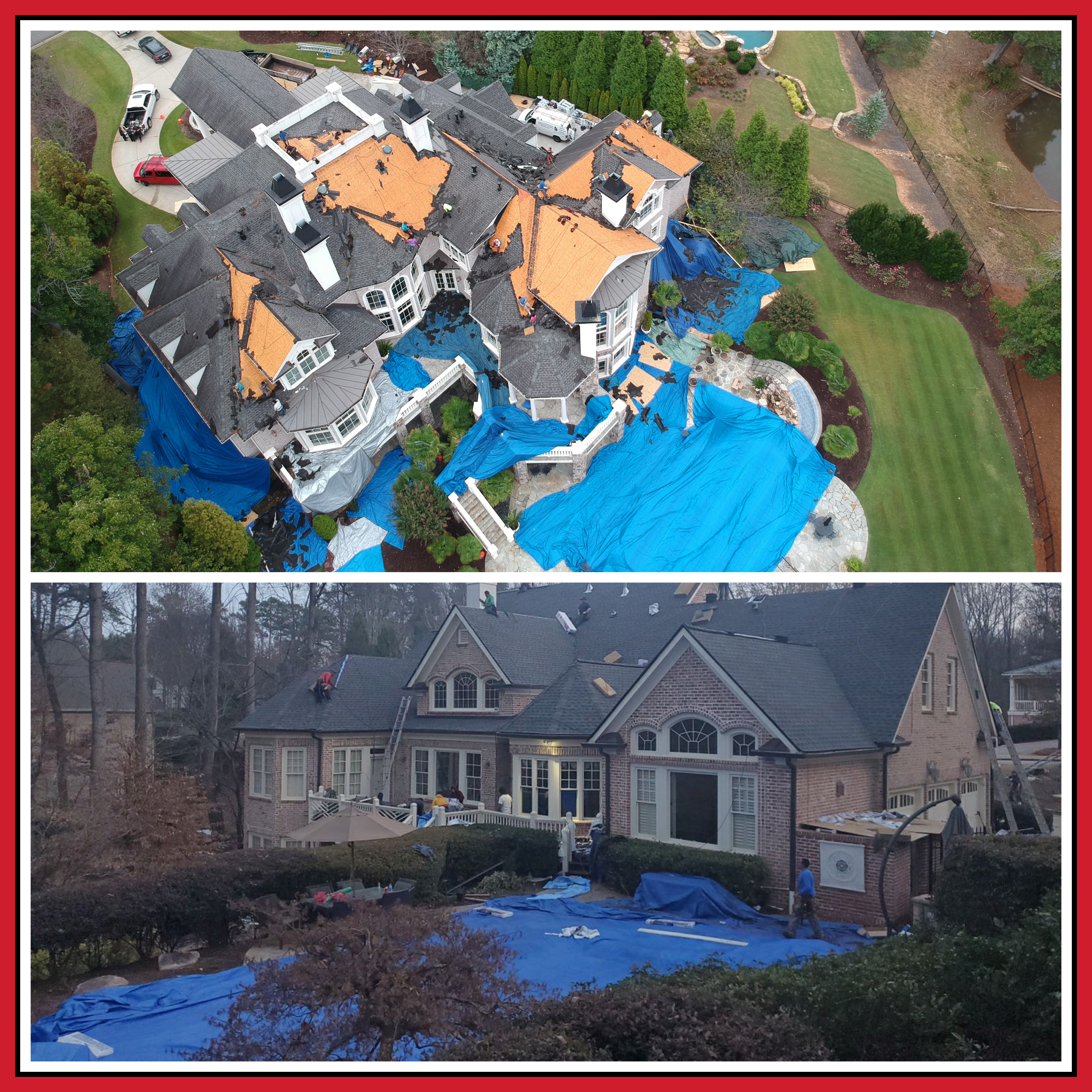
We provide 24-hour emergency tarping for storm-damaged roofs across the metro Atlanta area. When you call our emergency line, here is what happens:
- Immediate dispatch. Our crew is on-site as fast as conditions allow — typically within 2 to 4 hours during daylight, same night for after-hours emergencies if the storm has passed and conditions are safe to work.
- Heavy-duty tarping. We use commercial-grade polyethylene tarps rated for UV exposure and high wind. The tarp is secured with 2x4 battens screwed through the tarp into the roof decking — not weighed down with sandbags or stapled to shingles. This method holds through subsequent storms and prevents the tarp itself from becoming a hazard.
- Temporary board-up and sealing. If the damage includes broken skylights, compromised soffits, or penetrated wall sections, we board and seal those openings as part of the emergency response.
- Photo documentation. Every emergency repair is photographed before, during, and after. These photos become part of your insurance claim file and establish the timeline of when damage occurred and when mitigation began.
Insurance coverage for emergency tarping: Your homeowner's policy includes a provision requiring you to take reasonable steps to prevent further damage after a loss. Emergency tarping falls squarely within that duty. The cost of the tarp installation is a covered expense on your claim — separate from the permanent roof repair. We include the tarping invoice in your claim filing so you are reimbursed as part of the settlement. You do not pay out of pocket for the tarp if your claim is approved.
The tarp stays in place until your permanent repair or replacement is scheduled and completed. For most storm damage claims, that means 4 to 8 weeks from the date of the emergency — enough time for the adjuster visit, scope approval, material ordering, and crew scheduling. Our tarps are rated to last 90 days or more in Georgia weather conditions, and we inspect them during the claims process to confirm they are holding.
If a tree is on your roof right now, or if your attic is taking water, do not wait until morning. Call (404) 277-1377 and we will get a crew to you.
Storm Damage Claim Questions — Answered
Direct answers from contractors who document storm damage every week
How soon after a storm should I have my roof inspected?
Within 48 hours if possible. Storm damage evidence deteriorates quickly — rain washes away granule displacement patterns, wind shifts loose shingles back into place, and sunlight re-seals lifted adhesive strips. The sooner we document the damage, the stronger your claim. Georgia insurers also look favorably on prompt reporting. A claim filed within days of a documented storm event is far harder to dispute than one filed months later.
Does my homeowner's insurance cover storm damage?
Most Georgia homeowner's policies cover storm damage including hail, wind, and fallen trees. The key exceptions are cosmetic damage exclusions (some policies exclude hail damage classified as cosmetic rather than functional) and named storm deductibles (which apply a percentage-based deductible for hurricane or tropical storm events instead of the standard flat deductible). We review your declarations page before you file to identify any exclusions that could affect your claim.
What size hail causes roof damage?
Hail at 1 inch diameter (quarter-sized) can damage standard three-tab shingles. At 1.25 inches (half-dollar size), architectural shingles start showing functional damage — cracked mat layers, displaced granules, and fractured fiberglass reinforcement. At 1.75 inches and above, most roofing materials sustain damage that warrants a full replacement claim. But size alone does not tell the whole story. Wind-driven hail hitting at an angle, hail density per square foot, and the age and condition of your existing roof all factor into the damage assessment.
Can I file a storm damage claim if I did not notice the damage right away?
Yes. Many homeowners do not discover storm damage until weeks or months later — often when a leak appears during the next heavy rain. Georgia does not impose a strict deadline for filing, but most policies require you to report damage within a reasonable timeframe. We can still correlate damage to a specific storm event using NOAA records. The longer you wait, though, the more the insurer can argue that subsequent weather or normal wear contributed to the damage. File as soon as you discover a problem.
Will filing a storm damage claim raise my insurance premiums?
It depends on your carrier and claims history. A single weather-related claim typically does not trigger a rate increase on its own — storm damage claims are classified differently from liability or negligence claims. However, multiple claims within a 3-to-5-year window can affect your renewal rate or insurability. If your roof has minor damage that costs less than your deductible plus a reasonable buffer, it may not make financial sense to file. We assess the damage scope before filing and give you a straight recommendation on whether a claim is worth pursuing.
What if my insurance adjuster says there is no storm damage?
Request a re-inspection. You have the right to have your contractor present during the second inspection to point out specific damage the adjuster may have missed. If the re-inspection still results in a denial, you can invoke your policy's appraisal clause, which assigns an independent umpire to assess the damage. We support re-inspection requests regularly by presenting detailed photo documentation alongside NOAA storm data proving the event occurred, helping document damage that may have been overlooked. Read more about your options: Insurance Claim Denied in Georgia.
Does 1 Source handle emergency tarping after storm damage?
Yes. We provide 24-hour emergency tarping to prevent further water intrusion after a storm. Emergency tarping is a covered expense under most homeowner's insurance policies — it falls under your duty to mitigate further damage. We document the tarping with photos and include it in the claim filing. The tarp stays in place until your permanent repairs are scheduled and completed.
What is the difference between a storm damage claim and a regular roof replacement claim?
A storm damage claim requires proof that a specific weather event caused the damage. That means correlating the damage on your roof to a documented storm — hail size, wind speed, date, and time. A regular replacement claim might stem from long-term wear, manufacturing defects, or improper installation. Storm claims tend to move faster because the cause is verifiable through NOAA records and the damage pattern is consistent with weather impact rather than aging. We specialize in storm claims and know exactly what documentation adjusters need to approve them.
Don't Wait for the Next Storm to Make It Worse.
Every rain that hits an already-damaged roof compounds the problem. One call gets you a free inspection, professional documentation, and a contractor who knows exactly what adjusters need to see. No cost. No obligation.
Call (404) 277-1377 — Free Storm Damage AssessmentStorm Damage Insurance Help Across Metro Atlanta
We document storm damage and support insurance claims for homeowners throughout the Atlanta metropolitan area. Find your city below:
We are a roofing contractor, not a public adjuster. 1 Source Roofing and Restoration is a licensed Georgia roofing contractor. We inspect roofs, document damage, provide repair estimates, and perform roof restoration. We do not adjust, negotiate, or settle insurance claims on a homeowner's behalf — under Georgia law (O.C.G.A. § 33-23), only a licensed public adjuster may do that for compensation. You file and control your own claim, and your insurer determines coverage. If your claim calls for professional adjusting or formal dispute resolution, we are glad to refer you to a licensed Georgia public adjuster.