
A chimney is one of the few places on a roof where the water-shedding surface stops and a vertical wall begins. That interruption is where most chimney leaks start. On a narrow chimney, water running down the roof slips around the sides easily enough. On a wide masonry chimney — the kind that anchors so many traditional homes across metro Atlanta — the upslope wall acts like a small dam. Water and debris flowing down the slope hit that wall, slow down, and collect in the corner where the chimney meets the roof. That collection point is exactly where a cricket belongs.
The cricket, also called a saddle, is a peaked structure built behind the chimney that splits the flow and routes water cleanly around both sides. It is not a decorative add-on or an optional upgrade. For chimneys above a certain width it is a code requirement, and it is one of the single most important flashing details on the entire roof. When a cricket is missing or poorly built, the result is predictable: water pools, the back-wall flashing fails, decking rots, and a leak that started as a stain on the chimney chase eventually shows up on the living-room ceiling.
This guide explains what a cricket does, when Georgia code requires one, how the assembly is built and flashed, and how to recognize the warning signs that your chimney is shedding water poorly. Chimney detailing is precision work, and it rewards homeowners who understand what a correctly built assembly looks like.
1. What a Chimney Cricket Actually Is
A cricket is a small, double-sloped peak built on the high side of a chimney. Picture a tiny gable roof tucked against the back wall of the chimney, with its ridge running straight out from the center of the chimney toward the roof's upslope. Its two faces pitch away from each other so that any water arriving from above is forced to choose a side and travel around the chimney rather than into the corner behind it.
The term saddle is used interchangeably with cricket, though some roofers reserve "saddle" for the larger framed versions and "cricket" for the smaller metal-formed ones. The function is identical. Both exist to solve the same problem: a flat or near-flat surface on the upslope side of a chimney is a trap for water, leaves, pine straw, and the steady stream of granules that wash off an aging shingle roof. Atlanta's tree canopy makes the debris problem worse than it is in many parts of the country — pine straw and oak leaves pack against the back of a chimney and hold moisture against the flashing for days after a storm.
Without a cricket, that corner stays wet. Standing water finds the weakest seam in the back-pan flashing, wicks under the shingles, and saturates the decking. Because the leak happens slowly and out of sight, it often does its damage for years before anyone notices a problem indoors. By the time a ceiling stain appears, the framing and sheathing behind the chimney are usually already compromised. A cricket prevents the entire chain of events by never letting the water stop moving in the first place.
2. Why Wide Chimneys Leak Without One
The physics are simple. Water running down a roof carries momentum, and as long as it keeps moving it stays on the surface and exits at the gutter. The moment it hits an obstruction perpendicular to the slope, it slows, spreads sideways, and starts looking for the lowest point. On a chimney that is two or three feet wide across the upslope face, that lowest point is the long seam where the chimney masonry meets the roof deck.
A narrow chimney — say, a 16-inch flue chase — presents so little width that water deflects around it before it can accumulate. Standard step flashing and a back pan are enough. But the volume of water reaching the back of a wide chimney during a heavy Georgia downpour is substantial. A 36-inch-wide chimney on a moderately pitched roof is intercepting the runoff from a fan-shaped area of roof above it that can total many hundreds of square feet. All of that water converges on one horizontal line, and a simple back-pan flashing cannot move it sideways fast enough.
The result is ponding. Water backs up behind the chimney, rises above the bottom edge of the counter-flashing, and breaches the assembly from the top. This is why so many chimney leaks defeat repeated caulking and tar patching — the problem is not a hole in the flashing, it is a design that allows water to sit where flashing is not meant to hold back standing water. Flashing is built to shed moving water, not to dam a pool. A cricket fixes the root cause by keeping the water moving. For homeowners dealing with persistent chimney leaks, this distinction is the whole story, and it is why a competent roof repair evaluation always starts by checking whether a cricket is present and correctly built.
3. What Georgia Building Code Requires
The governing rule comes from the International Residential Code, which Georgia adopts with state-specific amendments. The IRC requires a cricket or saddle to be installed on the ridge side of any chimney that is more than 30 inches wide, measured perpendicular to the roof slope — that is, across the upslope face of the chimney. The code further requires the cricket to be covered with noncorrosive metal or with the same material as the roof covering, and it must be integrated with proper flashing.
Thirty inches is not a large chimney. A standard single-flue masonry chimney with a brick surround frequently measures 32 to 40 inches across, which means the majority of brick chimneys on metro Atlanta homes fall above the threshold and legally require a cricket. Many older homes in established neighborhoods were built or re-roofed before the requirement was consistently enforced, which is why missing crickets are such a common finding during inspections of homes from the 1980s and 1990s.
Code also dictates the supporting details. The cricket has to be flashed with step flashing along the chimney sides and counter-flashing let into a reglet cut in the masonry, so the system sheds water as a continuous, layered assembly rather than relying on sealant. Drip edge, underlayment, and ice-and-water shield requirements at the chimney follow the same code framework that governs the rest of the roof. For a deeper look at how these requirements interlock, our building codes hub and technical standards hub break down the specific provisions that apply to Georgia roofs.
If your chimney is wider than 30 inches and has only a flat strip of flashing across the back, it is almost certainly out of code — and almost certainly leaking or about to. A free on-site assessment measures the chimney, inspects the back-pan detail, and tells you exactly where the assembly stands before water finds its way into the framing.
4. Cricket vs. No Cricket: The Real Difference
It helps to lay the two approaches side by side. The comparison below shows what changes when a chimney has a properly built cricket versus a back pan alone, on a wide masonry chimney in Atlanta's climate.
| Factor | Properly Built Cricket | Back Pan Only (No Cricket) |
|---|---|---|
| Water behavior at upslope wall | Split and diverted around both sides | Pools and dams against masonry |
| Debris accumulation | Sheds leaves and pine straw down both slopes | Traps debris that holds moisture |
| Flashing performance | Sheds moving water as designed | Asked to hold back standing water it can't |
| Decking behind chimney | Stays dry, full service life | Saturates and rots over time |
| Code compliance (over 30 in wide) | Meets IRC requirement | Non-compliant installation |
| Typical leak history | None when properly maintained | Chronic; resists caulk and patch repairs |
The pattern is consistent. A cricket addresses the cause; a back pan alone fights the symptom and loses. Homeowners who have paid for two or three rounds of chimney caulking that never fully solved the leak are almost always looking at a missing or undersized cricket — the sealant was never the right tool for the job.
5. How a Cricket Is Built and Sized
Cricket construction scales with chimney width. There is no single correct method; the size of the chimney and the roof pitch determine the approach.
Smaller crickets, generally for chimneys under about 24 inches wide, are commonly fabricated from a single sheet of formed metal. A roofer bends 26-gauge galvanized steel, aluminum, or copper into the two-sided peaked shape, then ties it into the surrounding step and counter-flashing. This is fast, durable, and leaves no seam at the ridge of the cricket itself.
Larger crickets, required for wider chimneys, are framed structures. The crew installs a ridge board running out from the center of the chimney and frames two valley-like planes that slope down to the roof on either side. The frame is sheathed with plywood or OSB, the same substrate used across the roof deck. From there the cricket is treated like a miniature roof: self-adhering ice-and-water membrane goes down first for a fully waterproof base, then the surface is finished either with shingles woven into the field or with standing-seam metal panels.
Proper sizing matters as much as proper construction. The cricket has to be tall enough at the ridge that its slopes actually carry water away with authority — a cricket that is too shallow simply moves the ponding line a few inches up the roof. Experienced crews size the ridge height relative to the chimney width and the roof pitch so the diverting slopes are steep enough to keep water moving even in a hard rain. This is where craftsmanship separates a cricket that works for the life of the roof from one that looks right but underperforms.
6. Flashing: Where the Cricket Meets the Chimney
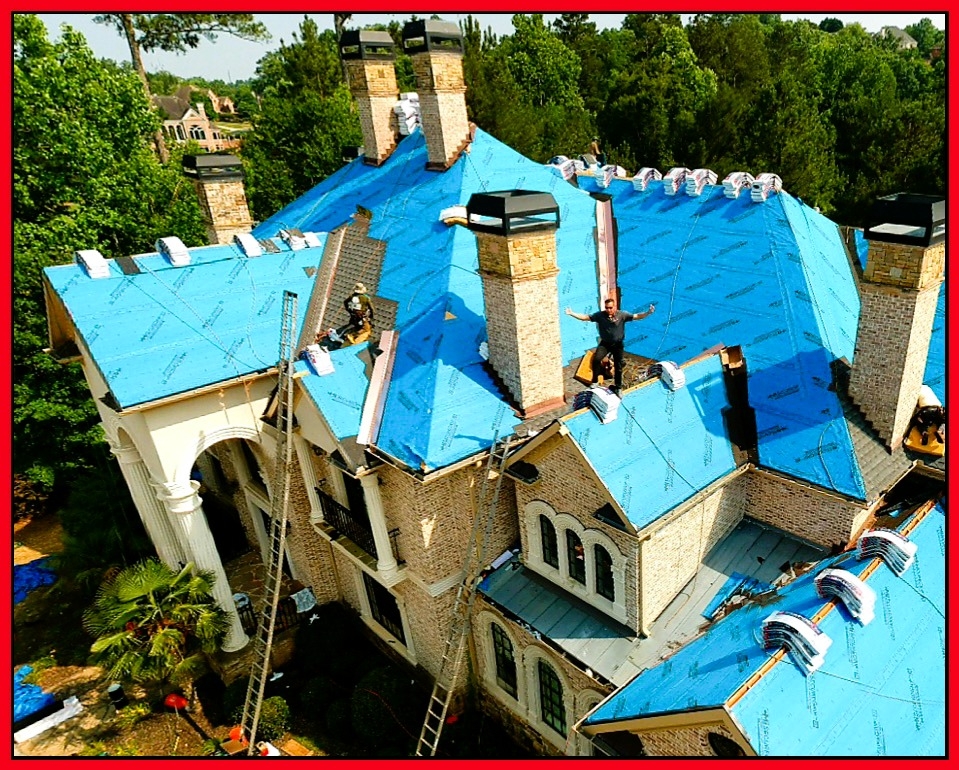
A cricket only works because it is part of a layered flashing system. The structure diverts the bulk of the water, but the seams where the cricket meets the chimney and the roof still have to be sealed against the moisture that does reach them. This is the part of the job that demands the most skill, because every layer has to lap correctly over the one below it so that water always travels onto a surface, never into a seam.
Along the sides of the chimney, step flashing is woven shingle-by-shingle up the slope. Each L-shaped piece tucks under one shingle course and laps over the next, creating a stair-stepped barrier that carries water down and out. This is the same principle covered in our guide to step flashing versus reglet flashing, and it is the standard for any roof-to-wall transition.
Over the step flashing sits the counter-flashing, set into a reglet — a groove cut into the mortar joint of the masonry — and sealed so water running down the brick is directed out over the step flashing rather than behind it. At the base of the cricket where its slopes meet the roof field, a back pan or apron flashing ties everything together. Done correctly, the assembly has no reliance on caulk for its waterproofing; sealant is a finishing touch at the reglet, not the thing holding water out.
Related transition details such as kickout flashing at the bottom of the chimney's downslope side often need attention at the same time, because the same water the cricket diverts has to be steered safely past the wall below the chimney and into the gutter rather than behind the siding. Chimney flashing is best evaluated as a complete system, which is why our crews assess every component during a roof flashing evaluation rather than addressing one leak at a time.
7. Warning Signs Your Chimney Lacks a Proper Cricket
Most homeowners never climb onto their roof, so the warning signs of a failing chimney detail usually appear from the ground or inside the house. Knowing what to look for lets you catch the problem while it is still a flashing repair rather than a framing-and-drywall project.
From the ground, watch the back of the chimney for dark staining on the masonry, a noticeable buildup of leaves and pine straw against the upslope wall, and rust streaks running down from the flashing line. Discoloration or moss on the shingles directly above and behind the chimney points to chronic moisture that never fully dries. Our guide to inspecting your roof from the ground covers the technique for spotting these signals safely with binoculars.
Inside the home, the telltale signs are a water stain or bubbling paint on the ceiling near the chimney chase, a musty odor in the attic, and visible moisture or dark staining on the attic framing around the chimney during a flashlight inspection. Atlanta's humidity means moisture trapped behind a chimney rarely dries on its own, so even a slow leak produces a steady supply of indoor symptoms once the decking is saturated.
From the roof, which is best left to a professional, the clearest sign is the absence of any peaked structure behind a wide chimney — just a flat strip of metal flashing across the back. If a cricket is present but obviously undersized for the chimney width, or if the flashing relies on visible beads of caulk and roofing tar rather than properly lapped metal, the assembly is compromised. Any of these findings warrant a closer look before the next storm season.
A chimney leak rarely stays a chimney leak. Water that breaches the back-wall flashing travels down the framing and into the decking, insulation, and ceiling below. Addressing a missing or failing cricket early keeps the fix at the flashing layer — waiting turns it into a structural and interior repair that can cost several times as much.
Is Your Chimney Quietly Leaking?
Free on-site assessment. Our inspectors measure the chimney, check the cricket and flashing, and document exactly what they find — before any commitment.
Call (404) 277-13778. Retrofitting a Cricket on an Existing Roof
A cricket does not require a full roof replacement to install. On an otherwise sound roof, it can be added as a focused repair — the kind of targeted work that resolves a chronic leak without the cost of redoing the entire surface.
The process starts with removing the shingles and flashing across the upslope side of the chimney to expose the decking. The crew then frames or fabricates the cricket to the correct size for the chimney width and roof pitch, sheaths and waterproofs it with ice-and-water membrane, and installs new step and counter-flashing tied into the masonry. The final step is weaving new shingles back into the surrounding field so the repair sheds water as one continuous surface and blends visually with the existing roof.
The challenge in a retrofit is integration. The new work has to lap correctly with shingles that are already in place, and on an older roof those shingles may be brittle and harder to lift without damage. This is precision work that depends heavily on crew experience, and it is not a job for a handyman or a general contractor without roofing-specific flashing expertise. Done well, a retrofit cricket performs identically to one installed during new construction.
There is also a timing question worth weighing. If the surrounding shingles are well into the back half of their service life, or if the chimney leak has already damaged the decking, a retrofit cricket may be money spent on a roof that needs broader work soon. In those cases, addressing the cricket as part of a roof replacement is usually the better value, because the chimney detail is built correctly into a fresh, fully warranted system. A 1Source assessment lays out both paths honestly so the decision fits the actual condition of the roof.
9. Cricket Materials and How to Choose
Material selection for a cricket follows the same logic as the roof it lives on, with an emphasis on durability because the chimney detail works harder than the open field. The right choice depends on chimney width, roof material, and how long the homeowner intends to keep the home.
- Galvanized steel: The workhorse for formed metal crickets and step flashing. Durable, well-priced, and widely available. The standard choice on most Atlanta homes when the cricket is metal-formed.
- Aluminum: Lighter than steel and naturally corrosion-resistant, a strong option in Atlanta's humid climate. Common on residential re-roofs.
- Copper: The premium choice for estate homes and historic properties. Copper develops a protective patina, lasts for generations, and is often specified on the luxury homes throughout Buckhead and Alpharetta where the chimney is an architectural feature.
- Shingle-clad framed cricket: For wider chimneys, a lumber-framed cricket finished with shingles matching the roof field. Visually seamless and the most common approach on large traditional homes.
- Standing-seam metal: A framed cricket topped with metal panels, often paired with metal roofs or chosen for maximum longevity on a steep, debris-heavy slope.
Whatever the surface material, the ice-and-water membrane underneath is what truly waterproofs a framed cricket. The relationship between membrane and surface mirrors what we cover in our guide to self-adhering ice and water shield — the visible material sheds the bulk of the water, but the self-adhering membrane is the last line of defense that makes the assembly genuinely watertight.
10. Why This Matters More in Atlanta's Climate
Metro Atlanta presents a specific combination of conditions that punishes a poorly detailed chimney faster than a drier or less wooded region would. Understanding the local stressors explains why chimney crickets deserve more attention here than the building code minimum suggests.
Rainfall volume is the first factor. Atlanta averages more than 50 inches of rain a year, well above the national average, and much of it arrives in intense bursts. The back of a wide chimney has to shed a lot of water in a short time during a typical summer thunderstorm, and a missing cricket fails fastest under exactly those high-volume conditions.
Tree canopy compounds the problem. The mature oaks and pines that make Atlanta neighborhoods beautiful also drop a constant load of leaves, pine straw, and seed pods onto roofs. That debris collects against the upslope wall of a chimney with no cricket and forms a moisture-holding dam that keeps the flashing wet long after the rain stops. Regular gutter and roof maintenance helps, but a cricket is what prevents the debris from accumulating in the worst possible spot to begin with.
Humidity and slow drying finish the cycle. In Georgia's sustained summer humidity, decking and framing that get wet behind a chimney simply do not dry out between rain events. Moisture that would evaporate harmlessly in an arid climate instead lingers, feeding rot and creating the conditions for mold in the attic. The same humidity that makes balanced roof ventilation so important for the attic as a whole also makes a dry, well-shedding chimney detail essential. The chimney is simply the most concentrated place on the roof where water wants to sit, and Atlanta's climate gives it every opportunity to do damage.
11. How 1Source Builds and Repairs Chimney Crickets
Chimney detailing is one of the clearest tests of a roofing crew's craftsmanship, because the work is invisible to the homeowner once it is done and the consequences of cutting corners show up years later. The 1Source approach treats the chimney as a system, not a single leak to be patched.
Every assessment begins with measurement. We measure the chimney width across the upslope face to determine whether code requires a cricket, then inspect the existing flashing detail to see whether what is there meets the standard. If a cricket is present, we evaluate whether it is correctly sized and whether the step and counter-flashing are properly lapped or merely sealed with caulk. The findings are documented with photographs so the homeowner can see exactly what the inspector saw on the roof.
When we build or rebuild a cricket, the structure is sized to the chimney and pitch, framed and sheathed where the width calls for it, and waterproofed with self-adhering membrane before any surface material goes on. Step flashing is woven into the shingle courses, counter-flashing is set into a fresh reglet cut in the masonry, and the surface is finished to match the roof field or upgraded to metal where it makes sense. The result is an assembly that sheds water by design and does not depend on sealant to stay watertight.
For the estate homes and architecturally significant properties throughout Sandy Springs, Johns Creek, and Roswell, the chimney is often a defining feature of the roofline, and the detailing has to be as clean as it is functional. Whether the work is a focused cricket retrofit or part of a complete roof replacement, the standard is the same: a chimney that sheds water cleanly for the full life of the roof. The free assessment starts that process with no obligation — because you should know exactly what your chimney needs before you commit to anything.
Schedule Your Free Chimney & Flashing Assessment
Measurement, cricket and flashing inspection, photo documentation, and a written recommendation — before any commitment. Serving Atlanta, Buckhead, Alpharetta, and all of metro Atlanta.
(404) 277-1377 — No ObligationCertified by Industry-Leading Manufacturers