
Roof Deck and Sheathing Code in Georgia
Georgia code sets minimum standards for roof deck thickness, span ratings, fastening, and moisture content. This guide covers IRC R803 requirements, OSB vs. plywood specifications, and when decking must be replaced during a reroofing project.
Certified by Industry-Leading Manufacturers
IRC R803: Georgia's Roof Sheathing and Decking Requirements
IRC Section R803 governs roof sheathing for residential structures. Georgia adopts this section through the Department of Community Affairs (DCA), establishing minimum standards for the structural panels that form the foundation of every residential roof in the state. The roof deck transfers wind loads, gravity loads, and live loads from the roof surface to the rafters or trusses below. Every other roofing component, from the underlayment to the shingles, depends on a sound deck to function.
The code addresses four primary concerns: panel type and grade, minimum thickness for the rafter or truss spacing, fastening patterns, and edge support requirements. Each concern carries specific numerical standards that building inspectors verify during the framing inspection on new construction and that roofing contractors must assess during reroofing projects.
Georgia allows two primary panel types for roof sheathing: oriented strand board (OSB) and plywood. Both must carry an APA (Engineered Wood Association) or equivalent agency span rating that matches or exceeds the rafter spacing. The span rating appears as two numbers separated by a slash (e.g., 24/16), where the first number indicates the maximum support spacing for roof applications and the second indicates the maximum for floor applications.
In metro Atlanta, OSB dominates new residential construction because it costs 20 to 30 percent less than plywood of equivalent span rating. Plywood remains the preferred choice for premium installations and for areas with high moisture exposure because it tolerates moisture cycling better than OSB. Both materials, when installed per code, provide adequate structural performance for Georgia's climate and load conditions.
Building inspectors in Alpharetta, Buckhead, Sandy Springs, Johns Creek, Roswell, and Marietta check span ratings, panel thickness, fastening patterns, and edge support during framing inspections. For reroofing, the contractor bears responsibility for verifying that the existing deck meets code before installing new roofing materials on top of it.
Our team at 1 Source Roofing inspects the roof deck during every tear-off. We mark damaged panels, verify thickness and span ratings, and replace any sections that fail to meet code or manufacturer requirements.
Minimum Roof Sheathing Thickness by Rafter Spacing
The relationship between rafter spacing and minimum sheathing thickness is the core of the IRC R803 requirement. Wider rafter spacing means the panel spans a greater unsupported distance, which requires a thicker or higher-rated panel to prevent deflection under load.
Metro Atlanta residential construction uses two standard rafter spacings: 16 inches on center (OC) and 24 inches on center. Older homes (built before 1980) sometimes have irregular spacing or 12-inch OC framing. Newer tract homes and production builders favor 24-inch OC framing because it uses fewer rafters or trusses, reducing material and labor costs. Custom homes and high-end construction in Buckhead and Johns Creek may use 16-inch OC for a stiffer roof deck that produces a flatter, more refined appearance.
| Rafter Spacing | Min OSB Thickness | Min Plywood Thickness | Min APA Span Rating | H-Clips Required? |
|---|---|---|---|---|
| 12" OC | 3/8" (rare) | 3/8" | 24/0 | No (supported edges) |
| 16" OC | 7/16" | 15/32" | 24/16 | Yes, at mid-span |
| 24" OC | 15/32" (or 7/16" with H-clips) | 15/32" | 32/16 or 40/20 | Yes, at mid-span |
The span rating on the panel determines its suitability for the rafter spacing. A panel rated 24/16 can span up to 24 inches for roof applications (the first number) and 16 inches for floor applications (the second number). A panel rated 32/16 can span up to 32 inches for roof use. If your rafters sit at 24 inches OC, the panel must carry a span rating of at least 24/0 (though 32/16 is the standard used in practice for 24-inch spacing).
During a reroofing tear-off, our crews measure the existing panel thickness and check the APA stamp for span ratings. Older homes sometimes reveal non-structural sheathing boards (1x6 or 1x8 planks) instead of structural panels. Plank sheathing was common in Georgia homes built before 1970. While plank sheathing can function as a nailing surface, modern asphalt shingle manufacturers require structural panel sheathing for warranty coverage. A roof replacement on a plank-sheathed home may require adding structural panel overlay or replacing the sheathing to meet both code and manufacturer requirements.
H-Clips, Panel Edge Support, and Expansion Gap Requirements
Structural panels installed on a roof have two types of edges: supported edges that land on rafters or trusses, and unsupported edges that fall between framing members. The long edges of a 4x8 panel (the 8-foot dimension) run perpendicular to the rafters and land on framing at each rafter location. The short edges (the 4-foot dimension) may or may not land on a rafter, depending on how the panel layout aligns with the framing.
When an unsupported edge spans between rafters, it can deflect under foot traffic, ponding water, or accumulated debris. This deflection creates a visible ridge line in the finished roof surface and can crack shingles at the panel joint. H-clips solve this problem.
What H-Clips Do
An H-clip is a small galvanized steel bracket shaped like the letter H in cross-section. It slides onto the edge of one panel, and the adjacent panel slides into the other side of the H. The clip provides three functions: it supports the panel edges against deflection, it maintains a consistent 1/8-inch gap between panels for thermal expansion, and it aligns the panel edges for a flat joint.
The IRC requires panel edge support where the unsupported span exceeds the capability of the panel thickness. For 7/16-inch OSB on 24-inch OC rafters, H-clips at the mid-span of each unsupported edge are mandatory. For thicker panels on tighter spacing, the panel's own stiffness may provide adequate edge support, reducing or eliminating the H-clip requirement.
Expansion Gaps
Wood-based panels expand and contract with moisture content changes. Georgia's humid subtropical climate produces significant moisture cycling between summer humidity and winter dryness. The IRC requires a 1/8-inch gap between panel edges and a 1/8-inch gap between panel ends to accommodate this movement. Panels installed tight with no gap can buckle when they absorb moisture, creating a rippled roof surface visible through the shingles.
A 1/8-inch gap between panels prevents buckling in Georgia's humid climate. Panels installed tight will expand, buckle, and telegraph ridges through the shingles.
H-clips enforce the correct gap automatically because their width sets the panel spacing. When panels are installed without H-clips, the installer must use a spacer (a 10d nail works as a 1/8-inch spacer) to maintain the gap manually. H-clips are faster and more consistent.
Tongue-and-Groove Panels
Some structural panels come with tongue-and-groove (T&G) edges that interlock adjacent panels without H-clips. T&G panels provide edge support through the mechanical interlock and maintain expansion gaps through the tongue sizing. T&G panels cost more than standard square-edge panels but eliminate the H-clip requirement and the labor to install them. For premium installations in Buckhead and Sandy Springs, T&G panels provide the flattest deck surface.
Concerned About Your Roof Deck Condition?
Our team inspects every panel during a tear-off and replaces damaged decking before installing new roofing. Schedule a free inspection to assess your deck.
Call (404) 277-1377Roof Deck Moisture Content Limits at Installation
The IRC limits moisture content in structural panels at the time of installation to 19 percent. This limit prevents panels from shrinking after installation (which opens gaps and loosens fasteners) and prevents moisture-related degradation of the panel structure. Georgia's climate presents both a challenge and an opportunity: the humid summers can elevate panel moisture content quickly, but the warm temperatures also dry panels efficiently when given air circulation.
New OSB and plywood panels arrive from the manufacturer at moisture content between 6 and 12 percent. Panels stored on-site without protection can absorb moisture from rain, ground contact, or prolonged humidity exposure. A panel that sits on damp ground under a tarp for two weeks in a Georgia July can reach 25 to 30 percent moisture content, well above the 19 percent limit.
For reroofing projects, the existing deck's moisture content matters when evaluating whether panels need replacement. Chronic roof leaks can saturate panels to the point where the wood fibers break down and the structural adhesive in OSB delaminates. A moisture meter reading above 19 percent on an existing panel that has been exposed by tear-off indicates chronic moisture exposure. The panel may look intact but may have lost structural integrity.
Our crews carry moisture meters on every job. During a tear-off, we test suspicious panels and mark any that exceed 19 percent or show visual signs of moisture damage (staining, swelling, delamination, soft spots). Panels that fail the moisture or structural assessment get replaced before new roofing goes on.
Proper storage of new replacement panels is part of the code compliance chain. We keep panels elevated off the ground on stringers, covered from rain but open to air circulation. Panels that arrive wet from shipping or rain exposure get dried before installation. Installing a wet panel traps moisture under the new underlayment and shingles, creating conditions for mold growth and accelerated wood degradation.
For context on how moisture management connects to the underlayment requirements, see our roof underlayment code guide.
When Roof Decking Must Be Replaced During a Reroofing Project
The most common surprise during a roof replacement is damaged decking that the homeowner could not see from the ground or attic. The damage hides under the old shingles and underlayment until the tear-off reveals it. Georgia code requires the deck to provide a sound structural surface for new roofing. Damaged panels must be replaced.
Five conditions trigger mandatory deck replacement:
1. Rot and Wood Decay
Water penetration through failed shingles, damaged flashing, or poor drip edge installation saturates the deck over time. Prolonged moisture exposure activates wood-decay fungi that consume the cellulose and lignin in the panel, leaving soft, spongy wood that cannot hold fasteners or support loads. Rotted panels have no structural value and must be cut out and replaced.
2. OSB Delamination
OSB panels consist of wood strands bonded with adhesive under heat and pressure. Chronic moisture exposure breaks down the adhesive bond, causing the strands to separate and the panel to swell and crumble. Delaminated OSB cannot hold nails, cannot support weight, and cannot serve as a roofing substrate. This failure mode is specific to OSB; plywood delaminates through a different mechanism but with similar consequences.
3. Sagging Between Rafters
Panels that sag visibly between rafters have lost stiffness from moisture damage, overstress, or both. Sagging creates pockets where water ponds, which accelerates further damage. A sagging panel may still hold weight at its supported edges but has failed in its primary function of spanning the rafter gap.
4. Fastener Pull-Through
When nails or staples pull through the deck surface during high-wind events, the deck has lost sufficient density to grip fasteners. New shingles installed on a deck with fastener pull-through damage will not achieve proper wind uplift resistance. The shingles will blow off in the next storm at the same locations.
5. Inadequate Original Material
Some older homes have non-structural sheathing, undersized panels, or damaged plank sheathing that does not meet current code for the rafter spacing. A reroofing project provides the opportunity to upgrade the deck to code-compliant structural panels.
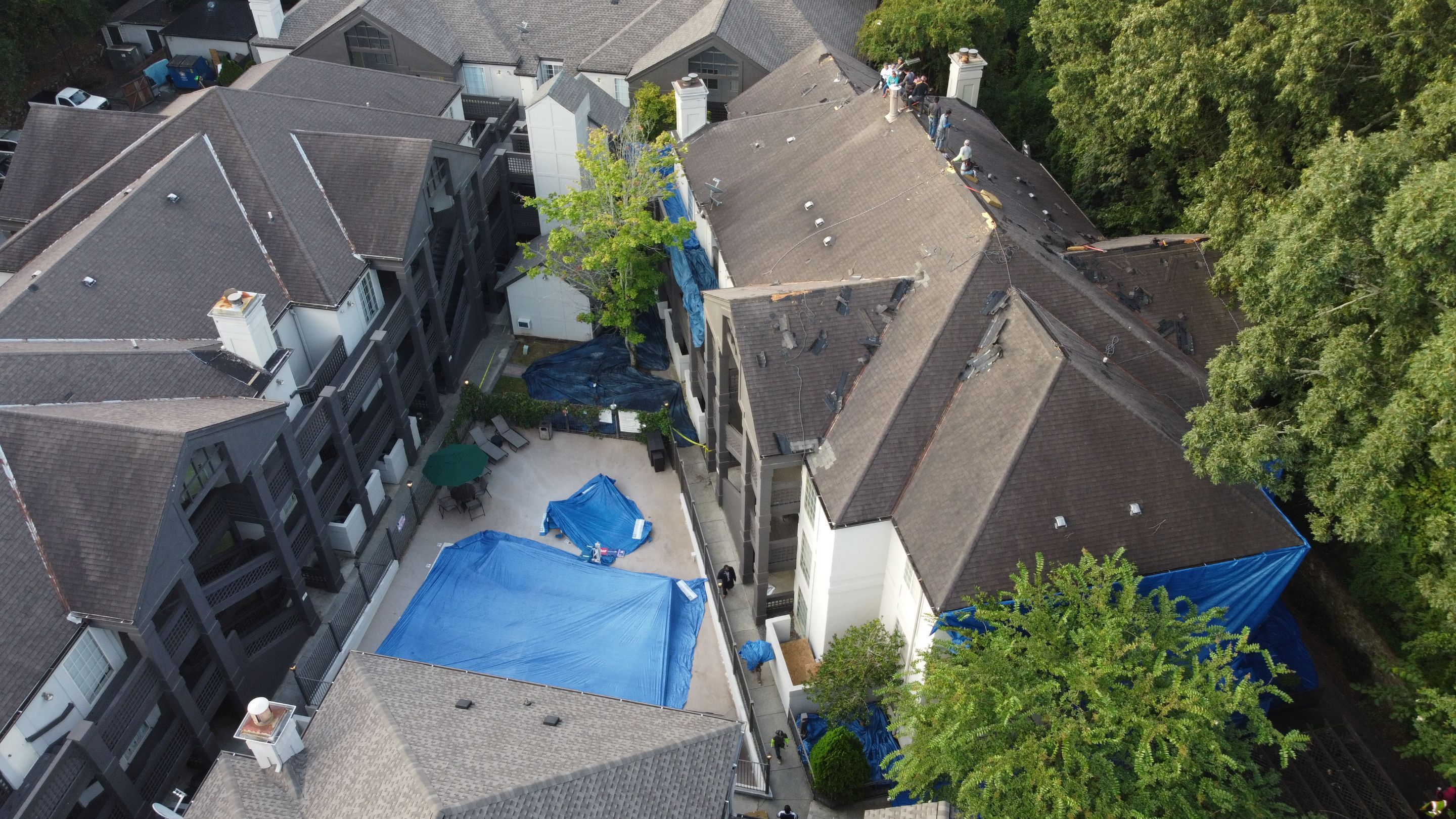
Replacement panels must match the thickness and span rating of the surrounding deck. You cannot patch a 15/32-inch deck with 7/16-inch panels because the thickness difference creates a step that telegraphs through the shingles. Our crews carry multiple panel thicknesses on the truck to match whatever the existing deck requires.
Structural Panel vs. Non-Structural Sheathing: What the Code Requires
The IRC distinguishes between structural panels (rated sheathing designed to resist loads and transfer forces) and non-structural panels (fiberboard, foam board, or other materials that provide insulation or a nailing surface but do not carry structural loads). Georgia code requires structural panels for roof sheathing unless an engineer designs an alternative system.
Structural panels carry APA stamps with span ratings, thickness classifications, and exposure durability ratings. The two grades relevant to roof sheathing are:
- Exposure 1: Bonded with exterior-grade adhesive that resists moisture exposure during construction delays but is not intended for permanent weather exposure. Most roof sheathing in Georgia uses Exposure 1 panels because the roof covering protects the panel from direct weather.
- Exterior: Bonded with waterproof adhesive intended for permanent weather exposure. Exterior-grade panels cost more and are specified where the panel may remain exposed to weather for extended periods or where moisture exposure is chronic.
Non-structural sheathing products include fiberboard, rigid foam insulation, and radiant barrier panels. These products serve specific functions (insulation, air sealing, radiant heat reflection) but do not qualify as structural roof decking under the IRC. A rigid foam panel cannot support a worker standing on it, cannot hold roofing nails against wind uplift, and cannot transfer racking loads from one rafter to the next. Non-structural panels may be installed over structural panels for supplemental insulation, but they cannot replace the structural panel layer.
During attic inspections on older homes, our team sometimes finds non-structural fiberboard used as the only sheathing layer. This occurs in homes built before structural panel requirements became standard. A roof replacement on these homes requires adding structural panel sheathing over or in place of the existing fiberboard to meet code and to provide the nail-holding capacity that asphalt shingles require.
For the connection between deck requirements and the roof load code, heavier roofing materials like tile or slate may require thicker structural panels or closer rafter spacing to distribute the additional dead load without exceeding deflection limits.
Roof Deck Nailing Patterns and Fastener Requirements
The IRC specifies minimum fastening requirements for attaching structural panels to rafters and trusses. Proper nailing transfers wind uplift and gravity loads from the panel to the framing. Inadequate nailing allows panels to lift, shift, or separate during high-wind events.
The standard nailing schedule for roof sheathing in Georgia's 115 mph wind zone requires:
| Panel Location | Fastener Type | Spacing at Panel Edges | Spacing at Interior Supports |
|---|---|---|---|
| Field (interior area) | 8d common nail (2.5" x 0.131") | 6" OC at edges | 12" OC at intermediate supports |
| High-wind zone (edges/corners per ASCE 7) | 8d common nail (2.5" x 0.131") | 4" OC at edges | 6" OC at intermediate supports |
Nail length must provide at least 1.5 inches of penetration into the rafter or truss. For 7/16-inch OSB, an 8d common nail (2.5 inches long) provides 2.06 inches of penetration, which exceeds the minimum. For thicker panels, verify that the nail length provides the required penetration through the panel and into the framing.
Ring-shank nails provide higher withdrawal resistance than smooth-shank nails. The IRC permits both, but ring-shank nails are preferred in Georgia's wind zone because they resist pull-through and withdrawal forces more effectively. GAF and CertainTeed both recommend ring-shank nails for roof deck attachment in their installation requirements.
Staples are permitted by the IRC for roof sheathing attachment, but major shingle manufacturers discourage or prohibit staples for shingle attachment. Some building departments in metro Atlanta have restricted staple use for roof deck attachment as well. Our team uses ring-shank nails for all deck fastening to meet both code requirements and manufacturer recommendations.
Proper deck nailing transfers wind forces from the sheathing to the framing. In a 115 mph wind zone, every nail matters: six-inch spacing at edges, 12-inch spacing in the field.
Overdriven nails (nails driven too deep so the head breaks through the panel surface) reduce the nail's holding power because the head no longer bears against the panel. Underdriven nails (nail heads sitting above the panel surface) create bumps that telegraph through the shingles. Proper pneumatic nailer adjustment sets the nail flush with the panel surface. Our crews check nailer depth settings at the start of every deck nailing operation.
Roof Deck Code: Frequently Asked Questions
Answers to common questions about roof decking requirements, replacement, and code compliance in Georgia.
How thick does roof sheathing need to be in Georgia?
Minimum thickness depends on rafter spacing. For rafters at 16 inches on center, the IRC requires 7/16-inch OSB or 15/32-inch plywood as the minimum. For rafters at 24 inches on center, the minimum increases to 15/32-inch OSB or 15/32-inch plywood. These minimums apply to standard residential roofs with live loads of 20 psf. Heavier roofing materials or higher load requirements may require thicker panels.
When should roof decking be replaced during a reroofing project?
Roof decking must be replaced when it shows signs of structural compromise: soft spots when walked on, visible rot or delamination, water staining that indicates chronic moisture exposure, sagging between rafters, or damage from previous fastener pull-through. During a tear-off, our crews inspect every panel and mark damaged sections for replacement. Georgia code requires the deck to provide a sound nailing surface for the new roofing materials.
What are H-clips and does Georgia code require them?
H-clips are small metal brackets that fit between adjacent roof sheathing panels at unsupported edges (panel edges that do not land on a rafter). They provide edge support and maintain the required 1/8-inch expansion gap between panels. The IRC requires H-clips or tongue-and-groove edges on panels with spans that exceed the unsupported edge limit for the panel thickness. Most 7/16-inch OSB panels on 24-inch rafter spacing require H-clips at the unsupported edges.
Can I install new shingles over damaged roof decking?
No. Both the IRC and every major shingle manufacturer require a structurally sound roof deck as the foundation for shingle installation. Installing shingles over damaged, rotted, or delaminated decking voids the shingle warranty and violates Georgia building code. The deck must be inspected and repaired before any new roofing material is installed. Damaged panels must be cut out and replaced with material that matches the original thickness and span rating.
Explore More Georgia Roofing Code Guides
- Georgia Residential Roofing Code Guide
- Roof Load Requirements in Georgia
- Roof Truss and Rafter Code in Georgia
- Hurricane Strap Requirements in Georgia
- Roof Underlayment Requirements
- Roof Fire Rating Code in Georgia
- Georgia Reroofing and Tear-Off Code
- Drip Edge Requirements in Georgia
- Roof Flashing Code in Georgia
- Roof Replacement Services
- Roof Repair Services
- Storm Damage Restoration