Georgia Reroofing and Tear-Off Code
Georgia limits asphalt shingle roofs to two layers and requires full tear-off in specific conditions. This guide covers the code sections, layer limits, deck inspection requirements, and permit process for every reroofing project in metro Atlanta.
Certified by Industry-Leading Manufacturers
Georgia's Reroofing Code Under IRC Section R907
IRC Section R907 governs reroofing on residential buildings. Georgia adopts this section through the Georgia Department of Community Affairs (DCA) as part of the state's minimum standard building codes. Every reroofing project in the state falls under R907's requirements, and local building departments in Gwinnett County, Fulton County, DeKalb County, and Cobb County enforce them through the permit and inspection process.
R907 addresses three core questions that affect every homeowner considering a roof replacement:
- Can you install new shingles over the existing roof (overlay), or must you remove the old material first (tear-off)?
- What conditions trigger a mandatory full tear-off?
- What must the contractor verify about the roof deck before installing new material?
The answers to these questions determine the scope, cost, and quality of your reroofing project. A contractor who understands R907 gives you an accurate assessment. A contractor who ignores it gives you a roof that may fail inspection, void its warranty, or hide structural damage beneath a layer of new shingles.
The code section works in conjunction with other parts of Chapter 9. Drip edge requirements under R905.2.8.5 apply to reroofing projects. Ventilation requirements under R806 must be met on the completed installation. Wind speed requirements dictate fastener patterns on the new shingles. R907 does not stand alone. It sits within a framework of code sections that together define what a code-compliant roof looks like when the inspector arrives.
For the complete overview of Georgia's residential roofing code framework, see our Georgia residential roofing code guide.
The Two-Layer Maximum Rule
The IRC permits a maximum of two layers of asphalt shingles on a residential roof. This means a contractor can install one layer of new shingles over one existing layer. If the roof already has two layers, the code requires complete removal of all existing material down to the roof deck before new shingles can go on.
The two-layer limit exists for structural reasons. Asphalt shingles weigh between 2 and 4 pounds per square foot, depending on the product line. A single layer of GAF Timberline HDZ shingles weighs approximately 2.5 pounds per square foot. Two layers weigh 5 pounds per square foot. Three layers would push 7.5 pounds per square foot across the entire roof surface. On a 2,500-square-foot roof, that third layer adds 6,250 pounds of dead load that the roof structure was never designed to carry.
Georgia's residential roof framing is designed to the IRC's load tables, which account for dead loads (the weight of the roofing materials themselves), live loads (maintenance workers, equipment), and environmental loads (rain accumulation, the rare ice event). Adding a third shingle layer pushes the dead load beyond what the framing was designed for, creating risk of deflection, sagging, and in extreme cases, structural failure during a heavy rain event when water load compounds the excess material weight.
How Inspectors Verify Layer Count
Before issuing a reroofing permit, some jurisdictions ask the contractor to declare the number of existing layers. During the final inspection, the inspector can verify this by examining the eave edge, where shingle layers are visible in cross-section. On an overlay (second layer) installation, the inspector confirms that only one existing layer remains beneath the new material. If the inspector finds three layers, the project fails inspection and the contractor must remove the excess material.
Some homeowners are unaware of how many layers their roof carries. A roof installed in 1995 with an overlay in 2010 already has two layers. A contractor proposing to overlay a third time in 2026 is proposing a code violation. Our team checks the layer count during every free inspection. We pull back the eave edge and count the layers before writing a proposal. This takes two minutes and prevents a code violation that would take two days to correct.
The rule is absolute: two layers maximum. If your roof has two layers now, the next roof starts with a full tear-off down to the deck.
Homeowners across Alpharetta, Sandy Springs, Johns Creek, Roswell, and Marietta should verify their current layer count before soliciting bids. The number of layers on your existing roof changes the scope and cost of the replacement. A contractor who does not check before bidding is guessing, and that guess can turn into a change order on day one of the project.
When Full Tear-Off Is Required by Code
The IRC mandates complete removal of existing roof coverings under several conditions. The two-layer limit is the most common trigger, but it is not the only one. Georgia building inspectors enforce all of the following tear-off requirements:
1. Exceeding the Two-Layer Limit
If the existing roof has two layers of asphalt shingles, a full tear-off is required before new shingles can be installed. No overlay is permitted. This is the most common trigger and the one most homeowners encounter.
2. Different Material Types
The code prohibits installing asphalt shingles over a different type of roof covering. You cannot overlay asphalt shingles on top of wood shakes, slate, tile, or metal roofing. The existing material must come off completely before asphalt shingles go on. This applies even if the existing material is a single layer. Older homes in Buckhead and Marietta sometimes have wood shake roofs that were later covered with asphalt shingles (a code violation at the time as well). When those roofs reach end of life, both layers must come off.
3. Existing Roof Damage
Section R907.3 requires that the existing roof covering be in a condition that can support the additional weight and provide an adequate nailing base for the new material. If the existing shingles are curled, cupped, buckled, or deteriorated to the point where they cannot function as a stable substrate, the code requires tear-off. An inspector who sees wavy, uneven new shingles will check for a deteriorated substrate beneath and can fail the inspection.
4. Structural Concerns
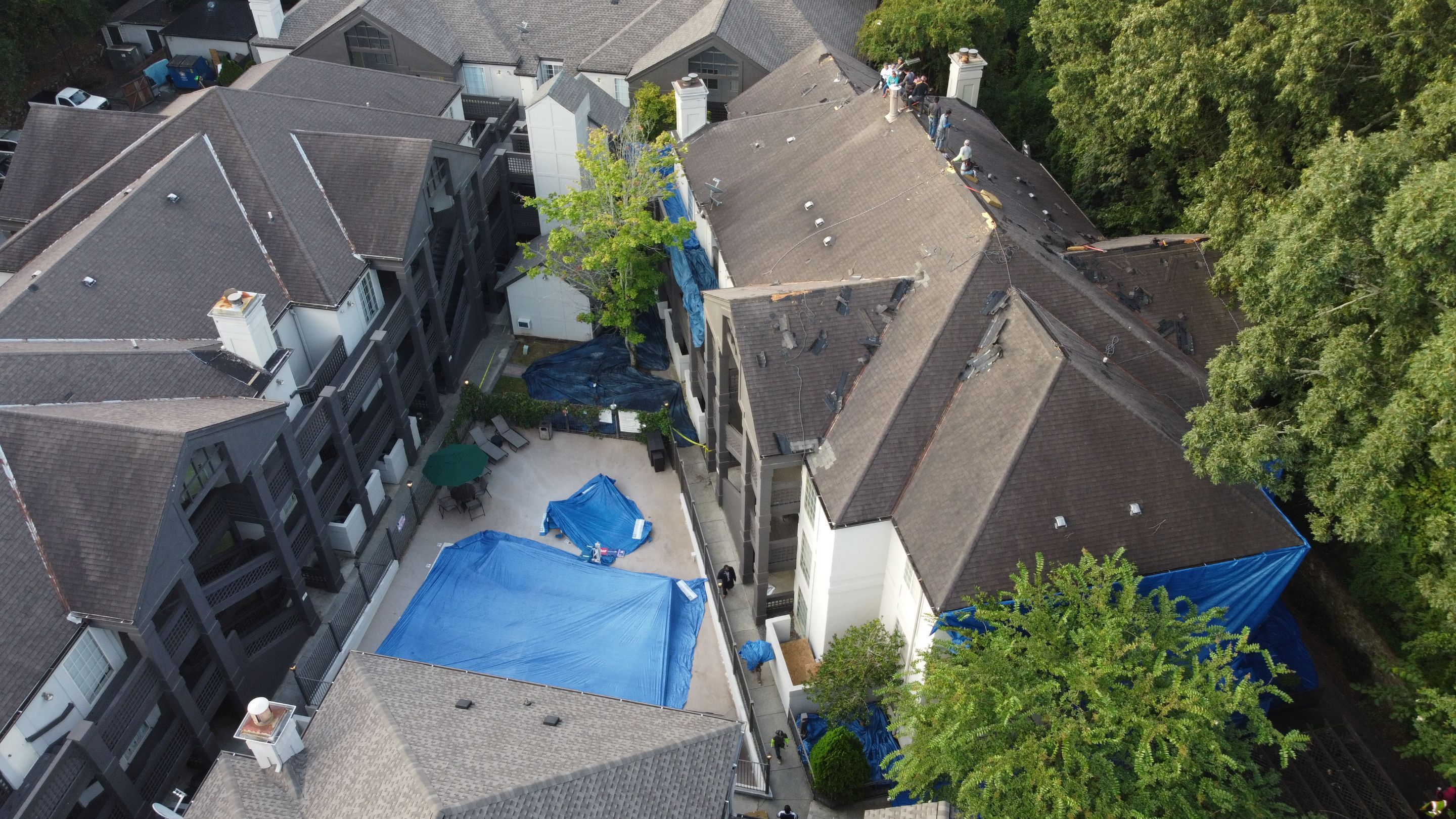
If the roof structure shows signs of deflection, sagging, or damage, the code requires removal of the existing roof covering to allow inspection and repair of the structural components. You cannot fix a sagging rafter by putting new shingles on top of it. The existing material must come off, the structure must be repaired to code, and then new roofing can be installed. Storm damage is a common trigger for this scenario. Our storm damage restoration page covers the process for assessing and repairing structural damage.
5. Wet or Damaged Roof Deck
If the existing roof has active leaks or visible signs of deck damage (soft spots, water staining visible from the attic), the code effectively requires tear-off because the deck must be inspected and repaired before new material goes on. You cannot verify deck integrity through an existing layer of shingles. This is one of the strongest arguments for tear-off even when overlay is technically permitted: you cannot see what is under the existing shingles without removing them.
Roof Deck Inspection During Tear-Off
The tear-off phase is not the end goal. It is the beginning of the most important step in any reroofing project: inspecting the roof deck. The deck is the structural surface that supports every component above it. If the deck is compromised, nothing installed on top of it will perform as intended.
What Inspectors and Contractors Look For
Once the existing shingles, underlayment, and drip edge are removed, the bare roof deck is exposed. A competent contractor inspects every square foot of that deck before installing new material. The inspection targets:
- Rot and water damage: Plywood and OSB roof decking absorb moisture when the roofing system above them fails. Rot weakens the panel and compromises its ability to hold fasteners. A nail driven into rotted decking has no holding power. The shingle it secures will lift in the first windstorm. The crew probes suspect areas with a screwdriver or awl. Soft, punky wood gets marked for replacement.
- Delamination: OSB (oriented strand board) is vulnerable to delamination when exposed to moisture. The layers of the panel separate, creating a spongy surface that cannot hold nails. Delaminated panels must be replaced entirely. Partial repairs do not work because the delamination typically extends beyond the visible damage area.
- Structural deflection: The crew walks the deck and checks for areas that flex under foot. Deflection indicates either a damaged panel, inadequate panel thickness, or a structural issue with the rafter or truss below. Panels should sit firm and flat on the framing. Bouncy or springy sections need investigation.
- Fastener condition: The crew examines how the existing panels were fastened to the framing. Over-driven nails, nails that missed the rafter, or panels attached with too few fasteners create weak spots that will affect the new installation. Panels that are loose or poorly secured get re-fastened to the framing with the correct schedule.
- Gap and edge conditions: The IRC requires a 1/8-inch gap between deck panels to allow for thermal expansion. Panels installed tight can buckle in Georgia's summer heat, creating ridges visible through the shingles. The crew checks panel spacing and trims or replaces panels as needed.
Deck Replacement Requirements
When damaged decking is found, the code requires replacement with material that meets the original structural specifications. In Georgia, most residential roof decks use 7/16-inch or 15/32-inch OSB or CDX plywood. The replacement panel must match the thickness and span rating of the original. APA-rated sheathing with the correct span rating (typically 24/16 for standard truss spacing) satisfies the code requirement.
The cost of deck replacement depends on the extent of the damage. On a typical reroofing project in metro Atlanta, 10 to 15 percent of homeowners need some deck replacement. Homes with a history of leaks, those in heavily treed areas where debris dams form, and roofs with failed flashing at chimney or wall intersections are more likely to have deck damage. Our proposals include a per-sheet price for deck replacement so homeowners know the cost before work begins. There are no surprises on the invoice.
The deck is invisible under shingles. Tear-off is the only way to see what you are building on. On homes worth $500,000 or more, guessing is not a strategy.
Planning a Roof Replacement? Get a Code-Compliant Assessment.
1 Source Roofing checks your layer count, inspects your deck, and builds a proposal that meets Georgia code from the first nail to the last. GAF Certified. CertainTeed Certified. Licensed across metro Atlanta.
Call (404) 277-1377Permit and Inspection Requirements for Reroofing in Georgia
Every reroofing project in metro Atlanta requires a building permit. This applies to full tear-off and replacement, overlay installations, and structural repairs that involve the roof covering. The permit requirement is not optional, and no legitimate contractor will suggest skipping it.
The Permit Process
The process follows a consistent pattern across Gwinnett County, Fulton County, DeKalb County, and Cobb County, though timelines and fees vary:
- Application: The contractor submits a permit application to the local building department. The application includes the property address, scope of work (tear-off or overlay, material type, square footage), contractor license number, and proof of insurance. Some jurisdictions accept online applications; others require in-person submission.
- Plan review: For standard reroofing (no structural changes), plan review is minimal. The building department verifies the contractor's license and insurance, confirms the scope of work, and issues the permit. Turnaround ranges from same-day in smaller jurisdictions to 3 to 5 business days in Fulton County.
- Permit issuance: The contractor receives the permit, which must be posted at the job site during work. In most jurisdictions, work cannot begin until the permit is issued and displayed.
- Work execution: The contractor performs the reroofing in accordance with the permit scope, the applicable code, and the manufacturer's installation instructions.
- Final inspection: Upon completion, the contractor requests a final inspection. A building inspector visits the site and examines the completed work.
What the Inspector Checks
During a reroofing final inspection, the building inspector verifies:
- Layer count: Confirms the number of shingle layers matches the permit scope. If the permit calls for tear-off and replacement, the inspector verifies that the old material was removed.
- Underlayment: Checks that an approved underlayment covers the entire deck. On steep-slope roofs, the inspector may verify underlayment at the eave edge where it is visible.
- Drip edge: Verifies drip edge installation at eaves and rakes, including correct sequencing relative to the underlayment.
- Flashing: Examines flashing at all penetrations (pipe boots, vents), wall-to-roof intersections, chimneys (chimney flashing guide), and valleys. Flashing is one of the most scrutinized components because it is the most common failure point.
- Shingle application: Checks shingle exposure, alignment, and offset pattern. May lift shingles at random locations to verify nail placement in the manufacturer's designated nailing zone.
- Ventilation: Confirms that the ventilation system meets code requirements for net free area. Checks that intake (soffit) and exhaust (ridge) vents are present and unobstructed.
- Ridge cap: Verifies proper hip and ridge cap installation with correct exposure and fastener pattern.
If the roof passes inspection, the inspector signs off on the permit and the project is complete from a code standpoint. If it fails, the inspector issues a correction notice listing the deficiencies. The contractor must correct all items and request a re-inspection. Some jurisdictions charge a re-inspection fee.
Consequences of Working Without a Permit
Unpermitted reroofing work creates cascading problems. Your homeowner's insurance company can deny claims related to a roof installed without a permit. The manufacturer's warranty can be voided because the installation was never verified for code compliance. A future buyer's home inspector will discover the unpermitted work and require retroactive permitting, correction, or price reduction. In some jurisdictions, building officials can require removal and reinstallation of unpermitted work. The permit fee is a fraction of these costs.
Cost Implications: Overlay vs. Tear-Off
The overlay vs. tear-off decision has direct cost implications, both at installation and over the life of the roof. Homeowners in Buckhead, Johns Creek, Sandy Springs, and other premium Atlanta neighborhoods should weigh the up-front savings of an overlay against the long-term risks.
Up-Front Cost Difference
An overlay costs less than a tear-off because it eliminates two labor-intensive steps: removing the existing material and disposing of the debris. On a typical 2,500-square-foot roof in metro Atlanta, the tear-off and disposal adds $1,500 to $3,000 to the project, depending on the number of existing layers, the roof complexity (hips, valleys, dormers), and the disposal fees at the local landfill.
That $1,500 to $3,000 savings is the entire financial argument for overlay. Every other factor favors tear-off.
| Factor | Overlay (Second Layer) | Full Tear-Off |
|---|---|---|
| Up-front cost | $1,500-$3,000 less | Higher (tear-off labor + disposal) |
| Deck inspection | Not possible | Full inspection, repair as needed |
| Shingle lifespan | Reduced 15-25% (heat trap) | Full manufacturer-rated lifespan |
| Warranty eligibility | Limited (no system warranty) | Full system warranty eligible |
| Appearance | May show underlying irregularities | Clean, flat surface |
| Next replacement | Mandatory tear-off of 2 layers | Option to overlay or tear off |
| Home sale impact | Buyers and inspectors flag double layers | Clean inspection report |
| Insurance | Some carriers penalize double layers | Preferred by all carriers |
The Hidden Cost of Overlay
Overlay installations trap heat between the old and new shingle layers. Asphalt shingles degrade faster at higher temperatures. Studies by roofing manufacturers show that shingles installed over an existing layer lose 15 to 25 percent of their rated lifespan compared to shingles installed on a clean deck. A 30-year shingle becomes a 22 to 25-year shingle. On a $15,000 to $25,000 roof replacement, that lost lifespan represents thousands of dollars in accelerated depreciation.
The overlay also conceals damage. A slow leak under the existing shingles continues to rot the deck beneath the overlay. The homeowner does not discover the damage until the next roof replacement, when the tear-off reveals decking that would have been a simple repair years earlier but is now an extensive replacement project.
Warranty Differences
Both GAF and CertainTeed restrict their strongest warranty programs to tear-off installations. A GAF Golden Pledge or Silver Pledge warranty covers the full system, including workmanship, for 25 to 50 years. These programs require that the installation start with a clean deck. Overlay installations receive only the standard manufacturer's material warranty, which covers manufacturing defects but not system performance or workmanship.
For homeowners in metro Atlanta's premium neighborhoods, the warranty difference alone justifies tear-off. A roof on a $1.5 million home in Johns Creek or a $2 million home in Buckhead warrants the strongest available warranty protection. The $1,500 to $3,000 cost difference between overlay and tear-off is irrelevant against the home's value and the warranty coverage at stake.
Why 1 Source Recommends Full Tear-Off
We recommend full tear-off on every roof replacement project. On the homes we serve across metro Atlanta, overlay is not the right approach. Here is why.
Deck Inspection Is Non-Negotiable
The homes in Alpharetta, Buckhead, Sandy Springs, Johns Creek, Roswell, and Marietta represent significant investments. A $500,000 to $3 million home deserves a roof installation that starts with a verified deck. Overlay hides problems. Tear-off reveals them. Our crews inspect every square foot of exposed decking and replace damaged panels before installing new material. This step is impossible with overlay.
Warranty Eligibility
As a GAF Certified contractor and a CertainTeed Certified contractor, we offer manufacturer system warranties that cover the full roofing assembly. These programs require tear-off installations. We want every homeowner to have the strongest warranty available, and that means starting with a clean deck.
Installation Quality
New shingles lay flatter, seal better, and last longer on a clean, smooth deck than on top of old shingles. The nailing surface is consistent. The shingle profile is clean. The drip edge, underlayment, flashing, and starter strip all go on without interference from the old material beneath. The finished product looks better from the street and performs better through Georgia's storms.
Future Flexibility
A tear-off installation leaves the homeowner with a single-layer roof. When that roof reaches end of life in 25 to 30 years, the homeowner has the option to overlay or tear off again. An overlay installation leaves a two-layer roof, which means the next replacement requires a mandatory tear-off of two layers. That future tear-off is more expensive, more labor-intensive, and produces more waste.
Our Process
Every 1 Source Roofing tear-off follows this sequence:
- Remove all existing shingles, underlayment, drip edge, and flashing down to the bare deck.
- Inspect every panel of the roof deck. Mark damaged areas for replacement.
- Replace damaged decking with matching APA-rated sheathing.
- Install new drip edge at eaves (under underlayment) and rakes (over underlayment).
- Apply synthetic underlayment over the entire deck surface.
- Install flashing at all penetrations, walls, chimneys, and valleys.
- Install starter strip, field shingles, and hip/ridge cap per manufacturer specifications.
- Install ridge ventilation to meet code-required net free area.
- Clean the property. Dispose of all old material. Run a magnetic nail sweep of the yard and driveway.
- Request final inspection from the local building department.
This ten-step process takes one to three days depending on roof size and complexity. The result is a code-compliant, warranty-eligible, inspector-approved roof that protects the home from Georgia's next storm. For homeowners weighing their options, the choice between saving $2,000 on an overlay and investing in a tear-off that protects a million-dollar home is clear.
Georgia Reroofing Code: Frequently Asked Questions
Answers to common questions about reroofing requirements, tear-off rules, and inspection standards in Georgia.
How many layers of shingles does Georgia code allow?
Georgia follows the IRC, which limits asphalt shingle roofs to a maximum of two layers. If your roof already has two layers, the contractor must perform a full tear-off down to the roof deck before installing new shingles. This rule exists to prevent excess structural loading and to allow inspection of the roof deck for damage.
Do I need a permit to reroof my house in Georgia?
Yes. Every jurisdiction in metro Atlanta requires a building permit for reroofing work, whether you are tearing off and replacing or overlaying a second layer. The permit triggers a final inspection that verifies the work meets code. Working without a permit can result in fines, required removal of the new roof, and complications with your homeowner's insurance and future home sale.
Is it better to tear off or overlay when reroofing?
Full tear-off is superior in almost every situation. Tear-off allows the contractor to inspect the roof deck for rot, water damage, and structural problems that are invisible under existing shingles. It also produces a cleaner nailing surface, better shingle adhesion, and eliminates trapped moisture between layers. Both GAF and CertainTeed offer their strongest warranty programs only on tear-off installations.
What does a building inspector check during a reroofing inspection?
Inspectors verify underlayment coverage, drip edge installation at eaves and rakes, flashing at all penetrations and wall intersections, shingle exposure and alignment, fastener patterns (sometimes opening a section to check nail placement), ridge ventilation, and overall workmanship. On tear-off projects, some jurisdictions require a pre-cover inspection of the deck before shingles go on.
Explore More Georgia Roofing Code Guides
- Georgia Residential Roofing Code Guide
- Drip Edge Code Requirements in Georgia
- Wind Speed Requirements for Georgia Roofing
- Roof Ventilation Code Requirements
- Minimum Roof Slope Requirements
- Shingle Nailing Installation Guide
- Underlayment and Ice Dam Protection
- Flashing Standards Technical Guide
- Chimney Flashing Installation
- Roof Replacement Services
- Roof Repair Services
- Storm Damage Restoration