

Ice Barrier and Ice Dam Code in Georgia
IRC Section R905.1.2 sets the rules for ice barrier membranes on Georgia roofs. This guide covers where barriers are required, the ASTM D1970 standard, and why many Atlanta contractors install them as a best practice.
Certified by Industry-Leading Manufacturers
IRC R905.1.2 and Georgia's Ice Barrier Trigger
Georgia regulates ice dam protection through the International Residential Code (IRC), adopted with state-specific amendments by the Georgia Department of Community Affairs (DCA). Section R905.1.2 establishes the trigger for ice barrier requirements: any area where the average daily temperature in January is 25 degrees Fahrenheit or below must have ice barriers installed on all new and reroofed residential structures.
The 25-degree threshold creates a clear geographic dividing line across the state. The National Weather Service publishes 30-year climate normals that building officials use to determine whether a jurisdiction falls inside or outside the requirement zone. Metro Atlanta, with average January temperatures between 34 and 42 degrees depending on the specific weather station, sits well above the threshold. North Georgia mountain communities tell a different story.
Blue Ridge (Fannin County) averages 32.4 degrees in January. Dahlonega (Lumpkin County) averages 33.8 degrees. Blairsville (Union County) averages 31.2 degrees. Ellijay (Gilmer County) averages 33.1 degrees. While these averages hover above the 25-degree trigger, higher-elevation sites within these counties and the surrounding mountains drop below it. Building officials in these jurisdictions evaluate each project site against available climate data and make the determination at permit issuance.
The code references NOAA climate normals as the data source for this determination. When a building official determines that the project site meets the temperature threshold, the ice barrier requirement activates for the entire roof system. There is no partial exemption. The barrier must cover eaves, valleys, and penetrations as specified in R905.1.2.
For a broader overview of how Georgia adopts and enforces roofing codes, including the permit process and inspection requirements, see our Georgia residential roofing code guide. This page focuses on the specific provisions of R905.1.2 that govern ice barrier installations.
Local jurisdictions within the metro Atlanta area enforce these requirements through their building departments. When you pull a roofing permit in Alpharetta, Marietta, or Roswell, the building inspector reviews the project against the state-adopted IRC. If your property sits in a zone that meets the temperature trigger, ice barriers become a mandatory line item on the permit application.
Where Ice Barriers Must Be Installed
When R905.1.2 activates, the code specifies three locations where ice barrier membranes must be applied: eave edges, roof valleys, and around roof penetrations. Each location has distinct coverage requirements that the building inspector verifies during the final roof inspection.
Eave Edge Coverage
The ice barrier must extend from the eave edge to a point at least 24 inches past the interior wall line of the building. On a home with a 12-inch overhang, the barrier extends at least 36 inches up the roof slope from the eave edge. On a home with a 24-inch overhang, the barrier extends at least 48 inches from the eave. The measurement follows the roof slope, not the horizontal distance.
This coverage dimension protects the zone where ice dams form. An ice dam builds at the eave when melting snow from the heated portion of the roof refreezes at the cold overhang. Water pools behind the dam and backs up under shingles. The ice barrier membrane creates a waterproof layer at this critical zone, preventing backed-up water from reaching the roof deck and the interior of the home.
Valley Coverage
Roof valleys concentrate water flow from two converging roof planes. The ice barrier must extend at least 36 inches from the valley centerline on each side, creating a 72-inch-wide protected zone. This width exceeds the coverage provided by standard valley flashing alone and accounts for the higher water volume that valleys carry during snowmelt events.
Penetration Coverage
Every roof penetration creates a potential water entry point. The ice barrier must extend at least 24 inches around all plumbing vents, exhaust fans, chimneys, and skylights. The membrane wraps around the base of the penetration and integrates with the flashing system to create a continuous waterproof barrier.
| Installation Location | Minimum Coverage | Measured From | Purpose |
|---|---|---|---|
| Eave edge | 24 inches past interior wall line | Along roof slope from eave | Ice dam zone protection |
| Valleys | 36 inches each side of centerline | From valley centerline | Concentrated water flow protection |
| Penetrations | 24 inches around penetration | From penetration edge | Flashing integration protection |
| Side laps | 6-inch minimum overlap | From membrane edge | Seam waterproofing |
| End laps | 6-inch minimum overlap | From membrane edge | Seam waterproofing |
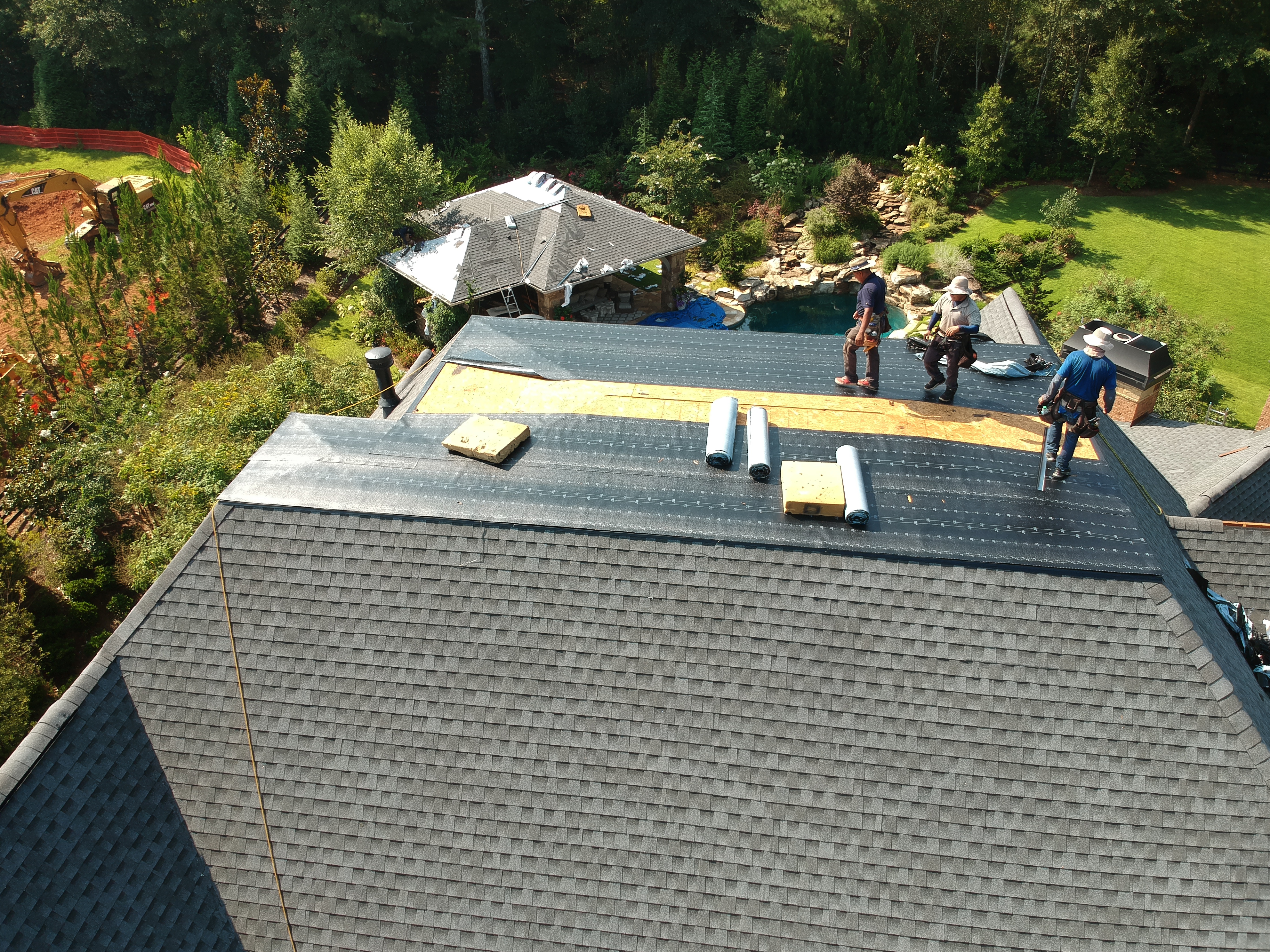
The installation sequence matters. The ice barrier membrane goes directly on the clean, dry roof deck before any other underlayment layer. Standard underlayment overlaps the top edge of the ice barrier by at least 4 inches. At the eave, drip edge goes on the deck first, and the ice barrier lays over the drip edge flange. This sequencing directs any water that reaches the membrane toward the drip edge and off the roof.
ASTM D1970 Membrane Specifications
ASTM D1970 is the standard specification for self-adhering polymer modified bituminous sheet materials used as steep slope roofing underlayment for ice barrier protection. Every ice barrier membrane installed on a Georgia roof must meet this standard. The specification sets minimum performance thresholds across several physical properties that determine how the membrane performs under real-world conditions.
Self-Adhesion and Deck Bond
The membrane must bond to the roof deck through factory-applied adhesive without the use of heat, torch, or supplemental adhesive. ASTM D1970 tests adhesion strength under controlled conditions. The bond must hold under thermal cycling, where summer temperatures in Georgia push attic-side deck temperatures above 150 degrees and winter temperatures drop the exposed deck surface below freezing. A membrane that loses adhesion under these extremes fails to protect the deck at the moment water intrusion occurs.
Nail Sealability
This is the defining performance characteristic that separates ice barrier membranes from standard underlayment. When a roofing nail penetrates the membrane, the modified bitumen compound must seal around the nail shank and prevent water passage through the puncture. ASTM D1970 tests this property by driving nails through the membrane, submerging the assembly in water, and measuring leakage. A conforming membrane allows zero water passage through nail penetrations under the test conditions.
This nail-sealability property is the reason ice barrier membranes protect against ice dam damage. When water backs up behind an ice dam, it pools on the roof surface and pushes under shingle edges. Standard felt underlayment allows water to penetrate through every nail hole in the deck. The ice barrier membrane seals around each penetration and maintains a waterproof layer between the standing water and the roof deck.
Tensile Strength and Tear Resistance
The membrane must resist tearing during installation and maintain structural integrity over its service life. ASTM D1970 specifies minimum tensile strength and tear resistance values in both the machine direction and the cross-machine direction. These properties matter during installation, when crews handle large rolls on steep slopes and apply the membrane over complex roof geometries including valleys, hips, and penetration flashings.
Low-Temperature Flexibility
The membrane must remain flexible at low temperatures without cracking or losing adhesion. ASTM D1970 tests flexibility by bending the membrane around a mandrel at specified temperatures. A membrane that cracks in cold weather loses its waterproofing integrity at the exact moment ice dams form. For Georgia mountain installations where ice barriers are code-required, this property is critical.
"ASTM D1970 testing drives nails through the membrane and submerges the assembly in water. A conforming membrane allows zero water passage through those nail holes. Standard felt has no such requirement."
Products That Meet ASTM D1970
GAF WeatherWatch and StormGuard are the two primary ice barrier products in the GAF system. WeatherWatch is a mineral-surfaced self-adhering membrane designed for eave and valley applications. StormGuard uses a film surface that allows repositioning during installation. Both meet ASTM D1970. CertainTeed WinterGuard is the equivalent product in the CertainTeed system. All three products carry the ASTM D1970 designation on their packaging and technical data sheets.
Need Ice Barrier Protection on Your Roof?
1 Source Roofing installs ASTM D1970 ice barrier membranes at eaves, valleys, and penetrations on every roof that warrants the protection. GAF Certified and CertainTeed Certified for full manufacturer warranty coverage.
Call (404) 277-1377Metro Atlanta and the Best Practice Argument
Metro Atlanta sits outside the R905.1.2 trigger zone. The average January temperature in Atlanta is 42.4 degrees, in Alpharetta 40.1 degrees, in Marietta 41.8 degrees, and in Johns Creek 39.6 degrees. None of these readings approach the 25-degree threshold. Georgia code does not require ice barriers on metro Atlanta roofs.
Yet many experienced contractors in the metro area install ice barrier membranes as a standard practice. The reason extends beyond ice protection. The self-adhering, nail-sealing properties of ASTM D1970 membranes provide valuable protection against several conditions that affect metro Atlanta roofs throughout the year.
Wind-Driven Rain Protection
Metro Atlanta experiences severe thunderstorms with wind speeds that push rain sideways and upward under shingle edges. When rain drives under shingles at the eave, the ice barrier membrane prevents water from reaching the deck through nail penetrations. Standard felt underlayment does not provide this protection. The same membrane that stops ice dam backup stops wind-driven rain infiltration.
Occasional Ice Events
Metro Atlanta averages two to three ice events per winter. The January 2014 ice storm coated Atlanta-area roofs in up to an inch of ice. The February 2021 cold snap pushed temperatures into the single digits across north metro Atlanta. These events create localized ice dam conditions on roofs with poor attic insulation or complex geometries. A roof without ice barrier protection during one of these events relies on shingle integrity alone, and shingles are not designed to resist standing water.
Condensation Protection
Humid air from the living space migrates into the attic through ceiling penetrations, recessed lights, and attic access panels. When this moisture-laden air contacts the cold underside of the roof deck on winter nights, condensation forms on the deck surface. Over time, repeated condensation events damage the deck substrate. An ice barrier membrane at the eave creates a moisture barrier that protects the most vulnerable section of the deck from condensation damage.
Manufacturer Warranty Requirements
Both GAF and CertainTeed require ice and water shield membrane in all roof valleys as part of their system warranty programs, regardless of the local climate zone. GAF's Golden Pledge and Silver Pledge warranty specifications call for WeatherWatch or StormGuard in valleys and at eaves. CertainTeed's 5-Star warranty program has similar requirements. A contractor who skips ice and water shield in valleys to save material cost may void the manufacturer warranty that protects the homeowner's investment.
"GAF Golden Pledge and CertainTeed 5-Star warranty programs both require ice and water shield in all valleys. A contractor who skips valleys to save $150 in material may void the warranty that protects a $20,000 roof."
How Ice Barriers Connect to Underlayment Code
Ice barrier membranes and standard roof underlayment work together as a layered weather protection system. The IRC treats them as distinct components with different material standards and coverage requirements. Understanding how they integrate prevents gaps in weather protection and avoids inspection failures.
Layering Sequence
The ice barrier membrane goes on the clean, dry roof deck first. At eaves, it lays over the drip edge flange. Standard underlayment starts above the ice barrier zone and overlaps the top edge of the barrier by at least 4 inches. This overlap directs water that reaches the underlayment layer onto the ice barrier and toward the eave.
At valleys, the ice barrier occupies the 72-inch center zone. Standard underlayment on each roof plane overlaps the edges of the valley barrier by at least 6 inches. At penetrations, the barrier wraps the base, and standard underlayment courses above and to the sides overlap the barrier edges.
Material Standards Comparison
| Property | Ice Barrier (ASTM D1970) | Felt Underlayment (ASTM D226) | Synthetic Underlayment (ASTM D6757) |
|---|---|---|---|
| Self-adhering | Yes | No | No |
| Nail sealability | Yes (zero leakage) | No | No |
| Waterproof layer | Yes | Water-resistant only | Water-resistant only |
| UV exposure limit | 30 to 90 days (varies by product) | 30 days | 90 to 180 days |
| Typical cost per square | $50 to $80 | $10 to $15 | $25 to $40 |
The cost difference between ice barrier membrane and standard underlayment is significant. A typical 30-square metro Atlanta roof uses 3 to 5 squares of ice barrier membrane at eaves and valleys, with standard synthetic underlayment covering the remaining field area. This targeted approach costs $150 to $400 more than using standard underlayment alone. On a $15,000 to $25,000 roof replacement, that investment represents a fraction of the total project cost and provides protection that standard underlayment cannot match.
The connection between ice barriers and underlayment extends to reroofing projects. When a contractor tears off an existing roof, the ice barrier and underlayment system must be replaced to meet current code. An old roof may have lacked ice barrier protection entirely. A new permit triggers compliance with the current IRC cycle, which means installing ice barriers where the code requires them and following current underlayment specifications across the entire roof surface.
How 1 Source Handles Ice Barrier Installation
Every roof replacement that 1 Source Roofing performs in metro Atlanta includes ice and water shield membrane at eaves and valleys as a standard component. This goes beyond code requirements for the metro area. It meets GAF and CertainTeed system warranty specifications and provides the secondary waterproofing layer that protects your home against wind-driven rain, condensation, and the occasional ice event.
Eave Application
Our crews install GAF WeatherWatch or equivalent ASTM D1970 membrane from the eave edge to a point at least 24 inches past the interior wall line. On homes with wide overhangs, this may require two courses of membrane. We overlap courses by at least 6 inches at horizontal laps and stagger end laps by at least 6 feet to prevent water tracking along seam lines.
Valley Application
We center a 36-inch-wide course of ice and water shield in every valley, extending from the ridge to the eave. On valleys longer than 34 feet (the length of a standard roll), we overlap courses by at least 6 inches, with the upper course overlapping the lower to direct water flow downhill. The membrane extends at least 18 inches from the valley centerline on each side, creating the 36-inch protected zone. Our valley flashing guide covers how the ice barrier integrates with open valley metal and closed valley shingle methods.
Penetration Application
Around chimneys, plumbing vents, exhaust fans, and skylights, we cut and fit ice and water shield to create a continuous waterproof collar. The membrane extends at least 12 inches from the penetration edge in all directions. Flashing components install over the membrane, and the standard underlayment course above the penetration overlaps the top edge of the membrane by at least 4 inches.
Quality Control
Our project manager inspects all ice barrier installations before the crew proceeds to standard underlayment and shingle application. We photograph the ice barrier layout for your project documentation file. This documentation proves that the manufacturer's warranty specifications were met at the time of installation, which protects your warranty claim position if you ever need to use it.
For homeowners in Buckhead, Sandy Springs, Johns Creek, and other premium neighborhoods, this level of installation detail separates a code-minimum roof from a warranty-backed, inspection-documented roof system. Both cost similar amounts. The difference shows up when storm damage occurs and you file an insurance claim. Documentation of proper installation supports your claim. Lack of documentation creates questions that delay or reduce your payout.
Ice Barrier and Ice Dam Code — Frequently Asked Questions
Common questions about Georgia's ice barrier requirements, ASTM D1970, and best practices for metro Atlanta roofs.
Does Georgia code require ice dam barriers on residential roofs?
IRC R905.1.2 requires ice barriers in areas where the average daily temperature in January is 25 degrees Fahrenheit or below. Most of metro Atlanta falls outside this threshold, with average January temperatures between 34 and 42 degrees. North Georgia mountain communities like Blue Ridge, Dahlonega, and Ellijay fall within the requirement zone and must install ice barriers at eaves, valleys, and around penetrations.
What is the ASTM standard for ice dam barrier membranes?
ASTM D1970 is the standard specification for self-adhering polymer modified bituminous sheet materials used as steep slope roofing underlayment for ice barrier applications. The membrane must bond directly to the roof deck without heat or additional adhesive, maintain watertight integrity under nail penetrations, and resist tearing during installation. Products like GAF WeatherWatch and CertainTeed WinterGuard meet this standard.
Should Atlanta homeowners install ice barriers even if code does not require them?
Many Atlanta-area contractors install ice barriers at eaves, valleys, and around penetrations as a best practice, even though the code does not mandate them in metro Atlanta. Ice and water shield membranes provide a secondary waterproofing layer that protects against wind-driven rain, condensation, and the occasional ice event that metro Atlanta experiences every few winters. Both GAF and CertainTeed require ice and water shield in valleys for their system warranty programs.
Where on the roof do ice barriers get installed?
When required or installed as best practice, ice barriers go at the eave edge extending at least 24 inches past the interior wall line, in all roof valleys extending at least 36 inches from the valley centerline, and around all roof penetrations including plumbing vents, exhaust fans, and skylights. The membrane must overlap any adjacent barrier or underlayment by at least 6 inches at side laps and 6 inches at end laps.
Related Building Code and Technical Guides
These pages cover related code requirements and technical installation standards for Georgia residential roofing:
- Georgia Residential Roofing Code Guide — Complete overview of IRC Chapter 9, permits, and inspections
- Roof Underlayment Code Requirements — IRC R905.1 underlayment standards, synthetic vs. felt, attachment methods
- Valley Flashing Code Requirements — Open valley, closed valley, and woven valley methods under IRC R905.2.8.2
- Drip Edge Code Requirements — IRC R905.2.8.5 material specs, installation sequence, and inspection standards
- Roof Flashing Code Requirements — IRC R903.2 flashing materials, methods, and penetration details
- Chimney Flashing Code Requirements — Base flashing, counter flashing, and cricket requirements
- Skylight Installation Code Requirements — Glazing, flashing, and energy code for skylight installations
- Asphalt Shingle Code Requirements — IRC R905.2 wind ratings, fastener patterns, slope minimums
- Reroofing and Tear-Off Requirements — When tear-off is required and reroofing code provisions
Questions about ice barrier protection for your home? Call 1 Source Roofing at (404) 277-1377 for a free roof inspection and protection evaluation.