

Asphalt Shingle Roofing Code in Georgia
IRC Section R905.2 governs every asphalt shingle roof in Georgia. This guide covers wind classifications, fastener patterns, slope minimums, and the ASTM standards your roof must meet.
Certified by Industry-Leading Manufacturers
Georgia Adopts the 2024 IRC for Shingle Installations
Georgia regulates asphalt shingle roofing through the International Residential Code (IRC), adopted with state-specific amendments by the Georgia Department of Community Affairs (DCA). Section R905.2 of the IRC is the controlling code section for asphalt shingle roof coverings. It sets material standards, application methods, fastener requirements, and wind resistance thresholds that every shingle installation in the state must satisfy.
The 2024 IRC cycle refines several provisions that affect metro Atlanta homeowners. Wind resistance classifications now reference updated ASCE 7 wind speed maps. Fastener schedules carry stricter requirements for enhanced wind zones. Underlayment pairing rules tie slope thresholds to specific product types. These are incremental changes rather than wholesale rewrites, but they affect the materials your contractor selects and the methods your crew uses on install day.
Section R905.2 is organized into subsections that address distinct aspects of shingle installation. R905.2.1 covers slope requirements. R905.2.4 addresses wind resistance classifications. R905.2.5 specifies fastener requirements. R905.2.6 mandates compliance with manufacturer installation instructions. R905.2.7 covers underlayment. R905.2.8 addresses flashing. Each subsection carries the force of law in Georgia once the DCA formally adopts the code cycle.
Local jurisdictions enforce these requirements through their building departments. When you pull a roofing permit in Alpharetta, the building inspector verifies compliance with R905.2 during the final inspection. The same applies in Marietta, Sandy Springs, Buckhead, and every other municipality in the metro area. Some jurisdictions add local amendments that exceed the state baseline. Gwinnett County, for example, has required additional documentation for re-roofing projects that goes beyond what the IRC mandates.
The code also incorporates manufacturer requirements by reference. R905.2.6 states that asphalt shingles must be installed "in accordance with the manufacturer's printed instructions." This means that when GAF publishes a technical bulletin specifying nailing zones for Timberline HDZ shingles, that bulletin becomes part of the code-required installation method. The same holds for CertainTeed Landmark series products and every other ASTM-listed shingle product. A contractor who follows the IRC but ignores manufacturer instructions violates the code.
For a broader overview of how Georgia adopts and enforces roofing codes, including the permit process and inspection requirements, see our Georgia residential roofing code guide. This page focuses on the specific provisions of R905.2 that govern asphalt shingle installations.
Shingle Classification and Wind Rating Requirements
IRC Table R905.2.4.1 is the reference table that links design wind speed to required shingle wind resistance classification. Every shingle product carries a wind resistance rating based on one of two ASTM test methods. Your contractor must select a product rated for your location's design wind speed, or the installation fails code.
The two ASTM wind resistance test standards are:
- ASTM D3161 (Standard Test Method for Wind-Resistance of Steep Slope Roofing Products): Assigns Class A, D, F, G, or H ratings based on sustained wind exposure in a test chamber. Class F corresponds to 110 mph. Class G corresponds to 120 mph. Class H corresponds to 150 mph.
- ASTM D7158 (Standard Test Method for Wind Resistance of Sealed Asphalt Shingles): Assigns Class D, G, or H ratings based on mechanical uplift testing. Class D corresponds to 90 mph. Class G corresponds to 120 mph. Class H corresponds to 150 mph.
Metro Atlanta sits in a 115 mph ultimate design wind speed zone under the ASCE 7-16 maps that the IRC references. This is a 3-second gust speed measured at 33 feet above ground in Exposure Category C. For this wind speed zone, Table R905.2.4.1 requires shingles rated at ASTM D7158 Class G (120 mph) or ASTM D3161 Class F (110 mph) with the appropriate fastener schedule.
| Design Wind Speed (mph) | ASTM D7158 Minimum | ASTM D3161 Minimum | Nails Per Shingle |
|---|---|---|---|
| Up to 110 | Class D | Class A | 4 nails |
| 111 to 120 | Class G | Class F | 4 nails |
| 121 to 130 | Class G | Class F | 6 nails |
| 131 to 140 | Class H | Class G | 6 nails |
| 141 to 150 | Class H | Class H | 6 nails |
Most residential shingles sold in metro Atlanta carry Class G or Class H ratings under both ASTM D7158 and ASTM D3161. GAF Timberline HDZ shingles carry a Class H wind rating (150 mph) under ASTM D7158 with a 6-nail pattern, and Class F under ASTM D3161. CertainTeed Landmark Pro carries a Class G rating under ASTM D7158. The product you select must match or exceed the rating required for your site's design wind speed. Your contractor should verify this before ordering materials.
Wind speed zones shift along Georgia's coastline, where design speeds reach 130 mph or higher. Inland communities near the fall line and in north Georgia sit at 115 mph. If your property sits near the boundary between zones, the local building official determines which speed applies. In metro Atlanta, the 115 mph designation covers Alpharetta, Johns Creek, Roswell, Marietta, Buckhead, and Sandy Springs.
Edge and corner zones on a roof experience higher uplift pressures than the central field area. The IRC addresses this through enhanced fastener requirements in these zones rather than through different shingle classifications. A 6-nail pattern in eave, rake, ridge, and hip zones provides additional holding power where uplift forces concentrate. Our wind speed requirements guide covers exposure categories, edge zones, and the fastener schedules that correspond to each.
Fastener Requirements for Asphalt Shingles
IRC Section R905.2.5 specifies the fasteners used to attach asphalt shingles to the roof deck. This is one of the most inspection-scrutinized elements of any shingle installation. Incorrect nail type, length, placement, or quantity is the single most common reason for failed roofing inspections in metro Atlanta jurisdictions.
Nail Specifications
The code requires roofing nails that meet these minimums:
- Shank gauge: Minimum 12-gauge (0.105-inch diameter) for smooth shank nails, or 13-gauge for ring-shank nails
- Head diameter: Minimum 3/8 inch (0.375 inch)
- Deck penetration: The nail must penetrate the roof deck by at least 3/4 inch, or through the thickness of the deck if the deck is less than 3/4 inch thick
- Material: Corrosion-resistant steel, stainless steel, or copper
On plywood or OSB roof decks (the standard in metro Atlanta residential construction), a 1-1/4 inch roofing nail satisfies the penetration requirement for most sheathing thicknesses. On older homes with skip sheathing (1x4 or 1x6 boards), longer nails may be needed to achieve full penetration and avoid splitting the narrow boards.
Four-Nail vs. Six-Nail Patterns
The standard fastener schedule for asphalt shingles in the 115 mph wind zone (metro Atlanta) calls for four nails per shingle strip. Each nail goes in the manufacturer's designated nailing zone, a narrow band typically 5/8 inch to 1 inch above the bottom of the shingle exposure line. Placement above or below this zone compromises both wind resistance and sealant strip activation.
The code requires six nails per shingle in these situations:
- Design wind speed exceeds 120 mph (coastal Georgia)
- The manufacturer specifies six nails for warranty coverage at the chosen wind resistance level
- The shingle is installed in a roof edge, corner, or hip/ridge zone where the local building official requires enhanced fastening
GAF requires a 6-nail pattern for its Timberline HDZ shingles to achieve the published 150 mph Class H wind rating under ASTM D7158. With a 4-nail pattern, the same shingle carries a lower wind resistance classification. This distinction matters for both code compliance and warranty coverage. Your contractor must match the nail pattern to the wind rating claimed for the project.
Pneumatic Nailer Depth Settings
Most production crews use pneumatic coil nailers for shingle installation. The air pressure must be set so the nail head sits flush with the shingle surface. An overdriven nail (head punched below the surface) tears through the mat and loses holding power. An underdriven nail (head standing proud of the surface) prevents the sealant strip on the overlying shingle from making contact, which prevents wind-seal activation.
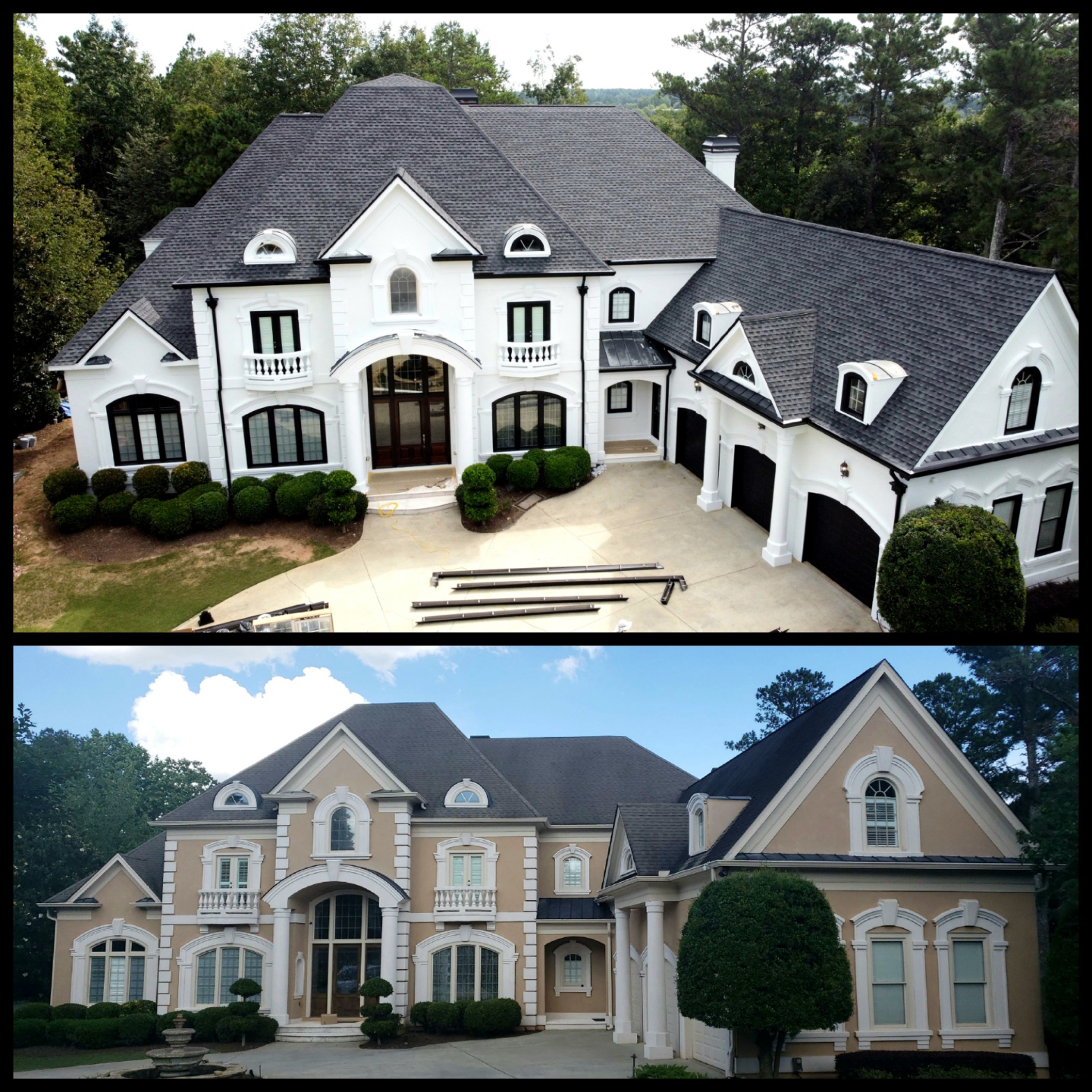
Building inspectors in Fulton County and Gwinnett County check nail depth by lifting shingle tabs during final inspection. They look for consistent flush placement across the field. Inconsistent depth signals a miscalibrated nailer or an inexperienced crew. At 1 Source Roofing, we calibrate pneumatic nailers at the start of each job and recheck throughout the day as temperature and compressor conditions change. Our shingle nailing guide covers the full calibration process and common nail-depth defects.
"At 1/8 inch overdriven, a roofing nail loses 50% of its holding power. At 1/8 inch underdriven, the sealant strip cannot bond to the shingle below. Inspectors measure both."
Staples vs. Nails
Some older installations in metro Atlanta used staples instead of nails. The current IRC permits staples for asphalt shingle attachment, but with significant restrictions: minimum 16-gauge wire, minimum 1-inch crown width, and the same deck penetration requirements as nails. Most shingle manufacturers do not approve staple attachment for their warranty programs. GAF does not warranty shingles attached with staples. CertainTeed limits staple use to specific products and conditions. For these reasons, nails are the standard fastener for every shingle installation 1 Source Roofing performs.
Need Shingles Installed to Georgia Code?
1 Source Roofing is GAF Certified and CertainTeed Certified. Every shingle installation meets IRC R905.2 requirements and manufacturer specifications, backed by system warranties that depend on code-compliant workmanship.
Call (404) 277-1377Slope Requirements and Underlayment Pairing
IRC Section R905.2.2 establishes the minimum roof slope for asphalt shingle application at 2:12 (two inches of vertical rise for every twelve inches of horizontal run). Below this slope, asphalt shingles cannot be used. The code directs you to low-slope roof covering systems (built-up, modified bitumen, or single-ply membrane) for slopes under 2:12.
The slope threshold also determines underlayment requirements. The code divides asphalt shingle applications into two slope categories:
Normal Slope: 4:12 and Steeper
Roofs at 4:12 or steeper require a single layer of underlayment complying with ASTM D226 Type I (No. 15 felt), ASTM D4869 Type I, or ASTM D6757 (synthetic underlayment). The underlayment must be applied shingle-fashion, with each course overlapping the one below by at least 2 inches at horizontal laps and 4 inches at end laps. The head lap ensures water running down the underlayment cannot reach the deck through a seam.
Most homes in Buckhead, Johns Creek, and other premium Atlanta neighborhoods have roof slopes between 6:12 and 12:12. These roofs fall well within the single-layer underlayment category. The steeper slope moves water off the roof faster, reducing the time moisture sits on any surface and lowering the risk of penetration through the shingle system.
Low Slope: 2:12 to Less Than 4:12
Roofs between 2:12 and 4:12 require enhanced underlayment protection. The code offers two options:
- Double-layer felt: Two layers of ASTM D226 Type I felt applied in a specific pattern. The first course is a 19-inch starter strip. Each subsequent course is 36 inches wide with a 19-inch head lap, producing two layers of felt across the entire roof surface.
- Self-adhered modified bitumen: A single layer of self-adhering polymer-modified bitumen sheet (ice and water shield) applied across the entire roof surface. This creates a continuous waterproof membrane under the shingles.
Low-slope sections appear on many Atlanta homes as porch roofs, additions, dormers, and transitions between building masses. Your contractor must identify these areas during the pre-installation survey and plan the appropriate underlayment system. A single layer of felt on a 3:12 porch roof violates code, even if the main roof at 8:12 uses single-layer underlayment. Our underlayment requirements guide covers the full specification for each slope category.
| Roof Slope | Shingle Permitted? | Underlayment Requirement | Common in Metro Atlanta |
|---|---|---|---|
| Less than 2:12 | No | N/A (use low-slope system) | Flat commercial sections, some porches |
| 2:12 to 3.99:12 | Yes | Double-layer felt or full ice & water shield | Porch roofs, dormers, additions |
| 4:12 to 6:12 | Yes | Single-layer felt or synthetic | Ranch homes, some colonial designs |
| 7:12 and steeper | Yes | Single-layer felt or synthetic | Traditional, craftsman, Tudor styles |
Georgia's adopted code also references R905.1.1 for general underlayment requirements that apply regardless of slope. See our roof underlayment code page for the complete specification, including attachment methods, product standards, and the distinction between synthetic and felt products.
Algae Resistance and Product Standards
Every asphalt shingle installed on a Georgia roof must comply with ASTM D3462, "Standard Specification for Asphalt Shingles Made from Glass Felt and Surfaced with Mineral Granules." This standard sets minimum performance thresholds for physical properties that determine how a shingle performs over its service life.
ASTM D3462 Performance Requirements
ASTM D3462 tests and rates shingles across several categories:
- Tear resistance: The force required to propagate a tear in the shingle mat. Higher tear resistance means the shingle better resists wind damage and mechanical stress during installation.
- Tensile strength: The force required to pull the shingle apart. This affects the shingle's ability to maintain structural integrity under wind uplift and thermal cycling.
- Granule adhesion: The percentage of granules that remain bonded to the shingle surface after standardized abrasion testing. Granule loss exposes the asphalt mat to UV degradation and accelerates aging.
- Self-sealing: The shingle's ability to bond to adjacent shingle courses through a factory-applied sealant strip activated by solar heat. Proper self-sealing is the primary defense against wind-driven rain infiltration.
ASTM D3462 compliance is printed on every bundle of code-compliant shingles. GAF Timberline HDZ, CertainTeed Landmark, Owens Corning Duration, and IKO Cambridge all carry ASTM D3462 certification. If a shingle product does not list ASTM D3462 compliance on its packaging, it cannot be installed on a Georgia residential roof.
ASTM D7158: Wind Resistance Standard
Separate from D3462, ASTM D7158 tests the wind uplift resistance of sealed asphalt shingles using a mechanical uplift device. This test produces the Class D, G, or H ratings referenced in IRC Table R905.2.4.1. A shingle that meets ASTM D3462 does not automatically meet ASTM D7158 at any particular class level. Both standards must be satisfied independently.
Algae Resistance in Georgia's Climate
Georgia's combination of high humidity, warm temperatures, and frequent rainfall creates ideal conditions for Gloeocapsa magma, the blue-green algae that produces dark streaks on asphalt shingle roofs. The IRC does not mandate algae-resistant shingles. This is a product selection decision, not a code requirement. But the practical reality in metro Atlanta makes algae resistance a near-necessity.
Algae-resistant shingles incorporate copper or zinc granules into the surface blend. As rainwater contacts these granules, it releases trace amounts of metal ions that inhibit algae colonization. The algae resistance designation carries an "AR" suffix in manufacturer product names and documentation. GAF's StainGuard Plus technology uses copper-containing granules to provide 25-year algae protection. CertainTeed's StreakFighter technology provides similar protection.
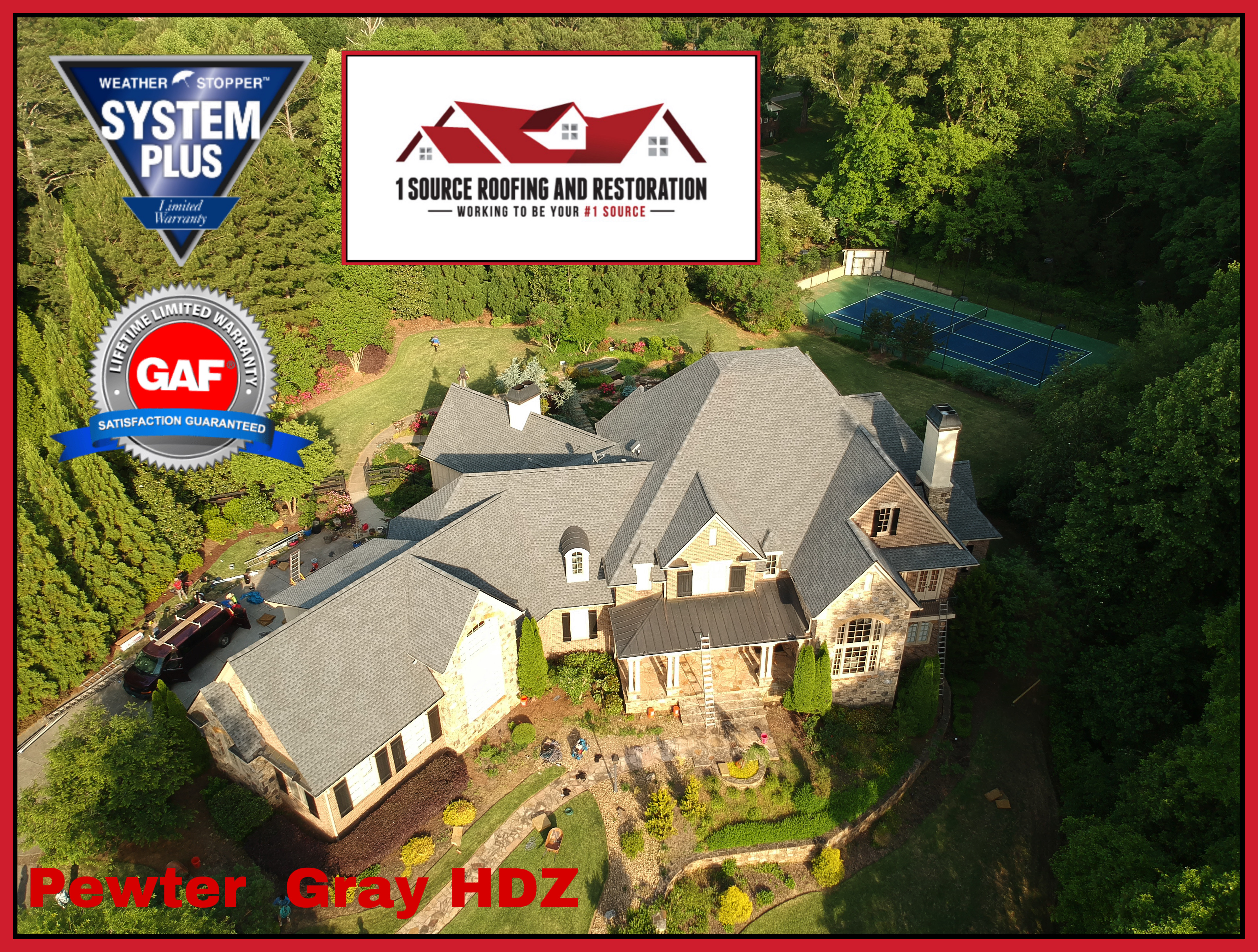
For homes in tree-covered neighborhoods throughout Roswell, Alpharetta, and Sandy Springs, algae resistance is a practical requirement. North-facing roof slopes and areas shaded by mature hardwoods are the first surfaces to show algae staining. Choosing a shingle with algae resistance at the time of roof replacement eliminates a maintenance headache for the life of the roof.
Fire Classification: ASTM E108
The IRC requires roof coverings to meet fire classification standards under ASTM E108. Asphalt shingles carry Class A, B, or C fire ratings. Class A provides the highest fire resistance. Georgia jurisdictions in the wildland-urban interface may require Class A roof coverings. Most asphalt shingles sold through major distributors carry Class A fire ratings. GAF Timberline HDZ and CertainTeed Landmark both carry UL Class A listings.
How 1 Source Installs to Code in Metro Atlanta
Every roof replacement and roof repair that 1 Source Roofing performs meets or exceeds the requirements of IRC R905.2. But meeting code is only part of the job. We also follow manufacturer installation specifications that trigger full system warranty coverage from GAF and CertainTeed.
Pre-Installation Code Review
Before any materials arrive at your property, our project manager reviews the applicable code requirements for your specific jurisdiction. This includes confirming the design wind speed for your site, identifying low-slope sections that require enhanced underlayment, checking for local amendments that exceed the IRC baseline, and verifying that the selected shingle product carries the required ASTM ratings for your location.
We pull permits for every project that requires one. In Alpharetta, Sandy Springs, Johns Creek, Roswell, Marietta, and throughout the 30-mile radius we serve, we maintain active business licenses and know each jurisdiction's permit process. The permit protects you by ensuring an independent inspector verifies our work meets code.
Material Verification
On delivery day, our crew verifies that every component matches the project specification. Shingle bundles carry lot numbers and ASTM certification stamps. Underlayment rolls carry product identification that confirms ASTM D226, D4869, D6757, or the applicable synthetic standard. Flashing material carries gauge stamps. Ridge vent carries airflow ratings. Nothing goes on your roof without verification that it meets the code standard for its application.
Installation Execution
Our crews follow the nailing patterns, overlap dimensions, flashing details, and application sequences specified by both the IRC and the manufacturer. We use pneumatic nailers calibrated for flush nail-head depth. We maintain the manufacturer's nailing zone placement. We apply starter strips, drip edge, and valley treatment according to the sequences specified in R905.2.8 and the manufacturer's technical bulletins.
On low-slope sections (2:12 to 4:12), we install the required double-layer underlayment or full ice and water shield. On standard slopes, we install synthetic underlayment with the correct horizontal and end-lap overlaps. At valleys, we follow the open or closed valley method specified in the project plan, with the ice and water shield extending 36 inches wide centered on the valley line.
Post-Installation Inspection
After installation, we schedule the final building inspection with the local jurisdiction. Our project manager meets the inspector on site. If the inspector raises any items, we address them before closing the permit. We do not leave permits open. A closed permit with a passed inspection is your documentation that the roof meets code, and it protects your insurance coverage and resale position.
"A closed permit with a passed inspection documents that your roof meets Georgia building code. It protects your insurance coverage and supports resale."
For homeowners in Buckhead, Johns Creek, and other premium neighborhoods, code compliance intersects with property value. A roof on a $2 million home needs more than visual appeal. It needs a passed inspection, an active manufacturer warranty, and documentation that supports future insurance claims and property transactions. That is what a code-compliant installation delivers, and it is the standard for every 1 Source Roofing project.
Asphalt Shingle Code Requirements: Frequently Asked Questions
Common questions about Georgia's asphalt shingle installation standards, wind ratings, and fastener requirements.
What code section governs asphalt shingle installation in Georgia?
IRC Section R905.2 governs asphalt shingle installation in Georgia. This section covers slope requirements, underlayment pairing, fastener specifications, wind resistance classifications, and application methods. Georgia adopts the IRC through the Department of Community Affairs with state-specific amendments, and local jurisdictions enforce it through their building departments.
How many nails per shingle does Georgia code require?
Standard installations in Georgia require four nails per shingle strip, placed within the manufacturer's designated nailing zone. In high-wind areas or when the design wind speed exceeds 120 mph, the code requires six nails per shingle. Both GAF and CertainTeed publish specific nailing zone diagrams for their products. Nails must be minimum 12-gauge with 3/8-inch heads and must penetrate the roof deck by at least 3/4 inch.
What is the minimum roof slope for asphalt shingles in Georgia?
The minimum slope for asphalt shingles under IRC R905.2 is 2:12 (two inches of rise per twelve inches of horizontal run). Roofs between 2:12 and 4:12 require double-layer underlayment or a single layer of self-adhered modified bitumen sheet as additional weather protection. Roofs at 4:12 or steeper use standard single-layer underlayment.
Do shingles in Georgia need algae resistance ratings?
Georgia code does not mandate algae-resistant shingles, but the state's high humidity and warm climate make algae growth a persistent problem. Most major manufacturers incorporate copper-infused granules in their standard product lines to resist algae staining. Choosing shingles that meet ASTM D3462 with algae resistance protects both appearance and resale value in metro Atlanta's climate.
Related Building Code and Technical Guides
These pages cover related code requirements and technical installation standards for Georgia residential roofing:
- Georgia Residential Roofing Code Guide:Complete overview of IRC Chapter 9, permits, and inspections
- Roof Underlayment Code Requirements:IRC R905.1 underlayment standards, synthetic vs. felt, attachment methods
- Wind Speed Requirements for Georgia Roofs:ASCE 7 wind maps, exposure categories, uplift calculations
- Roof Ventilation Code Requirements:IRC R806 ventilation ratios and methods
- Roof Slope Minimum Requirements:Slope thresholds for all roof covering types
- Shingle Nailing Installation Guide:Manufacturer nailing zones, depth calibration, common defects
- Underlayment and Ice Dam Protection:Product selection, application methods, manufacturer requirements
- Drip Edge Installation Guide:Profile types, eave vs. rake sequencing, code requirements
- Technical Standards Library:Complete index of roofing technical resources
Questions about shingle code requirements for your home? Call 1 Source Roofing at (404) 277-1377 for a free roof inspection and code compliance evaluation.