Atlanta homeowners considering solar face a choice that gets framed too simply. The common version sounds like "panels or shingles, pick one." The real decision is more useful than that, because the answer turns less on the energy technology and more on the condition of your roof, the look you want from the street, and how long you plan to own the home.
Solar shingles and solar panels both convert sunlight into electricity using photovoltaic cells. That is where the similarity ends. One is a roofing product that happens to generate power. The other is a power-generating product mounted onto a roof someone else installed. That distinction drives every meaningful difference in cost, durability, appearance, and how the system interacts with the rest of your roof over its life.
This guide walks through both systems the way a roofing contractor sees them — not as a solar salesperson, but as the company responsible for the surface everything attaches to. We install and replace roofs across metro Atlanta every week, and we are the ones called when a panel array starts leaking at the mounts or when a roof needs replacement and a five-year-old solar system has to come off first. That perspective matters, because the roof is the part of a solar decision that is easiest to get wrong.
1. How Solar Shingles and Solar Panels Actually Differ
A traditional solar panel is a rigid module — usually around 40 by 70 inches — built from photovoltaic cells laminated under tempered glass and framed in aluminum. The panels mount on rails that bolt into your roof framing through the shingles. The array sits a few inches above the roof surface, which is intentional: that air gap helps the panels shed heat and run more efficiently. A typical Atlanta home installs 18 to 30 panels depending on energy use.
A solar shingle is a roofing product. It replaces a portion of your shingle field with photovoltaic tiles that lie flat in the same plane as the surrounding shingles and lock into the roof the way conventional shingles do. From the street, a well-installed solar shingle roof reads as a slightly darker, more uniform section of an otherwise normal roof. There is no rack, no gap, no separate hardware silhouette. The roof is the solar system.
The practical consequence of this design difference shows up everywhere downstream. Panels are a bolt-on system you can add to an existing roof, remove, relocate, or upgrade independently. Solar shingles are a permanent part of the roof assembly — installed when the roof is installed, warrantied as one system, and replaced when the roof is replaced. Neither approach is universally better. They solve the same problem in fundamentally different ways, and the better fit depends on your specific home.
2. The Cost Comparison: What Atlanta Homeowners Actually Pay
The honest headline is that traditional panels cost less per watt of installed capacity than solar shingles, and the gap is substantial. For the same energy output, a solar shingle roof generally runs two to three times the installed figure of a comparable panel array. That premium buys aesthetics and integration, not more electricity.
The table below frames typical metro Atlanta project ranges for a home targeting roughly 8 kilowatts of solar capacity — enough to offset a large share of a typical household's electricity use. These figures reflect installed systems including inverters and standard interconnection, before any federal tax credit is applied.
| Factor | Traditional Solar Panels | Solar Shingles |
|---|---|---|
| Typical installed range (8 kW, Atlanta) | $22,000–$32,000 | $45,000–$70,000+ |
| Includes new roof? | No — roof installed separately | Yes — roof and solar are one system |
| Appearance | Rack-mounted, raised above roof | Flush, integrated, low profile |
| Roof penetrations | Dozens of racking bolts | Minimal — installs as roof field |
| Energy output per dollar | Higher | Lower |
| Best fit | Sound roof with 15+ years left | Roof due for replacement; aesthetics priority |
One adjustment changes this comparison significantly: if your roof is already due for replacement, the comparison is no longer "panels vs shingles." It becomes "new roof plus panels vs solar shingles." When you fold the cost of a premium roof replacement into the panel option, the gap between the two systems narrows considerably. That is the single most important framing for any Atlanta homeowner whose roof is past the midpoint of its life.
3. Your Roof Condition Decides More Than the Solar Brand
This is the part solar salespeople rarely lead with, and it is the part that matters most to your wallet over the next two decades. Solar panels last 25 to 30 years. An asphalt shingle roof in Georgia lasts roughly 22 to 26 years. If you bolt a 25-year solar array onto a 12-year-old roof, those timelines collide.
When the roof reaches end of life under an existing panel array, the panels must be detached, the roof torn off and replaced, and the panels reinstalled. In metro Atlanta, that detach-and-reset cycle commonly runs $3,000 to $6,000 on top of the roof replacement itself — money spent purely because the two systems were installed on mismatched timelines. Homeowners who skip a roof evaluation before going solar are the ones who pay this bill later.
The professional sequence is straightforward. Before any solar installation, the roof gets a thorough condition assessment — deck soundness, remaining shingle life, ventilation adequacy, and flashing integrity. If the roof has 15 or more years of reliable service ahead, panels on the existing roof are reasonable. If the roof is closer to end of life, replace it first, then install solar on a fresh, warrantied substrate. This is exactly the kind of evaluation a structural assessment is built to provide.
Never install solar on a roof you would not trust for the next 20 years. The solar system will outlive a tired roof, and removing an array to replace the shingles underneath is one of the most avoidable expenses in residential solar. A roof condition assessment before solar is the single best money-saving step you can take.
4. Durability and Georgia's Storm Reality
Metro Atlanta sees its share of severe weather — spring hail events, summer wind, and the remnants of Gulf systems that push heavy rain and gusts inland. Both solar systems are engineered for it, but they behave differently when the sky turns.
Quality solar shingles carry impact ratings comparable to Class 4 impact-resistant shingles and wind ratings up to 130 mph, which exceeds the design wind speeds for most of the metro area. Because they install flat in the roof plane, there is no raised array for wind to grab and no rack hardware to work loose over years of thermal cycling. Traditional panels are tempered-glass units tested against one-inch hail at roughly 50 mph and are mechanically fastened to the framing, so they stay put in high wind — but the array's raised profile does create wind loading the roof structure has to carry.
The storm-related risk that homeowners underestimate is not the solar hardware itself — it is the penetrations. Every racking bolt on a panel array passes through the shingles and into the framing. Each one is a potential leak path, and in a climate with 50 inches of annual rainfall and wind-driven rain events, sloppy flashing at those mounts is a recurring source of the leaks we get called to repair. When the flashing is done correctly with proper sealant and counter-flashing, panels stay watertight for decades. When it is rushed by an installer focused on the electrical work, water finds the gap. Solar shingles sidestep most of this because they integrate into the roof field rather than puncturing it. This is precisely why roof repair calls on solar homes so often trace back to mounting hardware rather than the modules.
5. Aesthetics and Curb Appeal on Premium Atlanta Homes
For a meaningful share of the homeowners we work with in Buckhead, Alpharetta, and the estate neighborhoods of Johns Creek, appearance is not a secondary concern. It is the deciding factor. A roofline is a major architectural element on a high-end home, and a rack-mounted panel array — however efficient — changes that line.
Solar shingles were created largely to answer this objection. From the curb, an integrated solar roof looks like a roof. The photovoltaic section reads as a slightly darker, more uniform field, and on the right home that uniformity can look intentional and refined rather than utilitarian. For buyers who want the energy and carbon benefits of solar without the visual signature of equipment bolted to their home, shingles are often the only option they will accept.
Panels have improved on this front. All-black modules with hidden frames and skirts that conceal the under-array gap look far cleaner than the blue-cell, silver-frame panels of a decade ago. A thoughtfully designed panel layout that respects the roof's symmetry can look sharp. But it still reads as equipment on a roof, not as the roof itself. If your priority is a roofline that gives nothing away, solar shingles win that comparison decisively.
Planning Solar? Start With the Roof
Free on-site assessment of roof condition, ventilation, and solar readiness — before you commit to any system. We tell you straight whether to replace first.
Call (404) 277-13776. Energy Production: Which System Generates More Power?
Per square foot of active surface, traditional panels generally edge out solar shingles in conversion efficiency. The reason is partly the air gap. Panels mounted on rails sit a few inches above the roof, and that ventilation keeps cell temperatures down. Photovoltaic cells lose efficiency as they heat up, and in Atlanta's summer — where roof surface temperatures push well past 140°F — that cooling matters. Solar shingles lie flat against the roof and run hotter, which trims output during the hottest hours.
That said, the efficiency gap has narrowed as solar shingle technology has matured, and total system output depends far more on usable roof area, orientation, and shading than on the per-module rating. A south-facing Atlanta roof with minimal tree shading will produce strongly with either system. A roof broken up by dormers, valleys, and chimneys offers less contiguous area, which can favor shingles for filling in irregular sections that panels cannot easily cover.
For the typical metro Atlanta household, both systems can be sized to offset the majority of annual electricity use. The decision rarely comes down to a few percentage points of efficiency. It comes down to cost per watt, roof condition, and appearance — which is why those factors dominate this guide.
7. Installation: Why a Roofer Belongs at the Table
Solar installation is sold as an electrical project, and the electrical work genuinely requires a licensed solar contractor. But the part that determines whether your roof leaks in five years is roofing work, and it is frequently the weakest link in a panel installation handled by a solar-only company.
When panels go onto an existing roof, every mounting point has to be flashed the way any roof penetration is flashed — with the right base flashing, sealant rated for the exposure, and integration into the shingle courses so water sheds over the penetration rather than into it. A roofing professional does this work in their sleep. A solar crew focused on rails and wiring may treat it as an afterthought, and the result shows up as a stain on a ceiling the next spring. This is the same discipline that governs step and reglet flashing at any roof-to-wall transition.
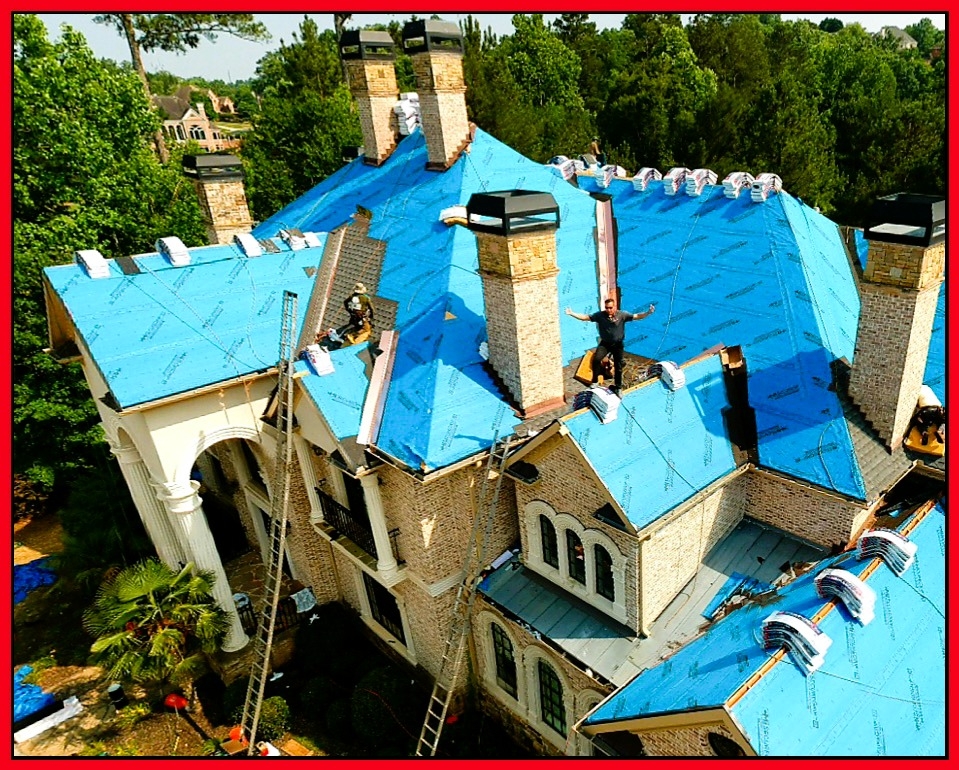
Solar shingles change the staffing entirely. Because the product is a roofing material, the roof installation is the project, with the electrical interconnection handled by a qualified partner. The roofing crew controls the weatherproofing of the entire surface, which removes the coordination gap where panel installations so often fail. The underlayment, the flashing, the ventilation, and the solar tiles are all installed as one continuous assembly — the same standard we hold on every synthetic underlayment and shingle system we build.
8. Ventilation, Heat, and Georgia's Climate
Any solar system you put on a Georgia roof has to coexist with one of the harshest thermal environments in the Southeast. Attic temperatures in metro Atlanta routinely exceed 130°F in midsummer, and a roof assembly that cannot shed that heat shortens the life of everything attached to it — shingles, decking, and now solar cells.
This is where balanced ventilation becomes part of the solar conversation. A roof with proper intake at the soffits and exhaust at the ridge keeps the deck cooler, which protects the roofing material warranty and helps solar cells run more efficiently. Adding solar to a poorly ventilated roof compounds an existing problem. Before any solar project, the ventilation system deserves the same scrutiny as the deck — a principle we cover in our guide to balanced ridge and soffit ventilation.
Solar shingles, lying flat against a hot roof, are more sensitive to deck temperature than rack-mounted panels with their cooling air gap. That makes ventilation upgrades especially worthwhile on a solar shingle project. For homeowners pairing solar with energy efficiency goals, the combination of a well-ventilated attic, reflective or cool-roof shingle technology on non-solar sections, and properly sized solar can deliver compounding returns on Atlanta's brutal cooling bills.
9. Incentives, Warranties, and the Federal Tax Credit
Both systems qualify for the federal residential clean energy credit, which covers a significant percentage of the installed cost of a qualifying solar system. With solar shingles, the integrated roofing-and-solar product means a larger share of the project can count toward the credit basis than the simple roof-replacement portion of a panel project — though the specifics depend on current tax rules and your situation, so confirm with a tax professional. The credit materially changes the net cost of either system and should factor into any comparison.
Warranties differ in structure. Traditional panels carry separate warranties — typically 25 years on power output from the module manufacturer, with the inverter and workmanship covered under their own terms. The roof beneath them keeps its own shingle warranty, provided the mounting penetrations were installed to specification. Solar shingles are warrantied as a single system, with power-output and weatherproofing coverage typically running 25 years or more, matching a premium architectural shingle roof.
Improperly flashed panel mounts can compromise your roof warranty. Many shingle manufacturers will deny a warranty claim if leaks trace to penetrations they did not authorize. Coordinating solar mounting with a roofing professional — not a solar installer working alone — protects both the roof and the warranty that backs it.
10. Resale Value and Long-Term Ownership
Solar adds value to a home, but the type of system and how it was installed shape how much. Buyers increasingly view solar as a feature, particularly in metro Atlanta's energy-conscious markets. A clean, well-documented installation with transferable warranties reads as an asset. A poorly mounted array with visible roof staining or expired warranties reads as a liability and a future repair.
Solar shingles tend to present well at resale precisely because they look like a high-end roof rather than aftermarket equipment. The integration that costs more upfront pays back partly in how the home shows. For panels, the resale story hinges on documentation: production records, warranty transfers, and proof that the roof beneath the array has life left. A buyer's inspector will flag a panel array sitting on an aging roof, and that finding can complicate a sale the same way unpermitted work does.
For homeowners planning to stay in the home for the long term — the profile of most estate owners in Sandy Springs and Roswell — the calculus favors getting the roof and solar timelines aligned from the start, whether through solar shingles or through panels installed on a freshly replaced roof. The worst outcome financially is a solar system installed on a roof that fails first.
11. Which System Is Right for Your Atlanta Home?
The decision resolves cleanly once you answer three questions about your specific situation, in this order.
First: is your roof due for replacement? If your shingles are past the midpoint of their life, you are effectively choosing between a new roof plus panels or solar shingles — and that comparison is far closer than the raw per-watt numbers suggest. If your roof is young and sound, panels on the existing roof become the value-driven choice because you avoid paying for roofing you do not need.
Second: how much does appearance matter? If a clean, equipment-free roofline is a genuine priority — common on high-end homes and in HOA-governed communities that restrict visible equipment — solar shingles may be the only option that satisfies the requirement. If you are comfortable with a well-designed all-black panel array, panels deliver more energy for the money.
Third: how long will you own the home? Long-term owners benefit most from aligning roof and solar lifespans so they never pay to remove and reset an array. Shorter-horizon owners may favor the lower upfront cost of panels, accepting that the next owner inherits the timeline question. For a closer look at the broader decision of whether to replace at all, our guide on roof repair versus replacement walks through the same end-of-life math that drives solar timing.
There is no universal winner. There is a right answer for your roof, your home's appearance, and your ownership plans — and it becomes obvious once a roofing professional has stood on your roof and assessed its condition honestly.
12. How 1 Source Approaches a Solar-Ready Roof
We are not a solar installer, and we will not pretend otherwise. What we are is the roofing company that makes solar succeed or fail — because the roof is the foundation every solar decision rests on. Our role is to get that foundation right before a single panel or solar tile goes up.
It starts with a free on-site assessment of roof condition. We measure the roof, evaluate remaining shingle life, inspect the deck for moisture damage and soft spots, assess the ventilation system, and review the flashing details. From that, we tell you plainly whether your roof can carry a 25-year solar system or whether replacement should come first. If your roof has life left, we identify the right mounting and flashing approach so a solar crew's penetrations stay watertight for the life of the array.
When replacement is the right call, we install a premium architectural shingle roof built to outlast the solar system going on top of it — with proper underlayment, balanced ventilation, and flashing done to manufacturer specification so the roof warranty stays intact. For homeowners choosing integrated solar shingles, we handle the roofing side of the system as the certified roofing professionals the product requires, coordinating the electrical interconnection with a qualified partner.
Across metro Atlanta — from Marietta to the estate neighborhoods inside the perimeter — our standard does not change: thorough assessment, honest counsel about timing, and installation that protects the most expensive surface on your home. Learn more about our approach on the why choose 1 Source page, or browse completed work in our photo gallery. The free assessment starts everything, with no obligation and no pressure to buy a system you do not need.
Get a Straight Answer on Your Solar-Ready Roof
Roof condition, ventilation, and solar readiness — assessed before you commit to any system. Serving Atlanta, Buckhead, Alpharetta, and all of metro Atlanta.
(404) 277-1377 — No ObligationCertified by Industry-Leading Manufacturers