Most homeowners picture a roof as the surface they can see from the street: shingles, ridge lines, the occasional skylight or chimney. That picture stops at the deck. The part of the roof that actually controls how comfortable your home feels in August, how high your power bill runs, and how many years your shingles survive is the part you almost never look at — the attic directly beneath them.
The roof and the attic are not two separate things that happen to sit on top of each other. They are a single thermal and moisture system. Air moves between them constantly. Heat pushes down from the deck into the attic and from the attic into your bedrooms. Moisture rises out of the living space, collects against cold or hot surfaces, and decides whether your decking stays sound or starts to rot. When a roofing company treats the shingles in isolation and ignores what is happening eight inches below them, the homeowner ends up paying for a roof that ages faster than it should and a house that never quite gets comfortable upstairs.
This guide explains how the attic-and-roof system works in Georgia's specific climate, what goes wrong when one part is neglected, and how the three levers that control the whole system — air sealing, ventilation, and insulation — fit together. By the end you will understand why a hot upstairs is rarely an air conditioning problem, why ventilation protects your warranty, and why the smartest time to fix all of it is when the roof comes off.
1. Why the Attic and Roof Behave as a Single System
Heat and moisture do not respect the boundary between your roof deck and your attic. When the Georgia sun bakes a dark shingle roof, the deck below it can reach 160 degrees or more. That heat radiates into the attic air. From there it has two paths: out through ventilation, or down through the ceiling into your living space. If the ventilation path is blocked or undersized, the only path left is into your house. This is the chain that turns a roofing question into a comfort question.
The reverse happens in reverse seasons. Warm, humid air from showers, cooking, and simply breathing rises out of the living space through every gap in the ceiling — recessed light cans, the attic hatch, plumbing chases, top plates. In an attic that cannot exhaust that moisture, it condenses against the underside of the deck on cooler nights. Over time, that condensation cycle delaminates plywood, corrodes fasteners, and feeds mold. The homeowner sees a roof leak and assumes the shingles failed, when the water actually came from inside the house.
Because heat and moisture flow continuously across this boundary, you cannot solve a problem on one side by working only on the other. A homeowner who replaces an air conditioner to fight a hot upstairs has done nothing about the 150-degree attic feeding that heat downward. A contractor who installs premium shingles over a clogged ventilation system has built a roof that will overheat from below and age prematurely no matter how good the materials are. The system has to be addressed as a whole.
2. What Georgia's Climate Does to an Attic
Metro Atlanta presents a specific and demanding set of conditions. Summers are long, with sustained heat indexes between 95 and 110 degrees from June through September. Humidity is high almost year-round — the air carries a heavy moisture load even in the cooler months. Rainfall averages around 50 inches a year, and the region sees frequent wind-driven rain and periodic hail. Winters are mild but punctuated by cold snaps that create brief but real temperature swings across the roof assembly.
This climate punishes both ends of the attic system. The heat load is the obvious one: a Georgia attic spends months at temperatures that would be illegal to expose a worker to indoors. That heat soaks into the framing, the insulation, and the back of the shingles. Asphalt shingles installed over a chronically overheated deck shed their protective oils faster, become brittle sooner, and curl earlier than the same shingles on a cooler roof.
The humidity is the underrated threat. Because Georgia air holds so much moisture, an attic that cannot breathe accumulates dampness that never fully clears. That standing humidity is what feeds the wood rot, the fastener corrosion, and the musty smell homeowners notice when they open the attic hatch. Unlike northern climates where the enemy is ice damming, Atlanta's attic enemy is the relentless combination of heat and humidity working together to degrade everything in the assembly. The defense against both is the same: move that hot, wet air out and keep it moving.
3. The Three Levers: Air Sealing, Ventilation, Insulation
Every attic system is controlled by three mechanisms, and they have to be addressed in the right order. Homeowners often hear about only one of them — usually insulation, because it is the easiest to sell by the inch — and end up with an attic that still does not perform because the other two were skipped.
Air sealing comes first. This means closing the gaps in the ceiling plane where conditioned air escapes upward and humid air leaks into the attic: penetrations around wiring, plumbing, recessed lights, the attic access, and the seams where walls meet the ceiling. Air leakage bypasses insulation entirely, so sealing it is the highest-value step and the one most often neglected.
Ventilation comes second. With the ceiling plane sealed, the attic itself needs to exhaust heat and any residual moisture. Balanced ventilation means roughly equal intake at the soffits and exhaust at the ridge, so air flows continuously up the underside of the deck and out the top. Our companion guide on balanced ridge and soffit ventilation explains why intake and exhaust must be matched rather than simply maximized.
Insulation comes third. With air leaks sealed and the attic ventilating properly, insulation slows the heat that still wants to cross the ceiling plane. Insulation added before the first two steps can actually make things worse — deep insulation over leaky, poorly vented framing traps the very moisture that causes rot and mold.
Order matters more than product. Seal the ceiling plane first, ventilate second, insulate third. A contractor who leads with "just add more insulation" is selling a product, not solving the system. The most common attic failures we find in Atlanta homes come from skipping air sealing and ventilation, then burying the problem under fresh insulation.
4. How Balanced Ventilation Protects the Whole Roof
Ventilation is the part of the attic system most directly tied to the roof's lifespan, and it is the part most often installed incorrectly. The principle is simple: cool outdoor air enters low, at the soffits along the eaves, and hot attic air exits high, at the ridge. Because hot air rises and the ridge is the highest point, this creates a natural convective current that pulls a continuous stream of air across the underside of the deck.
The word that matters is balanced. Exhaust capacity at the ridge cannot exceed intake capacity at the soffits, or the system starves. When a contractor cuts in a long ridge vent but the soffit intakes are painted shut, blocked by insulation, or never existed, the ridge vent has nowhere to draw air from. It then pulls makeup air from the path of least resistance — often down through gaps in the ceiling, dragging conditioned air out of the house. The homeowner gets a roof that looks properly vented and a power bill that says otherwise.
Done correctly, balanced ventilation keeps the deck near outdoor temperature, which directly extends shingle life and protects the manufacturer warranty. It also clears the humidity that would otherwise condense against the deck. This is why a quality roof replacement always includes a ventilation evaluation — installing premium shingles over a broken ventilation system wastes the materials and forfeits the warranty.
5. Comparing Attic Ventilation Strategies
Not every roof can use the same ventilation approach, and the right choice depends on the roofline, the attic geometry, and whether the attic is vented or designed as a sealed conditioned space. The comparison below covers the strategies we evaluate on Atlanta homes.
| Strategy | How It Works | Best Suited For | Key Limitation |
|---|---|---|---|
| Ridge + Soffit (Balanced) | Continuous intake at eaves, continuous exhaust at the ridge | Most Atlanta homes with a usable ridge and open soffits | Requires matched intake; fails if soffits are blocked |
| Static Box / Turtle Vents | Individual roof-mounted exhaust vents near the ridge | Rooflines with limited continuous ridge length | Less even airflow than continuous ridge venting |
| Gable Vents | Vents in the end walls of the attic | Older homes; supplemental cross-flow | Can short-circuit ridge venting if mixed improperly |
| Powered / Solar Attic Fans | Mechanical exhaust driven by a fan | Hard-to-ventilate geometries; specific retrofits | Can depressurize the attic and pull conditioned air up |
| Unvented (Conditioned) Attic | Insulation at the roofline; attic inside the building envelope | Homes with HVAC equipment or ductwork in the attic | Requires spray foam or rigid insulation and careful design |
For most metro Atlanta homes, balanced ridge-and-soffit ventilation is the standard and the best performer. The unvented conditioned-attic approach has become more common on high-end homes where the HVAC system and ductwork live in the attic, since bringing that space inside the building envelope stops the cooling system from fighting a 150-degree environment. Each home's correct strategy comes out of the assessment, not a one-size template.
6. How Much Insulation a Georgia Attic Actually Needs
Atlanta falls in climate zone 3 under the International Energy Conservation Code. For attics, that translates to a target of roughly R-38 to R-49, which is about 13 to 18 inches of blown fiberglass or cellulose depending on the material's R-value per inch. New construction and major upgrades are built to this standard. The problem is that a large share of metro Atlanta's housing stock predates it.
Homes built in the 1980s and 1990s were commonly insulated to R-19 or R-30. Decades later, that insulation has settled, compressed, shifted away from the eaves, and in some cases been disturbed by every HVAC tech, electrician, and pest-control visit since. The labeled R-value on the original installation is rarely what the attic actually delivers today. We routinely measure effective insulation values well below the original spec in homes that have never been touched.
Depth is necessary but not sufficient. Insulation only works against conduction — heat trying to creep across a solid barrier. It does nothing against air leakage, which is convection: air physically moving through gaps carries far more heat than slowly conducts across a surface. This is why a home with deep insulation can still feel hot and run a high bill if the ceiling plane is full of unsealed penetrations. The insulation is doing its job; the air leaking around it is undoing that job faster than the insulation can keep up. Effective attic performance is depth plus air sealing, never one alone.
Find Out How Your Attic Is Performing
Free on-site assessment of your roof and attic as one system. We document ventilation, insulation depth, air leakage, and deck condition before recommending anything.
Call (404) 277-13777. The Step Almost Everyone Skips: Air Sealing the Ceiling Plane
If there is one part of the attic system that gets ignored more than any other, it is air sealing. It is invisible, unglamorous, and easy to leave out of a proposal. It is also the single highest-value improvement in most Atlanta attics, because it addresses the convective heat and moisture transfer that insulation cannot touch.
The ceiling between your living space and the attic is full of holes you never think about. Every recessed light fixture is a chimney of warm air. The attic access hatch is usually an uninsulated, unsealed panel. Plumbing vent stacks, wiring penetrations, bathroom exhaust fans, the chase behind a fireplace, and the top plates of interior walls all leak air continuously. In a typical home, these gaps add up to the equivalent of leaving a window open year-round.
Air sealing closes those gaps with fire-rated caulk, foam, gaskets, and sealed covers before insulation is placed on top. The payoff is double: in summer, conditioned air stops escaping into the attic and humid attic air stops leaking down; in winter, the same seal keeps heated air in the house and household moisture out of the attic where it would otherwise condense against the deck. Air sealing is what turns a pile of insulation into an actual thermal barrier — and it is why the assessment of an attic should always start with finding the leaks, not measuring the inches.
8. Radiant Heat and Reflective Strategies
There is a layer of attic heat control that sits above insulation and ventilation: managing the radiant energy that comes straight off the hot underside of the deck. Insulation slows conduction and ventilation moves air, but neither directly stops the deck from radiating heat downward like a stovetop. That is where radiant barriers and reflective approaches come in.
A radiant barrier is a reflective foil surface, usually applied to the underside of the roof deck or laid over the attic floor, that reflects radiant heat rather than absorbing and re-emitting it. In Georgia's intense summer sun, a properly installed radiant barrier can drop peak attic temperatures by 20 to 30 degrees, which directly reduces the heat load on the ceiling below. We cover the specifics in our guide to radiant barriers in Georgia attics, and there is an integrated option that builds the barrier into the deck itself, explained in radiant barrier roof decking.
Reflective strategy can also start at the shingle. Cool-roof and reflective shingle products reject a larger share of solar radiation before it ever reaches the deck, lowering the heat that the attic system then has to manage. For homeowners weighing that option, our article on reflective shingles for Georgia walks through the trade-offs. None of these reflective measures replace ventilation and insulation — they layer on top of a sound system to cut the radiant component of the heat load.
9. Moisture, Condensation, and Hidden Deck Rot
Heat gets the attention because you can feel it. Moisture does the quiet, expensive damage. In Georgia's humid climate, an attic that cannot exhaust water vapor becomes a slow-motion rot machine, and the homeowner usually does not find out until the damage is structural.
The mechanism is condensation. Warm, moist air from the living space rises into the attic through the leaks described earlier. When that humid air contacts a surface cooler than its dew point — often the underside of the deck on a clear night, or roofing nails that conduct outdoor cold — the moisture condenses into liquid water. Drop by drop, that water saturates the plywood or OSB deck, corrodes the fasteners holding the shingles, and creates the dark, damp conditions mold needs to colonize.
The damage looks exactly like a roof leak from inside the house: stained decking, dripping nails, musty odor, sometimes a water spot on a bedroom ceiling. Many homeowners spend money chasing a phantom roof leak when the water is condensing out of their own indoor air. The fix is not more sealant on the shingles — it is closing the ceiling air leaks that let the moisture up and restoring ventilation that carries it out. When deck rot is already advanced, that decking has to be replaced, which is far more involved than addressing the system before the damage spreads. Our overview of water damage restoration covers what happens when moisture has already done its work.
A "roof leak" with no storm damage is often an attic moisture problem. If you see deck staining, rusting nail heads, or a musty attic with no missing shingles, the water is likely condensing out of your indoor air — and sealing and ventilating the attic, not patching the shingles, is the real fix. Catching it early means replacing nothing; ignoring it means replacing decking.
10. When Your HVAC Lives in the Attic
A large share of metro Atlanta homes put the air handler and the ductwork in the attic. This is a building practice that makes the attic system even more consequential, because the cooling equipment is now sitting inside the harshest environment in the house.
Consider what that means in July. The air handler and ducts are surrounded by 150-degree air while trying to deliver 55-degree conditioned air to the rooms below. Every foot of duct in that superheated space gains heat through its walls, so the air that finally reaches the upstairs registers is warmer than it left the unit. Any leak in the ductwork — and attic ducts leak frequently — either dumps expensive cooled air into the attic or sucks scorching attic air into the supply. The cooling system runs longer, costs more, and still leaves the upstairs warm.
This is the scenario where an unvented, conditioned attic often makes the most sense. By moving the insulation to the roofline and bringing the attic inside the building envelope, the equipment and ducts operate in a near-conditioned space instead of an oven. For homes that keep a traditional vented attic, the priorities are aggressive duct sealing, insulated ducts, and the strongest possible ventilation to knock down the temperature the equipment has to fight. Either way, the attic system and the HVAC system are intertwined, and improving one without considering the other leaves savings on the table.
11. How Attic Performance Affects Your Roof Warranty
Homeowners who invest in premium shingles assume the manufacturer's extended warranty has them covered for decades. What many do not realize is that those warranties carry conditions, and attic ventilation is one of the most important. The major manufacturers — GAF and CertainTeed among them — specify code-compliant intake and exhaust ventilation as a requirement for their strongest coverage.
The logic is straightforward from the manufacturer's side. A shingle baked from below by a chronically overheated, unventilated attic ages on a timeline the warranty was never written for. So the warranty language requires balanced ventilation, and if an inspector determines that inadequate ventilation contributed to premature shingle failure, the claim can be denied. The homeowner paid for a 50-year shingle and a 50-year promise, then lost the promise to a ventilation deficiency they never knew existed. Our pages on GAF certification and why homeowners choose 1 Source explain how proper installation protects that coverage.
This is the practical reason ventilation cannot be an afterthought. It is not only about comfort and energy — it is the condition that keeps your material warranty enforceable. A roofing contractor who installs shingles without verifying the ventilation system is exposing the homeowner to a warranty they may never be able to collect on. Treating the attic and roof as one system protects the investment on both ends.
12. The Best Time to Fix the System: During a Roof Replacement
All of these improvements — air sealing, ventilation upgrades, insulation, radiant barriers — can be done as standalone retrofits. But there is one window when they are dramatically easier, more effective, and more economical to address together, and that is during a roof replacement.
When the old roof comes off, the deck is exposed and the underside of the roof becomes accessible in ways it never is during normal living. Ridge ventilation can be cut in or upgraded along the full length of the ridge. Soffit intakes can be opened, cleared, and protected with baffles that keep insulation from blocking them. A radiant barrier can be integrated into the deck. Deck rot from past moisture problems can be found and replaced while everything is open. And the attic improvements can be coordinated so the homeowner is not paying separate mobilization and access costs for each one later.
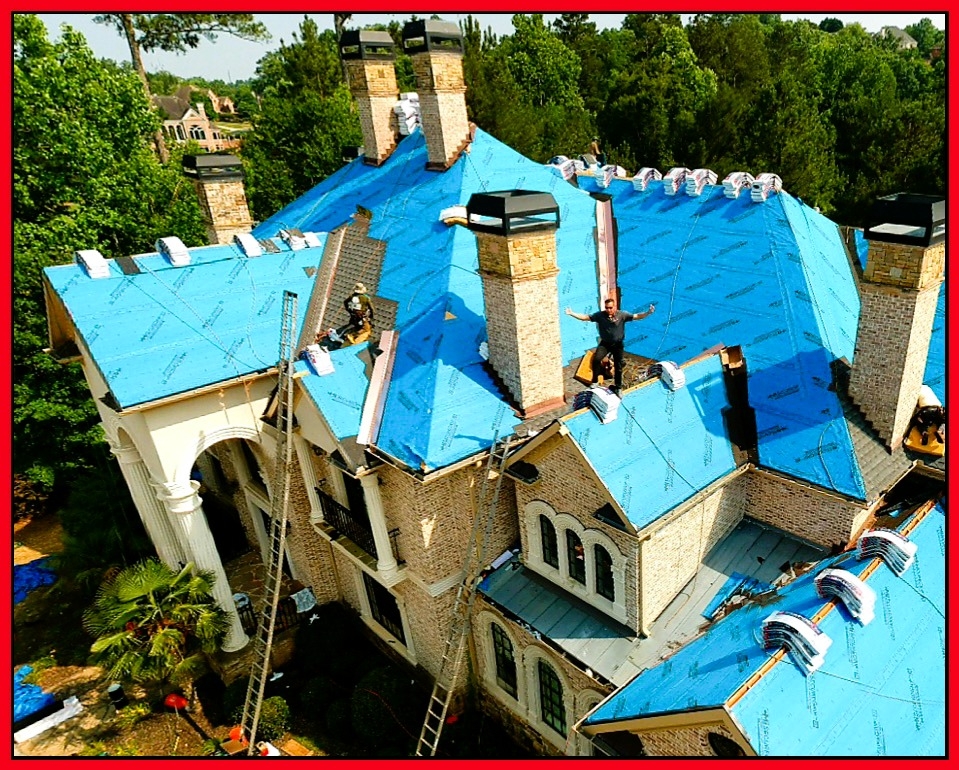
This is also the moment to coordinate the roof system with related details that affect attic performance and moisture control — proper drip edge, ice and water shield at the eaves and valleys, and synthetic underlayment that breathes correctly. For Atlanta homeowners in neighborhoods like Alpharetta, Sandy Springs, and Johns Creek, where homes are large and attics are substantial, getting the whole system right during a single project delivers comfort and energy savings the homeowner feels for the life of the roof.
13. How 1 Source Evaluates Your Attic and Roof Together
The reason attic problems persist is that they fall in the gap between trades. The roofer looks at shingles, the HVAC contractor looks at equipment, the insulation crew looks at depth, and nobody looks at the system. 1 Source approaches the roof and attic as the single system they are, which is the only way to actually solve comfort, energy, and durability problems instead of moving them around.
Our free on-site assessment documents the attic alongside the roof. We measure existing insulation depth and condition, identify the major ceiling-plane air leaks, evaluate whether intake and exhaust ventilation are present and balanced, check the deck for moisture staining and rot, and note whether HVAC equipment in the attic is adding to the load. The result is a written picture of how the system is performing and where it is failing — not a sales pitch for a single product.
From there we recommend the improvements that deliver the most benefit for your specific home, in the correct order, and we coordinate them with any roof work so you are not paying twice for access. Whether the right answer is a ventilation correction, an air-sealing and insulation upgrade, a radiant barrier, or a full system overhaul during a replacement, the recommendation is built on what the assessment actually found. You can explore more on our blog and resource library or reach out through the contact page to get started.
Schedule Your Free Attic & Roof Assessment
Insulation depth, air leakage, ventilation balance, and deck condition documented as one system — before any commitment. Serving Atlanta, Buckhead, Roswell, and all of metro Atlanta.
(404) 277-1377 — No ObligationCertified by Industry-Leading Manufacturers