
Copper Roofing Code in Georgia
Copper is the premium roofing material for Atlanta's luxury homes. This guide covers the IRC and ASTM standards that govern copper roofing in Georgia, including thickness requirements, seam specifications, expansion joints, dissimilar metal isolation, and where copper delivers the highest return on investment.
Certified by Industry-Leading Manufacturers
IRC R905.10 and ASTM B370: The Code Framework for Copper Roofing
IRC Section R905.10 governs metal roof panels, including copper. Georgia adopts this section through the Department of Community Affairs. The code references ASTM B370, "Standard Specification for Copper Sheet and Strip for Building Construction," as the material standard that copper roofing products must meet.
ASTM B370 specifies the alloy composition (C11000, electrolytic tough pitch copper, 99.9% pure), the temper designations (cold-rolled or soft), and the weight classes that define minimum thickness. The standard uses an ounce-per-square-foot weight designation that is unique to copper in the building trades. A "16 oz" copper sheet weighs 16 ounces per square foot and measures approximately 0.0216 inches thick. A "20 oz" sheet weighs 20 ounces per square foot and measures approximately 0.027 inches.
The IRC requires that copper roofing panels meet the ASTM B370 specification and that the installation comply with the manufacturer's instructions and accepted engineering practice. Georgia adds no state-level amendment that modifies the copper roofing section. The code applies uniformly across metro Atlanta, from Buckhead to Alpharetta to Marietta.
Copper roofing also falls under the general provisions of IRC R905.1 (weather protection), R905.10.2 (deck requirements), and R903.2 (flashing at wall intersections and penetrations). The flashing code requirements apply to copper the same way they apply to any other roofing material, with the added consideration that copper flashing must not contact dissimilar metals.
For the broader framework of Georgia's residential roofing code, see our Georgia residential roofing code guide.
Copper Thickness Requirements: 16 oz vs. 20 oz
The copper weight designation tells you the thickness and, by extension, the durability and forming characteristics of the material. Two weight classes dominate residential copper roofing in metro Atlanta: 16 oz and 20 oz.
16 oz Copper (0.0216 inches)
The minimum specification for standing seam copper roofing panels. At 16 oz, the copper is thick enough to form standing seam profiles, resist wind uplift in Georgia's 115 mph design wind zone, and withstand the thermal cycling that metro Atlanta's temperature range imposes (20 to 100 degrees F annual range). Most standing seam copper roof panels on residential homes in Sandy Springs and Johns Creek use 16 oz copper.
20 oz Copper (0.027 inches)
The industry standard for flat seam copper roofing (soldered joints) and the preferred specification for high-traffic areas, complex geometries, and applications where the copper must span between supports without deflection. The heavier gauge provides better resistance to hail impact, foot traffic during maintenance, and the stress of thermal expansion and contraction. Flat seam applications require 20 oz because the soldering process demands a thicker substrate for consistent joint integrity.
24 oz Copper (0.0323 inches)
Used on commercial applications and on residential structures with spans exceeding manufacturer recommendations for 20 oz material. Rare on typical residential roofing in metro Atlanta but specified on large-format panels, flat roof sections, and architectural features where maximum rigidity is required.
| Weight Class | Thickness (inches) | Weight (psf) | Primary Application | Typical Lifespan |
|---|---|---|---|---|
| 16 oz | 0.0216 | 1.0 lb | Standing seam panels, flashing, gutters | 75-100+ years |
| 20 oz | 0.027 | 1.25 lb | Flat seam, soldered panels, high-traffic areas | 100+ years |
| 24 oz | 0.0323 | 1.5 lb | Large-format panels, commercial, wide spans | 100+ years |
A key advantage of copper roofing is its weight. At 1.0 to 1.5 pounds per square foot, copper is lighter than asphalt shingles (2.5 to 4.5 psf), concrete tiles (9 to 12 psf), and slate (7 to 10 psf). This light weight means copper roofing requires no structural reinforcement on standard residential framing. The existing roof structure that supports asphalt shingles can support copper without modification.
"Copper weighs less than asphalt shingles and lasts four times longer. The material outlives the structure it protects."
Standing Seam vs. Flat Seam: Copper Joint Requirements
The seam type determines how copper panels connect to each other and how the roof handles water at the joints. Georgia code does not mandate a specific seam type, but ASTM B370 and the Copper Development Association (CDA) guidelines establish the performance requirements that each seam type must meet.
Standing Seam
Standing seam copper uses a raised vertical joint (the "seam") that connects adjacent panels. The seam stands 1 to 2 inches above the roof surface, which keeps the joint well above the water line on the roof. Standing seam joints are mechanically locked (folded) using either a single-lock or double-lock profile.
Single-lock standing seams fold the panel edges together once. This profile works on roof pitches of 3:12 and steeper where water does not pond at the seam. Double-lock standing seams fold the edges twice, creating a more weather-resistant joint that performs on pitches as low as 1/2:12. The double-lock is the standard specification for Georgia homes because it handles the state's heavy rainfall without relying on sealant at the joint.
The seam-locking process uses a hand seamer or mechanical seaming tool. The tool folds the copper edges into a tight, interlocking profile that resists wind uplift and water penetration. No solder is required on standing seam joints because the mechanical lock provides the seal. This makes standing seam installation faster than flat seam work and avoids the fire risk of soldering on the roof surface.
Flat Seam (Soldered)
Flat seam copper uses soldered joints where panel edges overlap and are bonded with 50/50 tin-lead solder or lead-free alternatives. The flat profile sits flush with the roof surface, creating a smooth, continuous appearance. Flat seam copper is the specification for low-slope applications (below 3:12), curved surfaces, and complex geometries where standing seam panels cannot follow the shape.
Soldering requires a clean copper surface (fluxed), a heated soldering iron, and 20 oz minimum copper thickness. The solder flows into the joint by capillary action and creates a watertight bond. Every joint must be soldered on both the top and bottom edges. The soldering process takes more time than mechanical seaming and requires a skilled metalworker. The result is a roof surface with no raised seams and a monolithic appearance that develops uniform patina over time.
Expansion Joints: Managing Copper's Thermal Movement
Copper has a coefficient of thermal expansion of 9.8 x 10^-6 inches per inch per degree Fahrenheit. In practical terms, a 20-foot copper panel exposed to metro Atlanta's 80-degree temperature swing (from 20 F in January to 100 F in July) expands and contracts approximately 0.19 inches in length. Over a 10-foot panel width, the movement is approximately 0.094 inches.
This movement is significant. A copper roof installed tight on a hot summer day will buckle on a cold winter night if the panel has no room to expand and contract. Conversely, a panel installed tight in winter will pull its fasteners in summer. The installation must accommodate thermal movement through three design strategies.
Floating Clip Systems
Standing seam copper panels attach to the roof deck through clips that hold the panel at the seam but allow the panel to slide along its length. The clip grips the panel's standing seam flange while a fixed leg fastens to the deck. As the panel expands, it slides through the clip. The clip holds the panel in position laterally while allowing longitudinal movement. Fixed clips (one per panel) anchor the panel at one end, and sliding clips accommodate movement along the rest of the panel length.
Expansion Joints
On long roof runs (exceeding 30 feet), a transverse expansion joint breaks the panel into segments that move independently. The expansion joint is a raised profile (similar to a standing seam but wider) that allows adjacent panel segments to expand toward each other without buckling. CDA guidelines recommend an expansion joint for every 30 feet of panel run in climates with temperature swings exceeding 100 degrees F. Metro Atlanta's climate falls below this threshold on most days, but sustained roof surface temperatures (which can exceed 160 F in summer) create the conditions that trigger the expansion joint requirement.
Fastening Pattern
Copper panels are never face-nailed. All fastening occurs through concealed clips or cleats. Face nails would restrict thermal movement and create leak points at every penetration. The clip spacing depends on the wind zone (metro Atlanta's 115 mph design wind speed), the panel width, and the copper weight class. Typical clip spacing for 16 oz standing seam copper in metro Atlanta is 12 inches on center.
Our team calculates the thermal movement for every copper roofing project and selects the clip system, expansion joint placement, and fastening pattern that accommodates the full temperature range. The calculation accounts for the specific panel length, the copper weight, and the orientation (south-facing panels experience higher surface temperatures than north-facing panels). For wind load requirements that affect clip spacing, see our wind speed requirements guide.
Considering Copper for Your Roof or Accent?
1 Source Roofing installs standing seam and flat seam copper roofing on premium homes across metro Atlanta. We handle the material specification, thermal calculations, and flashing integration for a watertight, code-compliant installation.
Call (404) 277-1377Dissimilar Metal Isolation: Preventing Galvanic Corrosion
Copper sits high on the galvanic series, which means it acts as the cathode (protected metal) when in contact with less noble metals like aluminum, galvanized steel, and zinc. The less noble metal corrodes at an accelerated rate at the contact point, not the copper. This galvanic corrosion can eat through aluminum gutter hangers, galvanized drip edge, and steel fasteners in a fraction of their normal lifespan.
Common Contact Points to Watch
- Copper roof panels meeting galvanized drip edge: If the drip edge is galvanized steel and the roof panels are copper, the drip edge corrodes where the two metals touch. The solution: use copper drip edge with a copper roof.
- Copper gutters with aluminum hangers: The aluminum hanger corrodes at the contact point with the copper gutter. Replace with copper or stainless steel hangers.
- Copper flashing touching galvanized step flashing: At the transition between a copper accent roof and an asphalt shingle main roof, the flashing materials must either match or use an isolation barrier.
- Copper roof runoff onto aluminum or zinc surfaces below: Copper-laden water (carrying dissolved copper ions) accelerates corrosion on aluminum surfaces it contacts downstream. A copper roof above an aluminum gutter destroys the gutter from the inside.
Isolation Methods
The code and ASTM standards require separation between copper and dissimilar metals. Accepted isolation methods include:
- Matching metals: Use copper for all components that contact the copper roof: copper drip edge, copper gutters, copper hangers, copper fasteners (or stainless steel).
- Barrier strips: Insert a non-conductive material (rubber, plastic, or bituminous tape) between the copper and the other metal at every contact point.
- Stainless steel fasteners: Stainless steel (304 or 316 grade) is compatible with copper in the galvanic series. Use stainless steel screws, clips, and connectors where copper contacts the fastening system.
| Metal Combination | Galvanic Risk | Required Action |
|---|---|---|
| Copper + aluminum | High (aluminum corrodes) | Isolate or replace aluminum with copper/stainless |
| Copper + galvanized steel | High (zinc coating corrodes, then steel) | Isolate or replace with copper |
| Copper + stainless steel | Low (compatible) | Direct contact acceptable |
| Copper + lead | Low (compatible) | Direct contact acceptable |
| Copper runoff + aluminum gutter | High (dissolved copper destroys aluminum) | Use copper gutter or intercept runoff |
Patina Development: Copper's Natural Protective Layer
New copper roofing installs as a bright, polished surface that catches sunlight and stands out against the surrounding roofscape. Within weeks, the copper begins to darken. Within months, it turns a chocolate brown. Within 7 to 15 years in Georgia's climate, the characteristic green patina (verdigris) develops across the surface.
The patina is copper carbonate, formed through the reaction of copper with moisture, oxygen, and carbon dioxide in the atmosphere. Georgia's humid subtropical climate, with its high moisture content and warm temperatures, accelerates patina formation compared to arid climates. South-facing surfaces develop patina faster than north-facing surfaces because higher surface temperatures speed the chemical reaction.
Patina and Performance
The patina does not degrade the copper. It protects it. The copper carbonate layer acts as a barrier between the atmosphere and the base metal, slowing further oxidation to a negligible rate. This self-protecting characteristic is why copper roofing lasts 75 to 100+ years. The material does not corrode through like galvanized steel (where the zinc coating eventually depletes) or aluminum (which pits in certain environments). The patina thickens over decades and becomes the permanent surface of the roof.
Appearance Control
Homeowners who prefer the green patina from day one can specify pre-patinated copper. Chemical treatments applied in the factory or on-site accelerate the patina formation to produce the green color at installation. Conversely, homeowners who prefer the bright copper appearance can apply a clear lacquer coating that delays (but does not prevent) patina formation for 2 to 5 years. Most homeowners in Buckhead and Sandy Springs allow the patina to develop naturally, as the gradual color transition is part of the material's architectural character.
"Copper does not wear out. It transforms. The patina that gives old copper its color is the same layer that makes it last a century."
Where Copper Roofing Delivers the Highest Value in Metro Atlanta
Copper roofing costs 3 to 5 times more than premium asphalt shingles per square foot installed. The material justifies its cost in specific applications where its lifespan, weight, and architectural impact outperform alternatives.
Accent Roofs and Architectural Features
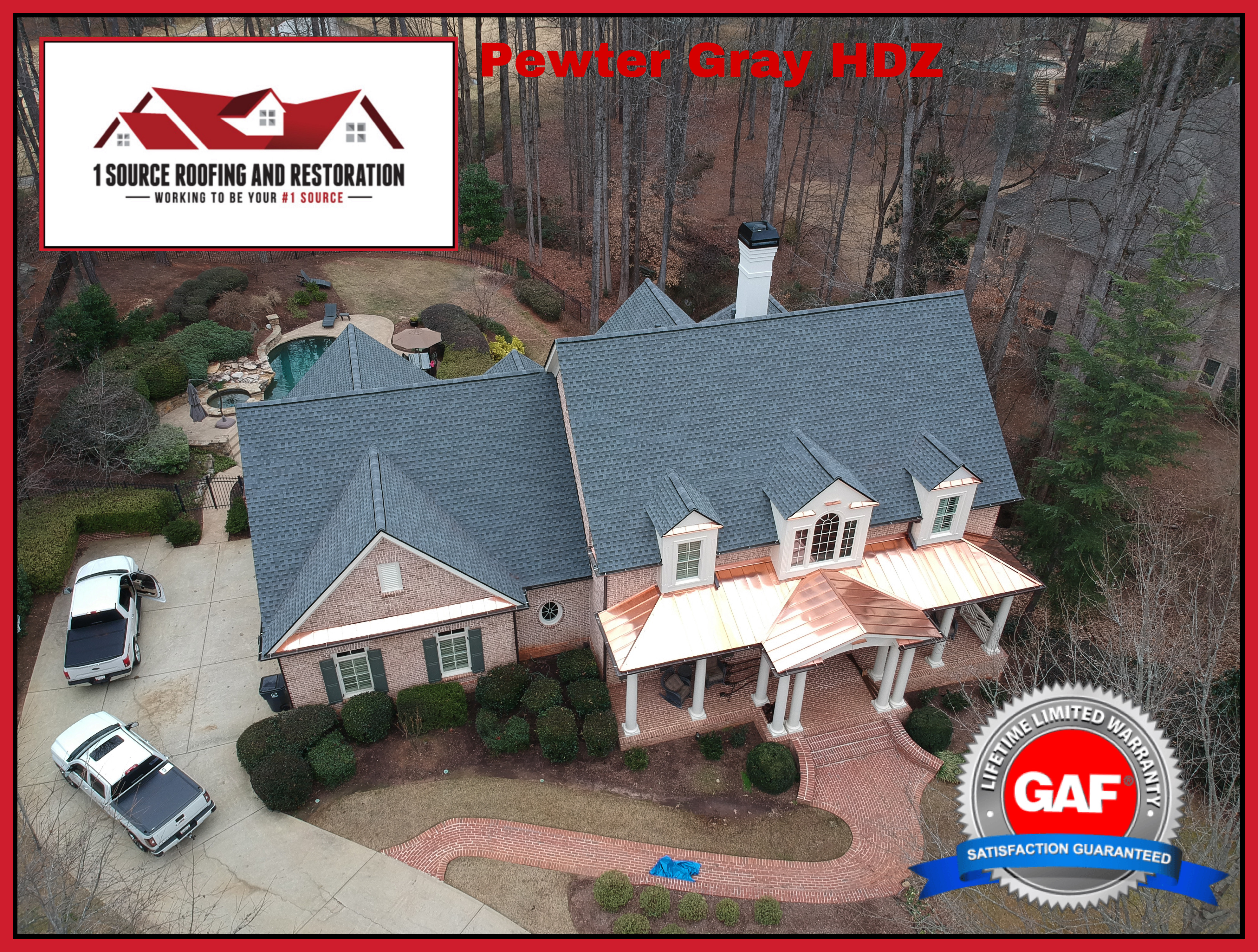
The most common residential copper roofing application in metro Atlanta covers accent areas rather than the entire roof. Bay windows, dormers, turrets, porticos, entry canopies, and curved roof sections receive copper panels while the main roof uses asphalt shingles or another material. This approach delivers the visual impact and durability of copper at a fraction of the full-roof cost. Homes in Buckhead and Johns Creek use this strategy to distinguish the roofline and elevate the home's architectural presence.
Copper Flashing: The Gold Standard
Copper is the premium flashing material for chimney flashing, kickout flashing, valley flashing, and roof-to-wall transitions. A copper flashing installation paired with a premium asphalt shingle roof gives the homeowner the durability of copper at the most vulnerable points (flashings outlast shingles in most cases) without the full-roof copper cost. Our team specifies copper flashing on projects where the homeowner wants maximum durability at penetrations and transitions.
Full Copper Roof on Smaller Structures
Pool houses, guest cottages, detached garages, and carriage houses in metro Atlanta's premium neighborhoods receive full copper roofing. These smaller structures have roof areas of 500 to 2,000 square feet, which keeps the total material cost manageable. The copper roof on a smaller structure outlasts multiple shingle replacements on the main house, eliminating the maintenance cycle entirely for that structure.
Value Proposition
Copper roofing delivers value through longevity. An asphalt shingle roof lasts 20 to 30 years. Over a 100-year horizon, the homeowner (or successive homeowners) replaces the shingle roof 3 to 5 times. Each replacement costs $15,000 to $40,000 on a metro Atlanta luxury home. The copper roof, installed once, costs $40,000 to $80,000 for the same area and requires no replacement within the 100-year period. The total cost of ownership favors copper on any structure the homeowner intends to maintain for decades.
For the chimney cricket applications where copper provides superior durability, and for the drip edge specifications that include copper as the premium option, see our related code guides.
.JPG)
Copper Roofing Code: Frequently Asked Questions
Answers to common questions about copper roofing standards, materials, and applications in Georgia.
What thickness of copper does Georgia code require for roofing?
IRC R905.10 references ASTM B370 for copper roofing specifications. The minimum thickness for standing seam copper roofing is 16 oz per square foot (approximately 0.0216 inches). For flat seam copper roofing (soldered joints on low-slope applications), the minimum is 16 oz, though 20 oz (0.027 inches) is the industry standard for superior durability and soldering performance. The weight designation refers to the weight of one square foot of copper sheet at the specified thickness.
Does copper roofing develop patina and does it affect performance?
Yes, copper develops a green patina (verdigris) through natural oxidation. The process takes 7 to 15 years in Georgia's humid climate. The patina is a protective layer of copper carbonate that shields the underlying metal from further corrosion. It does not affect the roofing performance. The patina is one of the reasons copper roofing lasts 75 to 100+ years. The color progression moves from bright copper to dark brown to the characteristic green, though the exact timeline varies with exposure, rainfall, and air chemistry.
Can copper roofing contact other metals without corroding?
No. Copper in direct contact with dissimilar metals such as aluminum, galvanized steel, or zinc creates galvanic corrosion. The less noble metal (aluminum or steel) corrodes at an accelerated rate at the contact point. Georgia code and ASTM standards require isolation between copper and other metals using separation strips, compatible sealants, or barrier materials. Copper gutters with aluminum hangers, or copper flashing touching galvanized drip edge, are common violation points.
Where is copper roofing most common in metro Atlanta?
Copper roofing is most common on high-end residential homes in Buckhead, Sandy Springs, Johns Creek, and Alpharetta. It appears as full roof coverage on smaller structures (bay windows, dormers, turrets, porticos) and as accent panels on larger homes. Copper also serves as the premium flashing material at chimneys, valleys, and roof-to-wall transitions throughout metro Atlanta. The material's cost positions it in the luxury market where homeowners specify premium materials for both performance and architectural distinction.