

Roof Flashing Repair in Johns Creek, GA
Manufacturer-specification flashing repair for Johns Creek's most architecturally complex homes. Stucco, stone, and multi-plane roofline expertise.
Certified by Industry-Leading Manufacturers
Why Johns Creek's Luxury Homes Are Prone to Flashing Failures
Johns Creek is defined by its gated communities of custom-built luxury homes — Country Club of the South, St. Ives, River Club, Rivermont — neighborhoods where homes routinely exceed 5,000 square feet and feature the kind of architectural complexity that creates dozens of flashing junctions per property. These are homes with multi-gable rooflines, shed dormers, bay window roof returns, turret-style tower elements, and multiple chimney penetrations. Every one of those architectural features creates a roof-to-wall or roof-to-penetration junction that requires flashing, and every one of those flashing junctions is a potential failure point.
The math is straightforward. A simple ranch home with a single gable roof may have 4 to 6 flashing junctions. A custom estate in Country Club of the South with intersecting gables, multiple dormers, two chimneys, and three sidewall transitions may have 15 to 20 distinct flashing points. Over a 15- to 20-year lifespan, even if each individual junction has a 95% probability of remaining watertight, the cumulative probability that at least one junction will fail increases dramatically with each additional junction. Johns Creek homes are not more poorly built than simpler homes — they simply have more points of potential failure by virtue of their architectural complexity.
The exterior cladding mix in Johns Creek compounds the challenge. Homes in St. Ives and Rivermont frequently combine stucco with stone veneer on the same facade. The transition between materials often occurs at or near a roofline intersection, which means a single flashing repair may need to address both stone integration and stucco cutting within the same project. Country Club of the South features extensive stone and brick exteriors on many of its estate homes, while newer sections include homes with Hardie board and mixed-material facades. Each cladding type demands a different flashing methodology.
The Chattahoochee River corridor that runs through Johns Creek introduces a moisture variable that accelerates flashing degradation. Homes near the river in communities like River Club and along Medlock Bridge Road experience higher ambient humidity levels, particularly in summer months. This sustained moisture exposure promotes corrosion on galvanized flashing metal and degrades sealant joints more rapidly than conditions in drier, higher-elevation neighborhoods. Flashing on river-corridor homes should be inspected more frequently as a result. Call (404) 277-1377 to schedule your inspection.
Flashing on Multi-Plane Rooflines: The Johns Creek Challenge
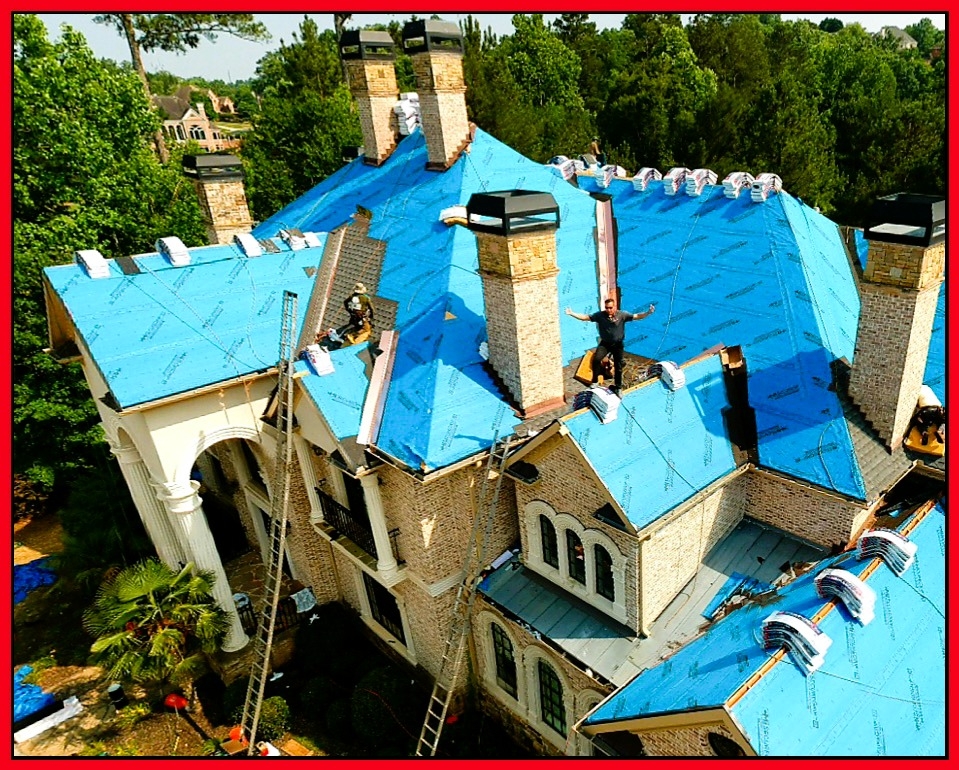
The architectural vocabulary of Johns Creek's luxury communities relies heavily on complex rooflines for visual interest and curb appeal. Intersecting gables at varying heights, hip-to-gable transitions, shed dormers, eyebrow dormers, turret elements with conical roof sections, and roof-to-wall transitions where second-story walls sit atop first-story roof planes — these are standard features on homes throughout Country Club of the South, St. Ives, and River Club. From an aesthetic standpoint, they create the commanding street presence that defines Johns Creek luxury real estate. From a roofing standpoint, they create a concentrated network of flashing requirements.
Each roof-to-roof intersection — where one plane meets another at a valley, ridge, or transition — concentrates water flow. Valleys on complex rooflines can drain the combined runoff from two or three roof planes into a single channel. If the valley flashing at that convergence is corroded, improperly lapped, or undersized for the volume it must handle, water enters beneath the shingle field. The problem is compounded on steep-pitch roofs common in Johns Creek, where water velocity through valleys is higher and the force pushing water under improperly sealed flashing edges is greater.
Dormers present a particularly concentrated flashing challenge. A single dormer has step flashing along both sides, a head wall flashing across the top, and often a small valley or transition where the dormer roof meets the main roof plane. A Johns Creek home with four or five dormers has 12 to 15 flashing points from the dormers alone. When a dormer flashing failure allows water entry, the leak path can travel along rafters and ceiling joists, causing water stains and damage far from the actual point of entry — making diagnosis difficult without a systematic inspection of all dormer junctions.
1 Source inspects every flashing junction on a Johns Creek home, not just the one where water was noticed. On homes with complex rooflines, a single reported leak often leads to discovery of developing problems at additional junctions. Addressing them as a coordinated project is more efficient and more cost-effective than returning multiple times as each junction fails independently. For a detailed look at our approach to step flashing installation, see our technical guide.
How 1 Source Repairs Flashing on Johns Creek Homes
Johns Creek's architectural complexity requires a methodical approach to flashing repair. Here is how we handle every project from the initial call through final walkthrough:
- Full-Property Flashing Audit We inspect every flashing junction on the property — all sidewall transitions, chimney surrounds, valley systems, dormers, pipe boots, and any custom penetrations. On Johns Creek homes with 15 to 20 flashing points, this audit regularly identifies issues beyond the original complaint. Drone photography captures conditions on upper-story and steep-pitch sections.
- Exterior Material Mapping We document the wall cladding at each junction: stucco, stone veneer, brick, Hardie board, or combinations. Many Johns Creek homes in St. Ives and Rivermont use two or three exterior materials on the same facade, and each material dictates the repair methodology at that specific junction.
- Insurance Documentation For storm-related damage, we create comprehensive photo documentation keyed to the storm event date. On Johns Creek properties with multiple affected junctions and mixed exterior materials, thorough documentation is essential for full claim scope approval.
- Ice & Water Shield Application GAF-specification ice and water shield extends a minimum of 5 inches up every sidewall. This step is photographed and documented as proof of manufacturer-specification compliance.
- Flashing Installation by Material Type Step flashing is woven into shingle courses. On brick and stone, counter flashing is set into reglet cuts. On stucco, controlled cuts expose the flashing layer, work is performed, and stucco is patched and finished. On Hardie board, siding is removed, flashing is installed behind the cladding, and siding is reinstalled. Kick-out flashing is installed at every step flashing termination.
- Final Inspection and Documentation A walkthrough with the homeowner confirms every repair meets performance and aesthetic standards. Written documentation with photos of each completed junction is provided for your records and any warranty purposes.
Flashing Repair by Exterior Type in Johns Creek
Stone and Stone Veneer
Full stone and stone veneer exteriors are prevalent throughout Country Club of the South, St. Ives, and many of Johns Creek's estate-class neighborhoods. Flashing integration with stone requires counter flashing set behind or between stone courses, sealed into mortar joints that may be irregular in depth and width compared to standard brick mortar. On homes where the stone was laid with thin-set adhesive rather than traditional mortar, the counter flashing methodology differs from standard masonry integration. 1 Source evaluates the stone installation method before determining the flashing approach.

Stucco Exteriors
Johns Creek homes with stucco — common in Rivermont and newer sections of River Club — face the same challenges that make stucco the highest-risk exterior for flashing failures. The stucco cannot be removed and reinstalled; it must be cut, the flashing work performed, and the stucco patched and refinished. The critical requirement is matching the existing stucco texture and color so the repair is visually seamless on the finished facade. Our stucco flashing guide details this specialized process.
Mixed-Material Facades
The most complex flashing scenarios in Johns Creek occur on homes that combine two or three exterior materials — stone below, stucco above, or brick on the front elevation with Hardie board on the sides. When a roof plane intersects a wall that transitions from one material to another, the flashing system must adapt at the transition point. A step flashing run that begins against brick, transitions to a stone section, and terminates at a stucco wall requires three different integration techniques within a single continuous flashing run. This is skilled work that demands familiarity with all three materials.
Hardie Board and Fiber Cement
Newer Johns Creek homes — particularly in recent developments along McGinnis Ferry Road and Jones Bridge Road — feature James Hardie fiber cement siding. The siding must be removed for proper step flashing installation behind the cladding. Hardie board can be carefully removed and reinstalled without damage, but it requires experience with the product's fastening system. Contractors unfamiliar with Hardie board sometimes break planks during removal, creating replacement and color-matching complications.
Need Flashing Repair on Your Johns Creek Home?
Free inspections for homeowners in Country Club of the South, St. Ives, River Club, Rivermont, and all Johns Creek communities. We inspect every flashing junction, not just the one you noticed.
Schedule Your Free InspectionIce and Water Shield: The Hidden Layer That Protects Johns Creek Homes
Beneath every properly installed step flashing, there is a layer that most homeowners never see: ice and water shield membrane. GAF specifications require this self-sealing membrane to extend a minimum of 5 inches up the sidewall at every roof-to-wall junction. The membrane creates a waterproof barrier between the metal flashing and the wall sheathing — a second line of defense that prevents water from reaching the building envelope even if the metal flashing is compromised.
On Johns Creek homes with 15 or more flashing junctions, the ice and water shield specification becomes a statistical protection. If one or two step flashing pieces lose their seal — from thermal cycling, tree debris impact, or corrosion — the membrane beneath continues to prevent water intrusion until the damaged flashing is repaired. Without adequate membrane coverage, a single failed flashing piece creates an immediate leak path to the interior.
We routinely inspect Johns Creek homes where the original ice and water shield was either omitted entirely at secondary junctions or applied with less than the required 5-inch sidewall extension. These installations may have been acceptable to the original builder's standard, but they do not meet current manufacturer specifications and they leave the home vulnerable to water intrusion at junctions where wind-driven rain pressure is highest. 1 Source applies manufacturer-specification ice and water shield on every flashing installation, measured and photographed for documentation. See our comprehensive flashing guide for more on this standard.
Flashing Damage Insurance Claims in Johns Creek
North Fulton County's storm track brings periodic hail and high-wind events through Johns Creek with enough regularity that flashing damage claims are a routine part of residential roofing service in the area. What distinguishes Johns Creek claims from simpler claims is the scope: the architectural complexity of Johns Creek homes means that storm damage to flashing rarely involves a single junction. High winds affect every exposed flashing point on the windward side of a home, and hail impacts multiple sections simultaneously.
When 1 Source documents flashing damage for a Johns Creek insurance claim, we inspect and photograph every junction — not just the one where the homeowner noticed water. On a Country Club of the South estate with 18 flashing points, the damage assessment may identify storm-related deterioration at six or seven junctions. Documenting all of them in the initial claim submission avoids the need for supplemental claims later, which adjusters and insurance companies generally view less favorably than a complete initial submission.
The exterior material scope on Johns Creek claims is often the largest cost component. Stucco cutting and patching, stone veneer repointing, Hardie board removal and reinstallation — these are legitimate repair costs that must be included in the claim scope to restore the home to pre-damage condition. Insurance may also cover painting of affected wall sections when the repair creates a visible mismatch with existing finishes. 1 Source includes all material-specific scope items in the initial documentation and attends every adjuster meeting to walk through the repair requirements in person. For more on our claims management process, see our insurance claims assistance page.
Types of Flashing Repair for Johns Creek Homes
Chimney Flashing
Johns Creek homes with masonry chimneys — common throughout Country Club of the South and St. Ives — require a complete flashing system around the chimney perimeter: base flashing, step flashing along the sides, counter flashing set into mortar joints, and a cricket on the upslope side. The cricket is particularly important on steep-pitch roofs where water and debris volume against the chimney back is concentrated. Our chimney flashing installation page details the full system.
Sidewall Step Flashing
Every roof-to-wall junction requires step flashing woven into the shingle courses with proper ice and water shield beneath. On Johns Creek homes with mixed exteriors, the step flashing run may transition between different wall materials, requiring different integration techniques at each transition. Kick-out flashing at the base of every run directs water into the gutter rather than behind the wall cladding. See our sidewall flashing page for technical details.
Valley Flashing
The multi-plane rooflines on Johns Creek estates create valley systems that handle high-volume water flow during Georgia thunderstorms. Some valleys drain the combined runoff from three or more roof planes. Corroded, improperly overlapped, or undersized valley flashing on these high-flow runs is a structural risk — not just a leak risk — because concentrated water entry can saturate and rot deck sheathing over time.
Dormer Flashing
Dormers on Johns Creek homes add architectural character, but each dormer creates step flashing junctions on both sides and a head wall flashing across the top. A home with five dormers has 15 dormer-related flashing points. When dormer flashing fails, leak paths often travel along the framing, appearing far from the actual failure point and making diagnosis without a systematic inspection unreliable.
Flashing Repair Across Johns Creek Communities
Country Club of the South
Country Club of the South is one of the premier gated communities in metro Atlanta, featuring estate homes on large lots with complex rooflines, multiple chimneys, and primarily stone and brick exteriors. Homes in this community were built over a span of decades, and many properties in the original sections are reaching the 20- to 25-year age range where comprehensive flashing evaluation is warranted. The community's HOA standards require that all exterior work be performed to high aesthetic standards — and 1 Source delivers flashing repairs that meet those standards.
St. Ives Country Club
St. Ives features luxury homes along the golf course with a mix of stone veneer, stucco, and brick exteriors. Many homes here have particularly complex rooflines with multiple dormers and intersecting gable planes designed to maximize views of the course. The flashing demands on these architecturally ambitious homes are substantial, and the junctions created by dormer arrays and multi-level rooflines require experienced crews who understand how water moves across complex roof geometries.
River Club
River Club's proximity to the Chattahoochee River and its associated green corridors introduces elevated humidity levels that accelerate flashing corrosion. The community's homes feature a range of exterior materials, and the mature tree canopy along the river corridor creates debris accumulation at flashing junctions. Regular maintenance inspections are particularly important for River Club properties.
Rivermont
Rivermont's custom homes along the river corridor represent some of Johns Creek's most architecturally distinctive properties. Mixed-material facades — stone, stucco, and Hardie board combinations — create flashing challenges that demand multi-material expertise. 1 Source has completed flashing projects on Rivermont homes that required three different flashing integration techniques within a single repair scope.
Whether your home is in a gated community or along one of Johns Creek's residential corridors, 1 Source provides manufacturer-specification flashing repair. Call (404) 277-1377 to schedule your inspection. For all our Johns Creek services, visit our Johns Creek roofing services page.
Johns Creek Homeowners on Their 1 Source Experience
"Our home has eleven dormers and two chimneys. The previous roofer patched one leak, but 1 Source inspected every single junction and found four additional areas that were starting to fail. Fixing them all at once saved us from dealing with individual leaks over the next several years."
James P. — Country Club of the South
"The stone and stucco combination on our home made flashing repair more complex than a typical job. 1 Source handled both materials seamlessly — the stucco patch is invisible and the stone repointing matches perfectly."
Linda H. — St. Ives, Johns Creek
Frequently Asked Questions About Roof Flashing Repair in Johns Creek
Answers to the questions Johns Creek homeowners ask most about flashing repair
Why do Johns Creek luxury homes have more flashing failure points than typical homes?
Johns Creek's luxury communities feature homes with complex multi-plane rooflines, multiple chimneys, numerous dormers, and extensive sidewall junctions. A typical Johns Creek estate may have 12 to 20 distinct flashing junctions compared to 4 to 6 on a simpler home. More junctions means higher probability that at least one will develop issues over a 15- to 20-year lifespan. Call (404) 277-1377 for a comprehensive inspection.
How does 1 Source handle flashing on homes with mixed stone and stucco exteriors?
Many Johns Creek homes combine stucco and stone veneer on the same structure. Stone requires counter flashing set behind the stone face, while stucco sections require cutting, flashing installation, and stucco patching. 1 Source handles both materials within the same project. Call (404) 277-1377.
Does insurance cover flashing repair on Johns Creek homes?
Storm-related flashing damage is covered under standard Georgia policies. On Johns Creek homes, claims often include stucco patching, stone repointing, and painting — increasing scope value. 1 Source attends every adjuster meeting with documentation. Call (404) 277-1377.
What is the GAF ice and water shield requirement for Johns Creek roof flashing?
GAF specifications require ice and water shield membrane to extend a minimum of 5 inches up the sidewall at every roof-to-wall junction. On Johns Creek homes with 15+ junctions, this specification provides statistical protection — even if one flashing piece fails, the membrane prevents water from reaching the building envelope until repairs are made.
How do I know if my Johns Creek home needs flashing repair?
Watch for water stains on interior walls near roofline intersections, damp attic spots along wall junctions, peeling exterior paint below the roofline, and visible rust or gaps in exposed flashing. Homes in Country Club of the South, St. Ives, and River Club that are 15+ years old are at elevated risk. Call (404) 277-1377 for a free inspection.