

Roof Flashing Repair in Alpharetta, GA
Manufacturer-specification flashing repair for Alpharetta's luxury homes. Proper ice and water shield, correct siding integration, lasting results.
Certified by Industry-Leading Manufacturers
Why Roof Flashing Fails on Alpharetta Homes
Alpharetta sits at the intersection of two roofing trends that make flashing failures particularly common: rapid residential growth and diverse exterior cladding materials. The neighborhoods along Old Milton Parkway and throughout the Windward corridor were developed over a 20-year boom that brought thousands of homes online in a compressed timeframe. Many of those homes are now reaching the 15- to 20-year mark where original flashing installations begin to deteriorate, and the problems reveal themselves in water stains, damp attic sheathing, and interior damage that homeowners often attribute to the roof surface when the actual failure point is a flashing junction.
The architectural mix in Alpharetta compounds the challenge. Drive through the Alpharetta Country Club area and you will see brick colonials, stone-front transitional builds, Hardie board farmhouses, and full stucco Mediterranean-influenced designs within a few blocks of each other. Each exterior material demands a different flashing integration approach. Brick homes allow flashing to be tucked into mortar joints through reglets. Hardie board homes require siding removal and reinstallation to properly seat step flashing behind the cladding. Stucco exteriors present the most complex scenario, because cutting into stucco to install or replace flashing requires both roofing expertise and stucco finishing skills to avoid creating a new water entry point while fixing the old one.
The newer subdivisions along GA-400 and near Avalon feature a significant percentage of homes with stucco and Hardie board exteriors. These homes look stunning when new, but the roof-to-wall junctions are the first place where water infiltration becomes a problem if the original flashing was not installed to manufacturer specification. We see this repeatedly in Alpharetta: a home that is 12 to 15 years old, showing no visible shingle damage, but developing water intrusion at a sidewall flashing point because the original installer did not run ice and water shield membrane the required distance up the wall before installing the step flashing.
GAF manufacturer specifications require ice and water shield to extend a minimum of 5 inches up the sidewall at every roof-to-wall junction. That membrane creates a waterproof barrier beneath the step flashing that prevents wind-driven rain from reaching the wall sheathing even if the metal flashing is breached. Contractors who skip this step — or who run the membrane only 2 or 3 inches up the wall — create an installation that looks correct on the surface but will fail under Georgia storm conditions. 1 Source follows manufacturer specifications without shortcuts on every flashing project in Alpharetta. Call (404) 277-1377 to schedule your free inspection.
How We Repair Roof Flashing the Right Way
Flashing repair is not a caulk-and-seal operation. When 1 Source repairs flashing on an Alpharetta home, we address the root cause of the failure rather than masking the symptom. Here is how our process works from initial contact through final inspection:
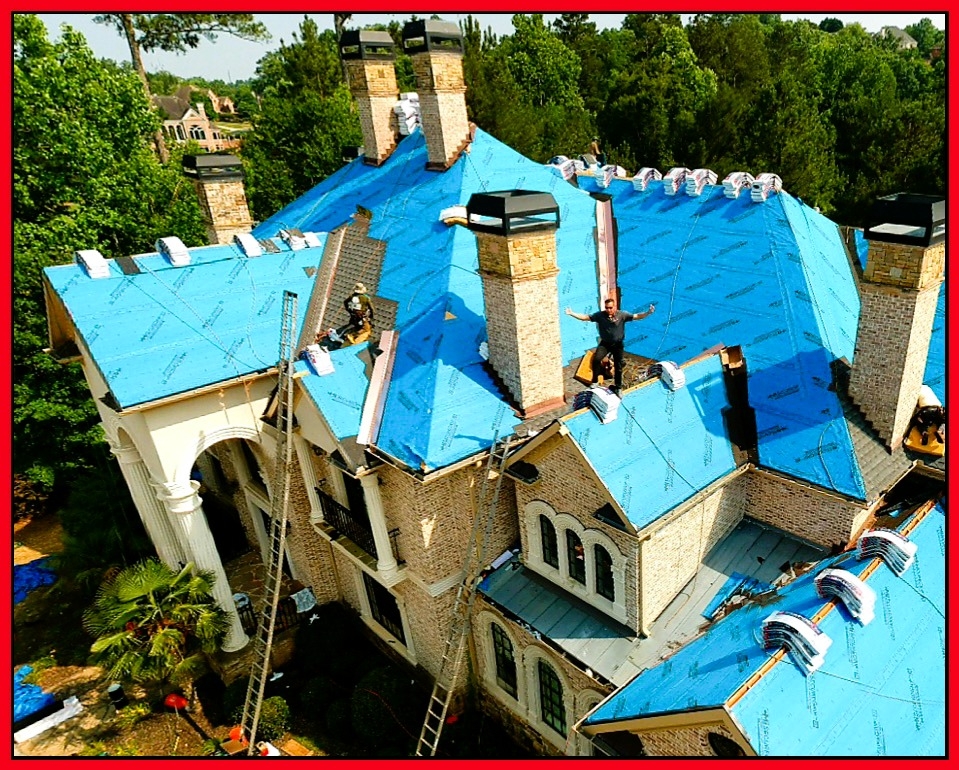
- Free Flashing Inspection We examine the entire roof-to-wall junction, chimney surrounds, and all penetration points — not just the area where you noticed water. Flashing failures at one point often indicate systemic issues at multiple junctions. We use drone photography to document conditions on steep-pitch and multi-level Alpharetta homes where ladder access is limited.
- Damage Assessment & Documentation Every area of concern is photographed and documented in a written report. If the damage qualifies as storm-related, this documentation becomes the foundation of your insurance claim. We note the exterior wall material at each junction — brick, Hardie board, stucco, or wood siding — because each material dictates the repair methodology.
- Siding Removal (When Required) On Alpharetta homes with Hardie board, vinyl, cedar shake, or other non-masonry cladding, the siding must be removed above and adjacent to the flashing repair area. Step flashing installed over the top of siding — rather than behind it — will leak. This step is not optional for a proper repair, and it is one of the most common shortcuts taken by contractors working in Alpharetta neighborhoods.
- Ice & Water Shield Application GAF-specification ice and water shield membrane is applied a minimum of 5 inches up the sidewall, extending onto the roof deck surface. This creates the waterproof underlayment that protects the junction even under wind-driven rain conditions common during Atlanta-area thunderstorms.
- Step Flashing Installation New step flashing is woven into the shingle courses and integrated with the wall cladding per manufacturer specifications. Each piece of step flashing overlaps the one below it by a minimum prescribed distance, and kick-out flashing is installed at the base of every roof-to-wall run to direct water into the gutter system rather than behind the siding.
- Siding Reinstallation & Final Inspection Removed siding is reinstalled and sealed. On stucco homes, the stucco is patched and finished to match the existing wall texture. We conduct a final walkthrough with the homeowner and provide written documentation of all work performed, materials used, and warranty terms.
Flashing Repair by Exterior Type in Alpharetta
The exterior wall material on your Alpharetta home determines how flashing repair is performed, what additional trades may be involved, and how your insurance claim will be scoped. Each material presents distinct challenges.
Brick Colonial Homes
Alpharetta's brick colonials — common in established neighborhoods near the Alpharetta Country Club and along Haynes Bridge Road — offer the most straightforward flashing integration. Step flashing tucks into reglet cuts in the mortar joint, and counter flashing is set in mortar and sealed. Brick does not need to be removed for flashing access, which reduces labor and cost compared to siding-clad homes. The primary failure point on brick homes is deteriorated mortar around counter flashing, which allows water behind the metal. Repointing the mortar joint and resetting the counter flashing typically resolves the issue without full flashing replacement.

Hardie Board and Fiber Cement Homes
Modern farmhouse and transitional designs throughout Windward, the Avalon-area developments, and newer subdivisions along Old Milton Parkway frequently feature James Hardie fiber cement siding. This material is durable, but it must be removed to access the flashing layer behind it. Hardie board planks are fastened with blind nails and can be carefully removed and reinstalled without damage when handled by a crew that has worked with the product before. The critical detail is ensuring the step flashing integrates behind the siding — not over it — so that water running down the wall face cannot reach the flashing junction.
Stucco Exteriors
Stucco homes represent the highest-risk category for flashing failures in Alpharetta. The newer subdivisions near GA-400 and throughout the Windward master plan include a significant percentage of stucco-clad homes, and stucco creates a unique problem: you cannot remove and reinstall stucco the way you can remove Hardie board planks. Flashing repair on a stucco home requires cutting into the stucco, performing the flashing work, and then patching and finishing the stucco to match the existing wall texture and color. This requires both roofing expertise and stucco finishing skills, and it increases the project scope. When storm damage necessitates this level of work, insurance policies typically cover the full scope including stucco repair and repainting of affected wall sections. 1 Source documents this scope thoroughly for your adjuster.
Cedar Shake and Wood Siding
Some of Alpharetta's established neighborhoods — particularly the older sections near downtown Alpharetta and along Rucker Road — feature cedar shake or wood lap siding. These materials require careful removal to avoid splitting and cracking. Aged cedar becomes brittle and may not survive removal intact, in which case replacement siding must be sourced and stained to match. Flashing repairs on wood-sided homes need to account for the thickness and profile of the siding material when sizing counter flashing and calculating step flashing reveal heights.
Why Proper Siding Removal Is Non-Negotiable for Flashing
The single most common shortcut in residential flashing work is installing step flashing over existing siding rather than behind it. Contractors take this shortcut because removing siding adds labor hours, requires skill with the specific cladding material, and sometimes reveals additional damage beneath the siding that expands the project scope. For the homeowner, the result of this shortcut is a flashing installation that appears complete from the exterior but has a fundamental design flaw: water running down the wall face can flow behind the step flashing and reach the roof-to-wall junction that the flashing was supposed to protect.
On Alpharetta homes — where Hardie board, vinyl, and cedar siding are prevalent on everything from homes in Windward to the newer transitional builds near downtown — this shortcut is particularly damaging. Georgia thunderstorms produce wind-driven rain that pushes water laterally across wall surfaces. Gravity alone is not the only force moving water on your exterior during a storm. Water driven by 40-mph wind gusts will find every gap, every unsealed overlap, every improperly integrated flashing joint. If the step flashing is installed over the siding rather than behind it, that wind-driven water has a direct path to the sheathing and interior wall cavity.
1 Source removes siding for every flashing repair on non-masonry Alpharetta homes. There is no exception to this practice, because there is no scenario where surface-installed flashing provides long-term protection against water intrusion. The additional labor is built into our estimates from the beginning — not discovered as a change order after work has started. When insurance is covering the repair, we document the siding removal and reinstallation scope in the initial claim submission so the adjuster approves the full cost before work begins.
When the siding removal and reinstallation is extensive enough that the repaired sections will not match the aging and weathering of the surrounding wall, insurance policies may also cover the cost of painting the affected wall to restore uniform appearance. This is a legitimate component of restoring the home to its pre-damage condition, and 1 Source includes it in the scope documentation submitted to your insurance carrier. Learn more about our approach to insurance claims assistance.
Concerned About Flashing on Your Alpharetta Home?
Free inspections for homeowners in Windward, Alpharetta Country Club, Old Milton Parkway, and all Alpharetta neighborhoods. We will tell you exactly what is happening at every roof-to-wall junction.
Schedule Your Free InspectionThe GAF Ice and Water Shield Requirement Explained
Every major shingle manufacturer publishes installation specifications that define exactly how flashing must be integrated with the roof system to maintain warranty coverage. GAF — whose products are among the most widely installed on Alpharetta homes — requires that ice and water shield membrane extend a minimum of 5 inches up the sidewall at roof-to-wall junctions before step flashing is applied. This is not a recommendation or a best practice. It is a specification, and failing to follow it voids the manufacturer warranty on the affected area of the roof.
The ice and water shield creates a self-sealing, waterproof membrane at the roof-to-wall junction. When step flashing is installed over this membrane, the junction has two layers of protection: the metal flashing that directs water down the roof surface, and the membrane beneath that prevents any water that passes the flashing from reaching the wall sheathing. Without adequate ice and water shield, the step flashing is the sole barrier — and a single point of failure at any flashing piece allows direct water contact with the wall structure.
We encounter Alpharetta homes regularly where the original flashing installation used ice and water shield, but applied it only 2 to 3 inches up the wall instead of the required 5 inches. On paper, this seems like a minor difference. In practice, it leaves exposed sheathing above the membrane and below the top of the step flashing where wind-driven rain can penetrate. The 5-inch minimum exists because manufacturers have tested the conditions under which water can bypass step flashing, and 5 inches provides the necessary safety margin for high-wind rain events.
1 Source measures and photographs ice and water shield application height on every flashing installation. This documentation is included in your project file and serves as proof of manufacturer-specification compliance if a warranty claim ever becomes necessary. For more on our flashing installation standards across metro Atlanta, see our comprehensive flashing guide.
Storm Damage, Flashing Claims, and Insurance in Alpharetta
Alpharetta is no stranger to severe weather. The storm track through North Fulton County brings hail, high winds, and fallen tree debris through Alpharetta neighborhoods with enough regularity that most long-term residents have filed at least one roofing-related insurance claim. What many homeowners do not realize is that flashing damage is often part of a larger storm damage claim, and the scope of flashing repair can significantly increase the total claim value when it is properly documented.
Wind-driven debris — branches, pine cones from the mature tree canopy in established Alpharetta neighborhoods, and displaced shingle fragments — can impact flashing at chimney surrounds, sidewall junctions, and pipe boots. High winds alone can lift and displace improperly sealed counter flashing. Hail impacts can dent and crease metal flashing to the point where it no longer creates a watertight seal. All of these conditions are coverable under standard Georgia homeowner's insurance policies when documented as storm-related damage.
The critical factor is documentation quality. 1 Source provides photo and written documentation of every damaged flashing point, cross-referenced to the storm event date and weather records. We attend the adjuster meeting with this documentation in hand, and we walk the adjuster through each damaged area to ensure the claim scope reflects the full repair needed — including siding removal, ice and water shield application, step flashing replacement, siding reinstallation, and painting when required.
When extensive siding work is required to properly repair flashing — particularly on stucco and Hardie board homes common throughout Alpharetta's newer communities — insurance may cover painting of the affected wall sections. The principle is restoring the home to pre-damage condition, and mismatched siding or visible stucco patches do not meet that standard. 1 Source includes painting scope in the initial claim documentation rather than discovering it as an afterthought mid-project. For details on how we manage the full claims process, see our insurance claims assistance page.
Types of Flashing Repair We Perform in Alpharetta
Flashing is not a single component — it is a system of integrated metal pieces that protect every junction, penetration, and transition on your roof. Each type serves a distinct purpose and fails in different ways. Here is how we approach each flashing type on Alpharetta homes.
Step Flashing at Sidewalls
Step flashing is the L-shaped metal piece woven into each shingle course where the roof meets a vertical wall. On Alpharetta homes with Hardie board or vinyl siding, step flashing repair requires siding removal, ice and water shield application up the wall, installation of new step flashing woven with the shingles, and siding reinstallation. We install kick-out flashing at the base of every step flashing run to direct water into the gutter rather than behind the siding. This detail is frequently omitted by other contractors and is one of the primary causes of wall cavity moisture damage. Learn more about our sidewall flashing installation approach.
Chimney Flashing
Chimney flashing failures are the most common source of interior water damage on Alpharetta homes with masonry chimneys. The flashing system includes base flashing around the chimney perimeter, step flashing along the sides, counter flashing set into the mortar joints, and a cricket or saddle on the upslope side that diverts water around the chimney. When any component fails, water reaches the interior through the chimney chase and can damage ceilings, walls, and the structural framing around the chimney opening. We detail our chimney-specific approach on our chimney flashing installation page.
Valley Flashing
Where two roof planes meet to form a valley, flashing directs the concentrated water flow down and off the roof. Valley flashing on Alpharetta homes with complex rooflines — common in the Alpharetta Country Club area and throughout Windward's estate sections — handles high-volume water flow during heavy rainfall. Corroded, creased, or improperly overlapped valley flashing allows water beneath the shingle field, causing deck rot and interior leaks that are often misidentified as shingle failure.
Pipe Boot and Penetration Flashing
Every plumbing vent, HVAC penetration, and exhaust port through your roof is sealed with a flashing boot or custom-fabricated flashing collar. The rubber gaskets on standard pipe boots degrade in Georgia's UV exposure within 10 to 15 years. On Alpharetta homes reaching that age range, cracked and split pipe boots are one of the most common — and most easily prevented — sources of roof leaks. Replacement is straightforward and should be part of any comprehensive flashing evaluation.
Flashing Repair Across Alpharetta Neighborhoods
Alpharetta's residential landscape spans everything from established estate communities to recently completed subdivisions, and the flashing challenges vary with the age and construction style of each area. 1 Source has repaired and replaced flashing on homes throughout the city, and our familiarity with Alpharetta's building stock gives us an immediate understanding of what to expect at each project site.
Windward
Windward's master-planned community includes homes built from the mid-1990s through the early 2010s, placing many of them squarely in the window where original flashing installations begin to fail. The community features a mix of brick, Hardie board, and stucco exteriors, and the larger homes often have complex rooflines with multiple sidewall junctions, dormers, and chimney penetrations. Each of these junctions is a potential flashing failure point, and we inspect all of them — not just the one where the homeowner noticed water.
Alpharetta Country Club
The homes surrounding the Alpharetta Country Club represent some of the city's most established luxury properties. These brick colonials and traditional estate homes often feature multiple chimneys, extensive valley systems on steep multi-gable rooflines, and mature landscaping that drops organic debris on the roof surface year-round. Flashing maintenance on these homes involves clearing debris from valley and sidewall junctions and evaluating counter flashing condition in chimney mortar joints that have been weathering for two decades or more.
Old Milton Parkway Corridor
The residential areas flanking Old Milton Parkway include some of Alpharetta's most architecturally diverse neighborhoods. Modern farmhouse designs with standing-seam metal roof accents sit near traditional brick ranches and contemporary builds with flat-roof sections. Flashing on mixed-material roofs — where asphalt shingles transition to metal panels or where a flat section drains onto a sloped section — requires specialized transition flashing that many general roofing contractors are not equipped to install or repair. 1 Source has direct experience with these transitions across multiple Alpharetta projects.
Whether your home is in an established community off Haynes Bridge Road, a newer development near Avalon, or an acreage property along Hopewell Road, 1 Source provides the same manufacturer-specification flashing repair. We are based in Lawrenceville and our crews are in the Alpharetta area regularly. Call (404) 277-1377 to schedule your inspection. For a comprehensive look at all our services in your area, visit our Alpharetta roofing services page.
Alpharetta Homeowners on Their 1 Source Experience
"We had water stains showing up on our bedroom wall for months. Two contractors told us we needed a full roof replacement. 1 Source diagnosed a flashing failure at the sidewall, removed the Hardie board, installed everything to spec, and the leak is gone. Saved us thousands."
David M. — Windward, Alpharetta
"The attention to detail was impressive. They showed us photos of the ice and water shield going up the wall, the step flashing being woven in — the whole process documented. Our insurance covered everything including repainting the affected wall section."
Sarah K. — Alpharetta Country Club area
Frequently Asked Questions About Roof Flashing Repair in Alpharetta
Answers to the questions Alpharetta homeowners ask most about flashing repair
Why do Alpharetta homes with stucco and Hardie board need special flashing attention?
Many newer Alpharetta subdivisions near Windward and along Old Milton Parkway feature stucco and Hardie board exteriors. These materials require specific flashing integration techniques because the siding must be removed to install step flashing correctly behind the wall cladding. With Hardie board, the planks need to be carefully detached and reinstalled after flashing work. With stucco, the process involves cutting and patching stucco around new flashing, which requires skilled stucco work to prevent future water intrusion. Call 1 Source at (404) 277-1377 for a free flashing inspection.
How much does roof flashing repair cost in Alpharetta?
Roof flashing repair costs in Alpharetta vary based on the flashing type, the exterior wall material, and the extent of water damage already present. A straightforward step flashing repair on a brick colonial may run significantly less than a full sidewall flashing replacement on a stucco home that requires siding removal and reinstallation. We provide detailed written estimates before any work begins. Call (404) 277-1377 to schedule your free inspection.
Does insurance cover roof flashing repair in Alpharetta?
If your flashing damage resulted from a storm event — wind, hail, or fallen debris — your homeowner's insurance policy typically covers the repair. When extensive siding work is required to properly install new flashing, insurance may also cover the cost of painting the affected wall sections to match the existing exterior. 1 Source attends every adjuster meeting to ensure your claim scope includes all necessary work. Call (404) 277-1377.
What is the GAF ice and water shield requirement for flashing?
GAF manufacturer specifications require ice and water shield membrane to extend a minimum of 5 inches up the sidewall before step flashing is installed. This creates a waterproof barrier at the critical roof-to-wall junction where most flashing leaks originate. Many contractors skip this step or apply insufficient coverage — which voids the manufacturer warranty. 1 Source follows GAF specifications exactly on every flashing installation in Alpharetta.
How do I know if my Alpharetta home's roof flashing needs repair?
Common signs of flashing failure include water stains on interior walls near where the roof meets a sidewall, damp spots in the attic along wall junctions, peeling paint on exterior walls below roofline intersections, and visible rust or separation in exposed flashing metal. Homes in the Alpharetta Country Club area and older Windward sections are particularly susceptible as original flashing installations age past 15 years. Schedule a free inspection by calling (404) 277-1377.