

Filing a Water Damage Insurance Claim in Georgia
Water damage hit your home. The clock is ticking on your insurance claim. We file it, document it, and fight for every dollar you deserve. So you can focus on your family instead of paperwork.
Certified & Trusted Emergency Restoration
Why Filing Your Water Damage Claim Correctly Matters More Than You Think
Insurance companies deny water damage claims at a higher rate than almost any other category of homeowner loss. The reason is straightforward: water damage claims are expensive. A burst pipe in a finished basement can easily generate $15,000 to $40,000 in restoration costs. A roof leak that saturates multiple rooms can exceed $50,000. When those kinds of numbers hit an adjuster's desk, the carrier looks for every possible reason to reduce or deny the payout.
The difference between a fully paid claim and a denied one almost always comes down to how the claim was filed. Incomplete documentation, missed deadlines, vague descriptions of the water source, or failure to mitigate ongoing damage. Any of these mistakes gives the insurance company grounds to push back. We see it constantly. A homeowner calls their insurance company in a panic, gives a rambling description of what happened, and accidentally says something that the carrier later uses to justify a denial.
When you call us first, we control that process. We document everything before you ever pick up the phone with your insurer. We know exactly what adjusters look for, what language triggers red flags, and what documentation closes the door on denial attempts. We file claims every single week across metro Atlanta. From Buckhead mansions to Alpharetta subdivisions. And we know the adjusters from every major carrier that writes policies in Georgia.

Most Georgia policies require damage notification within 24-72 hours. Formal proof of loss is due within 60 days. We file your claim the same day we respond to your emergency.
Georgia Insurance Claim Deadlines You Cannot Miss
Georgia law establishes specific timelines that govern the entire claims process. Understanding these deadlines protects you from having a legitimate claim thrown out on a technicality.
Immediate notification (24-72 hours): Most Georgia homeowners policies require you to notify your carrier of a loss "as soon as practicable." In practice, this means within 24 to 72 hours of discovering the water damage. Waiting a week to call your insurance company gives them ammunition to argue that you failed to mitigate, which can reduce or eliminate your payout.
Proof of loss (60 days): After reporting the claim, your policy likely requires a formal sworn proof of loss within 60 days. This is a detailed document that itemizes every damaged item, material, and structural component. Most homeowners have no idea how to prepare this document properly. We prepare it for you with line-item specificity that adjusters cannot dispute.
Insurer acknowledgment (15 business days): Under O.C.G.A. § 33-4-6, your insurance company must acknowledge receipt of your claim within 15 business days. If they fail to do so, you have grounds for a bad faith complaint with the Georgia Department of Insurance.
Claim decision (statutory requirements): Georgia regulations require insurers to accept or deny claims within a reasonable timeframe. While no specific day count is codified for every situation, the Georgia Insurance Commissioner has established guidelines that carriers must follow. We track every deadline and follow up aggressively when carriers drag their feet.
Missing any of these windows can cost you tens of thousands of dollars. When we manage your claim, we track every deadline and send documented follow-ups that create a paper trail the carrier cannot ignore.
How We File Your Water Damage Claim. Step by Step
We have filed hundreds of water damage insurance claims across Georgia. Our process is built on what actually works with adjusters, not what insurance company websites tell you to do. Here is exactly what happens when you call (404) 277-1377:
Step 1. Emergency response and stabilization. Our crew arrives within 60 minutes. Before we touch anything related to the insurance claim, we stop the water source and begin emergency extraction. Georgia policies require you to mitigate ongoing damage, and failing to do so gives carriers a reason to deny. We document the active water source before stopping it. That evidence is gold for your claim.
Step 2. Professional damage documentation. While our extraction team works, our claims specialist photographs and videos every affected area using professional equipment. We take moisture readings with calibrated meters and map the moisture penetration throughout the structure. This is not a homeowner taking phone photos. This is insurance-grade documentation that holds up under adjuster scrutiny. Read more about our documentation process for water damage claims.
Step 3. Policy review. We pull your declarations page and review your coverage limits, deductible, and any endorsements that affect water damage. We identify your specific coverage for the type of water loss you experienced. Sudden and accidental discharge, storm-driven water intrusion, appliance malfunction, or other covered perils. This review tells us exactly how to frame the claim for maximum coverage.
Step 4. Claim filing. We call your insurance company with you or on your behalf and file the claim using precise language that matches your policy's covered perils. We provide the claim number, adjuster assignment, and timeline expectations within hours of the loss.
Step 5. Estimate preparation. Using Xactimate. The same software insurance companies use internally. We prepare a detailed line-item repair estimate. When we speak the same language as the adjuster, there is far less room for negotiation games.
Step 6. Adjuster coordination. We schedule and attend the adjuster meeting at your property. We walk the adjuster through every damaged area, present our documentation, and make sure nothing gets overlooked. Most adjusters respect our documentation because they know we do this professionally, not as a one-time homeowner trying to figure it out.
Types of Water Damage Covered Under Georgia Homeowner Policies
Not all water damage is treated equally by insurance carriers. Understanding which types of water damage your policy covers. And which it excludes. Determines whether your claim gets paid or denied.
Covered. Sudden and accidental discharge: This is the bread and butter of water damage claims. A pipe bursts inside your wall. Your washing machine supply line fails. Your water heater tank ruptures. These events are sudden, unforeseeable, and covered under virtually every standard Georgia HO-3 policy. Typical claims range from $5,000 for a minor supply line failure to $40,000 or more for a catastrophic pipe burst in a finished basement.
Covered. Storm-driven water intrusion: When a severe storm damages your roof and water enters through the breach, that damage is covered as part of your wind and hail coverage. Georgia sees major storm events every spring and fall. The key is proving the water entered through storm damage, not through pre-existing deterioration. Our documentation makes that distinction clear. See our storm damage restoration services.
Covered. Appliance malfunctions: Dishwashers, refrigerators with ice makers, HVAC condensate overflows, and other appliance failures that cause sudden water release are generally covered. We document the specific mechanical failure to establish the sudden and accidental nature of the loss.
Not covered. Gradual leaks and maintenance failures: If your adjuster determines that a pipe has been leaking slowly for months, or that your roof has been deteriorating over time without repairs, the claim will be denied as a maintenance issue. This is where our documentation is your best defense. We establish timelines with moisture readings and material condition assessments that demonstrate the damage was sudden.
Not covered. Flood water (without separate flood policy): Standard Georgia homeowners policies do not cover rising floodwater. If your damage resulted from external flooding. River overflow, flash flooding, storm surge. You need a separate NFIP flood policy. We help you determine the water source and advise you on which policy to file under.
For a deeper look at coverage specifics, read our guide on what insurance covers for water damage.
Five Filing Mistakes That Get Georgia Water Damage Claims Denied
We have reviewed hundreds of denied claims over the years. The same mistakes show up repeatedly. Here are the five most common errors that Georgia homeowners make when filing water damage claims:
Mistake 1. Cleaning up before documenting. Your first instinct when water is pouring into your home is to start mopping, ripping out wet carpet, and throwing away damaged items. That is understandable. But every item you remove and every surface you clean before documenting is evidence that your adjuster will never see. We document first, then restore. Always.
Mistake 2. Calling the insurance company before calling a professional. When you call your carrier in a panic and describe the damage in your own words, you may inadvertently characterize the loss in a way that triggers an exclusion. Saying "it's been dripping for a while" when you mean "I just noticed water today" can be the difference between a paid claim and a denial. Let us frame the loss correctly from the start.
Mistake 3. Failing to mitigate. Georgia policies require you to take reasonable steps to prevent further damage. If water is actively entering your home and you wait three days to address it, the carrier will reduce your payout by the amount of damage that occurred after you should have acted. Our same-day emergency response eliminates this issue entirely.
Mistake 4. Accepting the first adjuster estimate. Insurance adjusters work for the insurance company. Their job is to close the claim for as little money as possible. The first estimate is almost always low. We prepare our own Xactimate estimate and supplement the claim when the adjuster's numbers do not cover the actual cost of proper restoration.
Mistake 5. Not reading your policy. Many homeowners file claims without understanding their coverage limits, sub-limits, or exclusions. Some policies have specific sub-limits for water damage. For example, $10,000 for mold remediation even if the overall dwelling coverage is $500,000. We review your policy before filing so we know exactly what we are working with.

Georgia Insurance Regulations That Protect You During Water Damage Claims
Georgia has specific statutes that protect homeowners during the claims process. Knowing these laws gives you use when dealing with carriers who delay, lowball, or deny legitimate claims.
O.C.G.A. § 33-4-6. Bad faith penalties: If your insurance company refuses to pay a valid claim without reasonable cause, they may be liable for up to 50 percent of the claim amount as a penalty, plus reasonable attorney's fees. This statute puts real teeth behind your rights as a policyholder. When we file a claim and the carrier stonewalls, we document every interaction to build a bad faith case if needed.
O.C.G.A. § 33-6-34. Unfair claims settlement practices: Georgia prohibits insurers from misrepresenting policy provisions, failing to acknowledge claims promptly, refusing to pay claims without conducting a reasonable investigation, and attempting to settle claims for less than a reasonable person would believe they are entitled to. We hold carriers to these standards on every claim we manage.
Georgia Department of Insurance complaint process: If your carrier violates these regulations, you can file a formal complaint with the Georgia Department of Insurance. The Commissioner's office investigates consumer complaints and can impose fines and corrective actions on carriers. We have helped homeowners across Sandy Springs, Johns Creek, and Marietta file complaints that resulted in claim reversals.
Appraisal clause: Most Georgia homeowners policies include an appraisal clause that allows either party to demand an independent appraisal when there is a dispute over the amount of loss. This is different from a lawsuit. It is a binding process where each side hires an appraiser, and the two appraisers select an umpire. We guide you through this process when the adjuster's estimate is significantly below the actual cost of restoration.
What Happens After You File a Water Damage Claim in Georgia
Once the claim is filed, the insurance company sets a series of events in motion. Here is the timeline you can expect and how we manage each stage:
Claim acknowledgment (1-3 business days): Your carrier will assign a claim number and an adjuster. For larger losses, they may assign a field adjuster who will inspect the property in person. For smaller claims, they may attempt to handle the claim via desk review using photos alone. Which is exactly why our documentation must be thorough enough to stand on its own.
Adjuster inspection (5-14 days): The assigned adjuster will schedule a property inspection. We coordinate this meeting and attend with you. During the inspection, we present our damage assessment, moisture readings, and Xactimate estimate. We walk the adjuster through every affected area and make sure nothing gets missed. Learn more about preparing for the adjuster meeting.
Initial estimate and determination (14-30 days): After the inspection, the adjuster submits their report to the carrier. The carrier issues an initial determination. Either approving the claim at a specific amount, requesting additional information, or denying the claim. If the amount is below our estimate, we immediately begin the supplement process.
Payment (30-60 days for initial payment): If the claim is approved, the carrier issues payment minus your deductible. For larger claims, the carrier may issue payment in stages. An initial payment to begin work and a final payment upon completion. Mortgage companies are often listed as co-payees on insurance checks, which adds another layer of processing time.
Supplement and final settlement: It is common for the actual restoration cost to exceed the initial approved amount once walls are opened and hidden damage is discovered. We document all supplemental damage and file additional claims to ensure full coverage. This is where most contractors fall short. They accept the initial check and eat the difference. We do not.
If the restoration cost exceeds your deductible by $3,000 or more, filing almost always makes financial sense. On a $1,000 deductible with $8,000 in damage, the $7,000 insurance payout far outweighs the typical 5-15% premium increase.
When to File a Claim vs. Paying Out of Pocket
Not every water damage incident warrants an insurance claim. Filing a claim goes on your CLUE report (Comprehensive Loss Underwriting Exchange), which insurers use when pricing renewals and new policies. Here is how we help you make that decision:
File the claim when: The estimated damage exceeds your deductible by $3,000 or more. If you have a $1,000 deductible and the restoration will cost $8,000, filing makes financial sense even with a potential premium increase. Claims in the $10,000 to $50,000 range are almost always worth filing.
Consider paying out of pocket when: The damage is minor and the repair cost is close to your deductible. If you have a $2,500 deductible and the damage is $3,500, the insurance payout of $1,000 may not justify the CLUE report entry and potential premium increase.
The gray area ($3,000-$5,000 above deductible): This is where our experience matters. We run the numbers with you. Current premium, likely increase percentage, claim payout amount, and the long-term cost of a CLUE entry. We have seen homeowners save money both ways depending on their specific situation.
For a detailed cost comparison, read our guide on out-of-pocket vs. Insurance claim for water damage. For general roofing insurance decisions, see our insurance vs. Out-of-pocket roof replacement analysis.
Emergency Mitigation: Your Policy Requires It, and We Provide It
Every Georgia homeowners policy includes a duty to mitigate. Meaning you are legally required to take reasonable steps to prevent additional damage after the initial loss. If storm damage created a roof breach that is allowing water into your home, you must cover that breach. If a pipe burst and water is spreading, you must stop it.
Failure to mitigate is one of the most common reasons insurers reduce claim payouts. The good news: mitigation costs are covered under your policy, usually under a separate coverage category that does not count against your dwelling coverage limits.
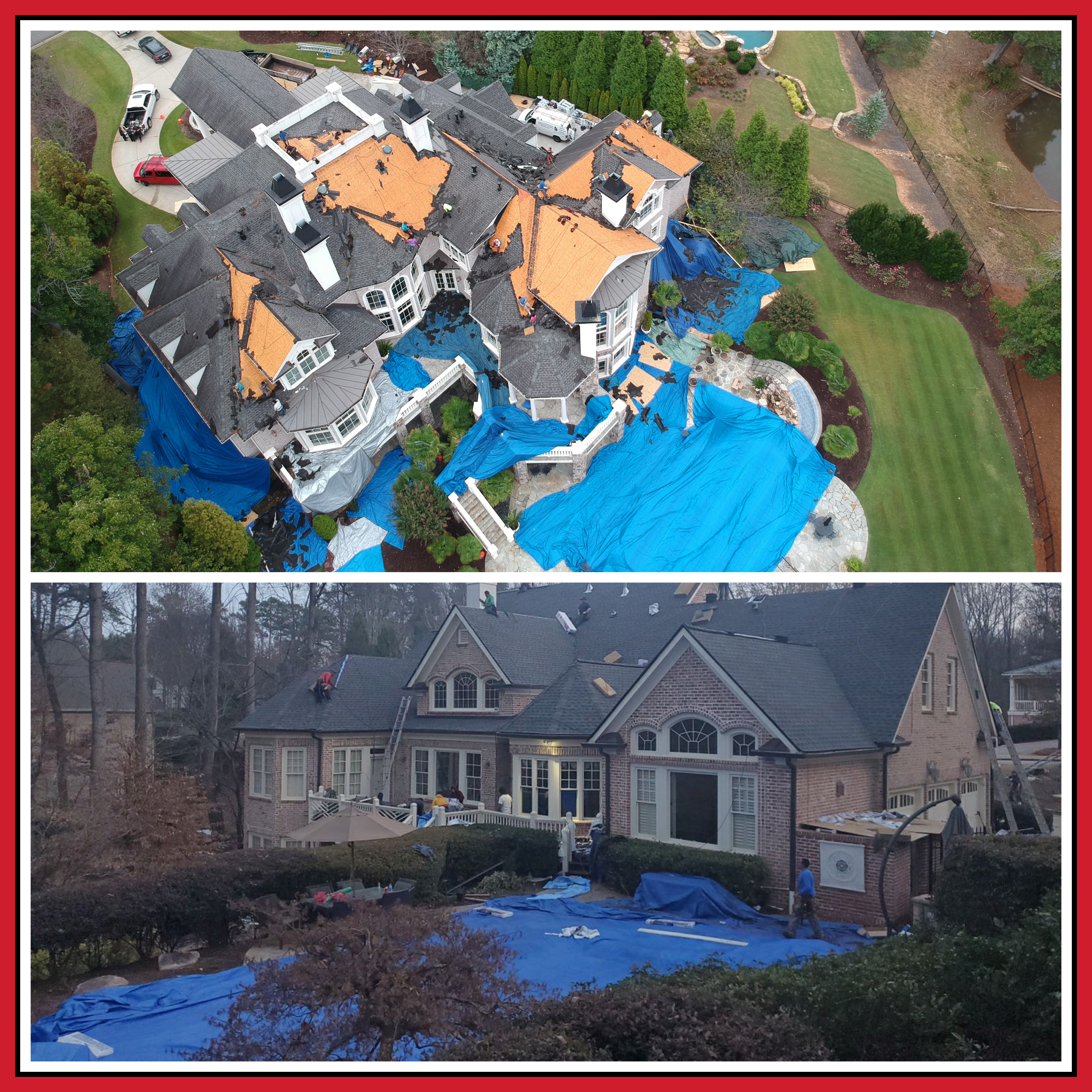
When you call us, our emergency team handles all mitigation immediately. We install emergency tarps, extract standing water, deploy drying equipment, and document every mitigation step as a separate billable item on your claim. This protects your claim by proving you fulfilled your duty to mitigate, and it adds covered costs to your total payout.
Our crews serve all of metro Atlanta including Roswell, Buckhead, Alpharetta, Sandy Springs, Johns Creek, and Marietta. We respond within 60 minutes, day or night.
What to Do If Your Water Damage Claim Is Denied
A denial letter is not the end. It is the beginning of the appeals process, and we have overturned denied claims that other contractors walked away from.
The most common denial reasons for Georgia water damage claims include: the carrier classifying the loss as gradual rather than sudden, the carrier citing a maintenance exclusion, the carrier claiming the damage pre-existed the policy period, or the carrier disputing the scope of damage.
When we manage a claim that gets denied, we respond with a formal written appeal that includes additional documentation, expert analysis of the water source, and a point-by-point rebuttal of the denial rationale. We know how to turn a denied claim into an approved one because we understand what the carrier is looking for and what evidence overcomes their objections.
Read our full guide on what to do when your water damage claim is denied in Georgia. For storm and roof-related denials, see our Georgia insurance claim denial guide.
Related Water Damage Insurance Resources
We have built an entire library of insurance claim guides specifically for Georgia homeowners dealing with water damage. Each guide addresses a different stage of the claims process:
- What Insurance Covers for Water Damage. Coverage types, exclusions, and policy language explained
- How to Document Water Damage for Insurance. Professional documentation that adjusters cannot dispute
- Meeting the Insurance Adjuster for Water Damage. What to expect and how we prepare
- Water Damage Claim Denied in Georgia. Appeals, rebuttals, and next steps
- Supplementing Water Damage Claims. Getting paid for the full scope of damage
- Emergency Tarping and Insurance Coverage. Mitigation costs your policy covers
- Out-of-Pocket vs. Insurance Claim. When filing makes financial sense
For our full range of restoration and roofing services, visit our water damage restoration and insurance claims assistance pages.
Frequently Asked Questions: Filing Water Damage Claims in Georgia
How long do I have to file a water damage insurance claim in Georgia?
Most Georgia homeowners policies require you to report water damage promptly, typically within 24 to 72 hours of discovery. The formal proof of loss must usually be submitted within 60 days. Under O.C.G.A. § 33-4-6, insurers must acknowledge claims within 15 business days. We file claims the same day we respond to your emergency so you never miss a deadline.
Can 1 Source file the insurance claim on my behalf?
Yes. We handle the entire claims process from start to finish. We document the damage with professional-grade equipment, compile the claim package with photos, moisture readings, and repair estimates, and submit everything directly to your insurance carrier. You sign off on the paperwork and we do the rest.
What information do I need to file a water damage claim?
You need your policy number, the date and time you discovered the damage, photos of the affected areas, and a description of the water source. We handle the technical documentation including moisture mapping, thermal imaging, affected material inventory, and line-item repair estimates that adjusters require.
Will filing a water damage claim raise my insurance premiums?
Georgia law does not prohibit insurers from increasing premiums after a claim. However, a single water damage claim typically results in a modest increase of 5 to 15 percent at renewal. If the damage is $10,000 or more, filing the claim almost always makes financial sense even with a premium increase. We help you evaluate the numbers before you decide.
What is the typical deductible for water damage claims in Georgia?
Most Georgia homeowners carry a $1,000 to $2,500 deductible. Some higher-end policies in areas like Buckhead, Sandy Springs, and Johns Creek may have percentage-based deductibles of 1 to 2 percent of the dwelling coverage amount. We review your policy declarations page with you before filing so there are no surprises.