
Ice Dam Water Damage Emergency Restoration in Georgia
Water is pouring through your ceiling from an ice dam on your roof. You need a roofing and restoration crew. not just a roofer, not just a water damage company. Call us now.
Certified & Trusted Emergency Restoration
Metro Atlanta homes are not built for sustained freezing. When temperatures drop below 28 degrees for 4+ hours, ice dams form on roofs that lack proper ice and water shield underlayment.
Ice Dams in Georgia. Rare but Devastating
Most Atlanta homeowners do not think about ice dams. Georgia is not Minnesota. But when a hard freeze hits metro Atlanta. and it does hit, roughly every 2-3 years. ice dams form on roofs across the region and the damage is severe precisely because our homes and roofs are not built for prolonged cold the way northern homes are.
The January 2014 ice storm paralyzed Atlanta and left ice on roofs for over a week. The December 2022 arctic blast dropped wind chills into single digits across north Georgia for three consecutive days. In both events, our phones rang nonstop with homeowners watching water pour through their ceilings, stain their walls, and soak their attic insulation. all from ice dams they did not know existed until the damage started.
Here is why ice dams hit Georgia homes so hard: our roofs are designed for heat and rain, not sustained cold. Most Atlanta homes lack the ice and water shield membrane that northern builders install along the eaves. Attic insulation levels are lower than in cold climates. Roof ventilation systems are often inadequate because the primary design concern was summer heat dissipation, not winter ice prevention. When a genuine freeze event occurs, these gaps in cold-weather protection turn into water entry points.
If water is coming through your ceiling right now during a freeze event, call (404) 277-1377 immediately. We handle both the roof and the interior damage. ice dam removal, emergency tarping, water extraction, structural drying, and mold prevention. One company, one call, one crew that handles everything.
The Mechanics of Ice Dam Formation on Atlanta Roofs
Understanding how an ice dam forms explains why the water enters where it does and how much damage you are facing. This is not abstract science. it is the difference between a $2,000 ceiling repair and a $25,000 attic-to-living-space restoration.
An ice dam forms through a specific sequence of events. Heat from your living space rises into the attic. In a poorly insulated attic. and most metro Atlanta attics are under-insulated by northern standards. that heat warms the roof deck above. Snow on the upper portions of the roof melts because the deck beneath it is above 32 degrees. The meltwater runs down the roof slope toward the eaves. At the eave, the roof extends past the exterior wall. there is no heat source beneath this overhang. The meltwater hits the cold eave, refreezes, and begins forming a ridge of ice.
As this cycle repeats. melt, flow, refreeze. the ice ridge grows. After 2-3 days of sustained freeze with snow on the roof, the ice dam can be 4-8 inches thick and extend 1-3 feet up the roof from the eave edge. Now the meltwater from the warm upper roof has nowhere to go. It pools behind the ice dam, and standing water on a roof finds every gap, every nail penetration, every seam in the underlayment.
On northern homes, a self-adhering ice and water shield membrane (required by code in cold climates) covers the first 3-6 feet of roof from the eave edge. This membrane seals around nail penetrations and prevents backed-up water from reaching the roof deck. Georgia building code does not require this membrane on the entire eave edge. only at specific vulnerable points like valleys and around penetrations. Many Georgia roofs, especially those built before 2010, have only standard felt underlayment at the eaves, which does not seal around nails and allows backed-up water to pass through to the deck.
Once water gets past the underlayment, it flows onto the roof decking (typically 7/16-inch OSB in Georgia construction), saturates the decking, drips onto the attic insulation below, soaks through the insulation, saturates the ceiling drywall from above, and eventually breaks through as visible water stains, bulging drywall, or active dripping into the living space.
What Ice Dam Water Damage Looks Like Inside Your Home
Ice dam water damage has a distinctive pattern that experienced restoration contractors recognize immediately. The damage follows the path of the exterior walls because that is where the eave meets the heated building envelope. Here is what to look for and what each sign means for the scope of the restoration.
Ceiling stains along exterior walls. Brown or yellowish stains on the ceiling within 2-3 feet of an exterior wall are the classic sign. The stain represents water that soaked through attic insulation and saturated the ceiling drywall from above. If the stain is still wet or expanding, the leak is active. If it has dried but left a visible ring, water has already been absorbed into the drywall and potentially into the ceiling joists above.
Dripping or running water at the wall-ceiling junction. When the volume of water overwhelms the drywall's ability to absorb it, you get active dripping or running water where the ceiling meets the exterior wall. This means significant water is entering the attic and the drywall is saturated. The insulation above this area is soaked and will need to be replaced.
Bulging or sagging ceiling drywall. A bubble or sag in the ceiling means water has pooled on top of the drywall and the weight is pulling it away from the joists. Do not puncture this bubble yourself. the volume of water above may be substantial, and an uncontrolled release can cause more damage to the floor below. We place tarps and containers before making a controlled drain hole.
Wet or stained exterior walls. Water entering at the eave can travel down inside the exterior wall cavity, soaking insulation and drywall from the top down. You may notice damp patches or blistering paint on the upper portion of exterior walls. In severe cases, water runs down the wall cavity and pools at the base, saturating the floor and baseboards at the wall-floor junction. far from the original entry point on the roof.
Attic damage (often unseen). The worst damage is frequently in the attic where you cannot see it from the living space. Soaked fiberglass insulation loses virtually all of its R-value when wet. Saturated OSB roof decking swells and can delaminate. If the attic stays wet for more than 48 hours, mold colonizes the roof decking, trusses, and any stored items. Many homeowners fix the ceiling stain and never check the attic. only to discover widespread mold months later.
How 1 Source Handles Ice Dam Water Damage. Roof to Floor
Ice dam damage requires a company that does both roofing and restoration. A water damage company can dry your ceiling but cannot fix the roof. A roofer can address the ice dam but cannot extract water, dry structural cavities, or prevent mold. 1 Source does both. and that is why we exist.
When you call (404) 277-1377 during an ice dam emergency, here is our response protocol:
Immediate assessment. exterior and interior. Our crew inspects the roof to locate the ice dam and assess its severity. Simultaneously, we inspect the interior. attic, ceilings, walls. to map the water intrusion. Thermal imaging identifies moisture in wall cavities and ceiling spaces that may not yet show visible damage. This dual assessment gives us the complete picture: where water is entering, where it has traveled, and what materials are affected.
Ice dam mitigation. If the ice dam is accessible and conditions are safe, we create drainage channels through the ice dam to relieve the water backup and stop new water from entering. For accessible dams, we use low-pressure steam equipment that melts the ice without damaging shingles or flashing. For situations where roof access is unsafe due to ice, we apply calcium chloride in stocking tubes to create melt channels. In severe cases where water is actively flooding the interior, we install temporary emergency tarping above the ice dam to divert meltwater away from the compromised entry point.
Interior water extraction. Once we have stopped or reduced the water entry, we extract standing water from affected areas. If ceiling drywall is holding water, we make controlled drain openings with containment below. We pull saturated attic insulation off the ceiling drywall to stop the continuous wicking of water through the ceiling. Wet insulation that is removed is bagged and staged for disposal.
Structural drying. Dehumidifiers and air movers go into affected rooms and, critically, into the attic space. Drying the attic is as important as drying the living space. that is where the OSB decking, trusses, and remaining insulation are holding moisture. We monitor daily until all readings meet the IICRC S500 dry standard. Typical drying time for ice dam water damage is 3-5 days for the interior and 5-7 days for the attic, depending on severity.
Roof repair. Once the ice has melted and conditions allow safe roof access, we inspect the roof for damage caused by the ice dam. lifted shingles, damaged flashing, compromised underlayment, swollen or delaminated decking. We repair all damage and, where appropriate, recommend the installation of ice and water shield membrane along the eaves to prevent recurrence during the next freeze event. As GAF Certified contractors, all roofing repairs meet manufacturer specifications.
Ice Dam Water Damage. The 24/48/72 Hour Breakdown
Ice dam water damage has a wrinkle that makes it different from other water emergencies: the water keeps coming as long as the ice dam is in place and temperatures cycle above and below freezing. A dishwasher leak can be shut off. A burst pipe can be isolated. An ice dam keeps feeding water into your attic every time the sun hits the roof or the attic warms above freezing. This means the damage window can stretch across multiple days.
First 24 hours: Water saturates attic insulation directly above the entry point. Ceiling drywall begins absorbing moisture from the top side. If the insulation is fiberglass batts (standard in Georgia construction), water passes through relatively quickly to the drywall. If blown-in cellulose, the insulation absorbs and holds a massive amount of water, becoming extremely heavy. heavy enough to cause ceiling drywall to sag or collapse under the weight. Drywall paper backing begins softening.
24 to 48 hours: Water damage expands beyond the initial entry zone as meltwater follows the path of least resistance across the attic floor. along joist bays, through wiring holes, and toward any gap in the ceiling. Visible ceiling stains may appear 10-15 feet from the actual roof entry point. Mold germination begins on the warm, wet surfaces of the roof decking and truss members inside the attic. Wall cavities along the exterior wall begin accumulating moisture as water tracks down from the eave area.
48 to 72 hours: Mold colonies are now visible on attic surfaces. typically appearing as dark spots on the underside of the roof decking and on the top chords of trusses. Ceiling drywall in the most saturated areas may be structurally compromised and at risk of collapse. If water has been running down inside wall cavities, baseboards and flooring along exterior walls show moisture damage. The total affected area may be 3-5 times larger than what is visible from the living space.
Beyond 72 hours: Full mold remediation becomes likely. Attic insulation over the entire affected zone is a total loss. Sections of roof decking may need replacement if the OSB has swollen or delaminated. Interior reconstruction. ceiling drywall, paint, insulation replacement, potentially wall drywall and flooring. adds weeks to the project timeline and thousands to the cost.
Water Through Your Ceiling? Call Us Right Now.
We handle the ice dam on the roof and the water damage inside. one crew, one call. 24/7 emergency response anywhere in metro Atlanta. Do not wait for it to stop on its own. It will not.
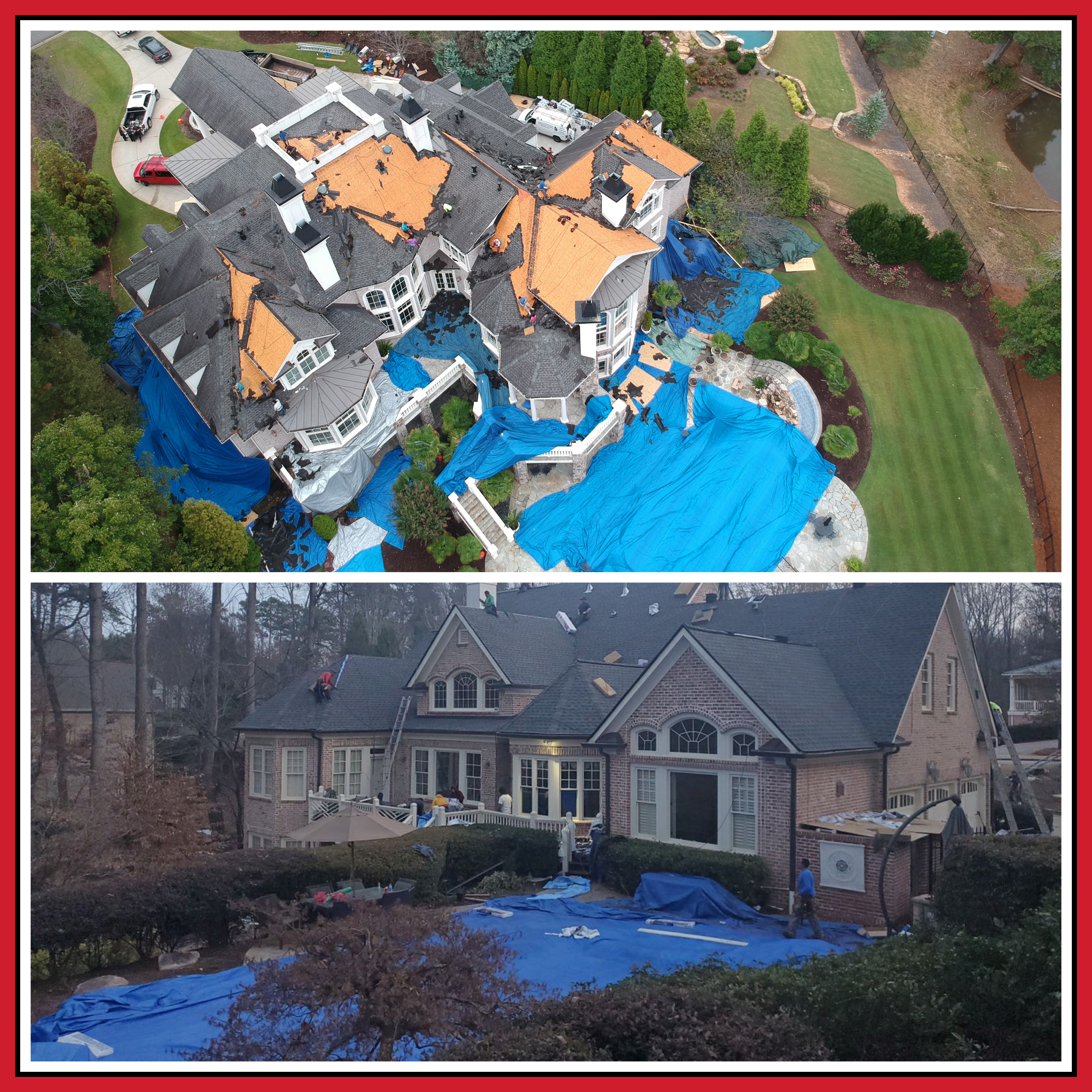
Ice and water shield membrane installed along roof edges and in valleys prevents 90%+ of ice dam water intrusion. Ask about retrofitting during your next roof replacement.
Insurance Claims for Ice Dam Damage in Georgia
Here is the good news: ice dam water damage is generally well-covered by Georgia homeowners insurance policies. Because ice dams result from weather events. specifically freezing temperatures and precipitation. the resulting interior water damage falls under the sudden and accidental coverage provisions of a standard HO-3 policy.
What is typically covered:
- Interior water damage. ceiling drywall, wall drywall, paint, insulation, flooring damaged by water that entered through the ice dam
- Personal property damaged by the water. furniture, electronics, stored items
- Water extraction and structural drying. professional mitigation costs
- Mold remediation. if mold results from the ice dam water intrusion (some policies have sublimits for mold)
- Temporary repairs. emergency tarping, temporary ceiling patches to prevent further damage
What is typically NOT covered:
- Ice dam removal. the cost of removing the ice dam itself is usually excluded as a maintenance item
- Roof improvements. if we recommend installing ice and water shield membrane to prevent future dams, the upgrade cost is typically the homeowner's responsibility
- Attic insulation and ventilation improvements. addressing the root cause of the ice dam (inadequate insulation and ventilation) is considered a maintenance/improvement issue, not damage repair
- Pre-existing conditions. if the adjuster determines that the roof had pre-existing damage that allowed water entry independent of the ice dam, they may deny or reduce the claim
What 1 Source does for your claim: We document every square inch of damage with photos, moisture readings, and thermal imaging before any demolition occurs. Our Xactimate-formatted scope of work speaks the same language as your adjuster's software. We clearly delineate between covered water damage and any recommended upgrades, so the adjuster can process the claim without confusion. We have handled hundreds of insurance claims across metro Atlanta and we know what adjusters need to see and how to present it.
If your ice dam claim gets disputed, read our guide on what to do when your Georgia insurance claim is denied or call us to talk through your options.
Attic Mold and Structural Damage from Ice Dam Leaks
The attic is ground zero for ice dam water damage, and it is the area most homeowners neglect during and after a freeze event. You see the ceiling stain in the bedroom and focus on that. Meanwhile, the attic above has gallons of water soaked into the insulation, pooled on the ceiling drywall, and wicking into the roof decking and truss members. If that attic damage goes unaddressed, you end up with a mold problem that dwarfs the original water stain.
Fiberglass batt insulation is the most common attic insulation in metro Atlanta homes. When soaked, fiberglass loses its R-value because the insulating effect depends on trapped air pockets. water fills those pockets and the insulation becomes thermally useless. Wet fiberglass also becomes extremely heavy. A section of saturated fiberglass insulation can weigh 5-10 times its dry weight, placing significant load on the ceiling drywall below. We have seen instances where the combined weight of wet insulation and pooled water caused ceiling sections to collapse entirely.
Blown-in cellulose insulation. used in some newer Atlanta homes and retrofits. is even more problematic when wet. Cellulose absorbs and holds water like a sponge. It mats down, compresses, and loses virtually all insulating value. Wet cellulose is also an ideal mold food source because it is made from recycled paper treated with borate fire retardant. While the borate provides some mold resistance when dry, it leaches out when the cellulose is saturated, leaving untreated paper pulp in direct contact with moisture. Mold colonizes wet cellulose rapidly.
OSB roof decking. the standard sheathing material on Georgia roofs. swells when wet. The oriented strand board absorbs water through the cut edges and at fastener penetrations. Swollen OSB loses structural capacity and may not properly hold roofing nails, compromising the attachment of the shingle system above. In severe cases, delaminated decking panels must be replaced. a major repair that requires removing the shingles above.
Our attic drying protocol addresses all of these concerns: remove saturated insulation, set up dehumidifiers and air movers in the attic space targeting the roof decking and framing, monitor moisture levels in the decking and trusses daily, and do not close the space until every structural member reads dry. After drying is complete and mold testing confirms the space is clean, we replace insulation to code-minimum R-values. or, better yet, upgrade to the R-38 level recommended for Georgia attics by the Department of Energy.
Preventing Ice Dam Damage on Your Atlanta Home
Georgia homeowners cannot prevent hard freezes, but you can prevent ice dams from forming and minimize damage when they do. These are the recommendations we make to every client after an ice dam restoration, and they apply to any metro Atlanta home.
Improve attic insulation. The root cause of most ice dams is heat escaping from the living space into the attic, warming the roof deck, and melting snow from below. Increasing attic insulation to R-38 (the Department of Energy recommendation for Climate Zone 3, which includes Atlanta) significantly reduces heat loss through the ceiling. Many Atlanta homes built before 2000 have R-19 or less in the attic. barely half of the recommended level. Adding blown-in insulation to bring the attic to R-38 typically costs $1,500-$3,000 for an average home and pays for itself in reduced heating and cooling costs within 3-5 years.
Seal attic air leaks. Insulation alone is not enough if warm air is leaking directly into the attic through gaps around recessed lights, plumbing penetrations, HVAC ducts, and the attic hatch. These air leaks deliver warm, moist air to the attic that melts snow on the roof deck far faster than conductive heat loss through insulation. Sealing these penetrations with caulk, spray foam, and weatherstripping is one of the most cost-effective home improvements you can make.
Ensure proper attic ventilation. A well-ventilated attic stays close to the outdoor temperature, which prevents the differential heating that causes ice dams. Georgia code requires a minimum ventilation ratio of 1:150 (1 square foot of net free ventilation area per 150 square feet of attic floor). Ridge vents combined with soffit vents create continuous airflow from eave to peak. Many Atlanta homes have inadequate soffit ventilation. either the soffits are solid (no perforations) or the insulation at the eaves blocks the soffit vents from drawing air into the attic.
Install ice and water shield during your next roof replacement. If your roof is due for replacement, specify ice and water shield membrane along the first 3-6 feet of eave edge. This self-adhering membrane seals around nail penetrations and prevents backed-up water from reaching the roof deck. It is standard in northern climates and should be standard on every Georgia roof, given that we experience freeze events regularly. As GAF Certified contractors, we install GAF WeatherWatch or StormGuard ice and water shield on every roof replacement we do. Learn more about our roof replacement services.
Keep gutters clear. Clogged gutters accelerate ice dam formation by trapping water at the roof edge where it freezes first. Clean gutters in late November before the freeze season and confirm downspouts are flowing freely.
Emergency snow removal. If a significant snowfall is followed by a sustained freeze forecast, removing snow from the lower 3-4 feet of roof with a roof rake (from the ground. never climb an icy roof) eliminates the raw material the ice dam needs to grow. No snow at the eave means no meltwater to refreeze into a dam.
Georgia Construction Standards and Ice Dam Vulnerability
There is a reason ice dams cause disproportionate damage in metro Atlanta compared to cities in the northern states that get far more ice and snow. It comes down to building practices, code requirements, and how homes are designed for our predominant climate.
Georgia building code follows the International Residential Code (IRC) as adopted by the Georgia Department of Community Affairs. The IRC has specific ice dam prevention requirements. ice barrier membrane along eaves, enhanced attic insulation, and ventilation requirements. but these provisions apply based on climate zone. Georgia sits in Climate Zone 3 (with some mountain areas in Zone 4), where the code requirements for ice protection are minimal compared to Zones 5-7 in the northern states.
Specifically, the Georgia-adopted code does not require continuous ice and water shield membrane along the entire eave edge on most residential roofs. It requires ice barrier only in specific locations. valleys, around roof penetrations, and at certain wall-to-roof transitions. A northern code would mandate 3-6 feet of ice barrier from the eave edge on every roof plane. This single difference in code requirements is the primary reason Georgia roofs leak during ice dam events while comparably built northern roofs do not.
Attic insulation minimums in Georgia code are also lower than northern code requirements. Georgia requires R-30 minimum in the attic for new construction (R-38 recommended by the Department of Energy). Northern states require R-49 to R-60. Higher insulation means less heat reaching the roof deck and less snowmelt. the lower Georgia requirements leave more heat loss potential and more ice dam risk.
Roof ventilation in many existing Georgia homes is inadequate even by our own code minimums. Older homes with gable vents only (no ridge or soffit ventilation) have poor air circulation in the attic. Without continuous soffit-to-ridge airflow, warm air stagnates in the attic, heating the roof deck unevenly and creating the conditions for ice dam formation.
None of this is a design flaw. Georgia homes are optimized for the 350+ days per year when the temperature is above freezing. But during that rare hard freeze with snow or ice on the roof, these climate-appropriate building practices become vulnerabilities. That is why you need a contractor who understands both the roofing system and the water damage restoration process when an ice dam strikes.
Ice Dam Water Damage. Your Questions Answered
Do ice dams actually happen in Atlanta and north Georgia?
Yes. Metro Atlanta experiences ice dam conditions during winter freeze events, particularly when temperatures drop into the teens or twenties for multiple consecutive days. The January 2014 ice storm, the 2017 freeze, and the December 2022 arctic blast all produced ice dams on homes throughout Fulton, Gwinnett, Cobb, and DeKalb counties. Homes with poor attic insulation and inadequate ventilation are most vulnerable.
How does an ice dam cause water damage inside my house?
An ice dam forms a ridge of ice along the roof edge that blocks snowmelt from draining. As snow above the dam melts from attic heat, water pools behind the ice ridge and backs up under shingles and past the underlayment, flowing into the attic space and down through ceilings, walls, and insulation. The entry point is at the eave, but damage can appear anywhere along the exterior wall line.
Will my insurance cover ice dam water damage in Georgia?
Most Georgia homeowners policies cover interior water damage caused by ice dams because the damage results from a weather event. The insurer covers interior damage. wet ceilings, walls, flooring, personal property. but typically does not cover the cost of removing the ice dam itself or improving attic insulation and ventilation. 1 Source documents all damage thoroughly to maximize your covered claim.
How long does it take for mold to grow after ice dam water enters my attic?
Mold can begin colonizing wet attic surfaces within 24-48 hours, especially if the attic temperature stays above 40 degrees Fahrenheit. In Georgia, even during a freeze event, attic temperatures in poorly insulated homes often remain in the 50-70 degree range due to heat loss from below. creating conditions where mold establishes while ice is still on the roof outside.
Can I remove an ice dam myself with a hammer or ice pick?
Do not attempt mechanical ice dam removal. You will crack or puncture the shingles and roof decking underneath, creating new leak points. Professional removal uses low-pressure steam that melts ice without damaging roofing materials. For immediate relief before a crew arrives, fill a nylon stocking with calcium chloride ice melt and lay it perpendicular across the dam to create a drainage channel.
More Emergency Restoration Resources
Water Damage Restoration
Full-service water damage restoration for Atlanta metro homeowners. extraction, drying, mold prevention, and reconstruction.
Roof Leak Water Damage
When a roof leak sends water through your ceiling, call 1 Source for immediate extraction and structural drying.
Storm Damage Restoration
Wind, hail, ice, and rain damage restoration for roofs, siding, and interiors across metro Atlanta.
Roof Repair
Emergency and scheduled roof repairs. flashing, shingles, decking, and leak diagnosis by GAF Certified contractors.
Insurance Claims Assistance
We handle documentation, adjuster meetings, and Xactimate scoping so you get the full payout your damage warrants.
Storm Flooding Damage
Georgia storms drive water through roofs, windows, and foundations. Emergency flood restoration across metro Atlanta.
Roof and Interior. We Handle Both. Call Now.
Ice dam water damage requires a company that does roofing and restoration under one roof. We remove the ice, stop the leak, extract the water, dry the structure, and handle your insurance claim. One call does it all.
Serving Alpharetta, Buckhead, Sandy Springs, Johns Creek, Roswell, Marietta, Lawrenceville, and all of metro Atlanta.