Lawrenceville, GA • Serving Metro Atlanta 30-Mile Radius info@1sourceroofingandrestoration.com
Free InspectionsLicensed & Insured
Aerial view of damaged roof being inspected in metro Atlanta

Homeowner Guide

Signs You Need a New Roof: 10 Warning Signs Atlanta Homeowners Shouldn't Ignore

Free Roof Inspections Across Metro Atlanta — Serving Buckhead, Alpharetta, Lawrenceville & Beyond

Schedule Your Free Roof Inspection  — (404) 277-1377
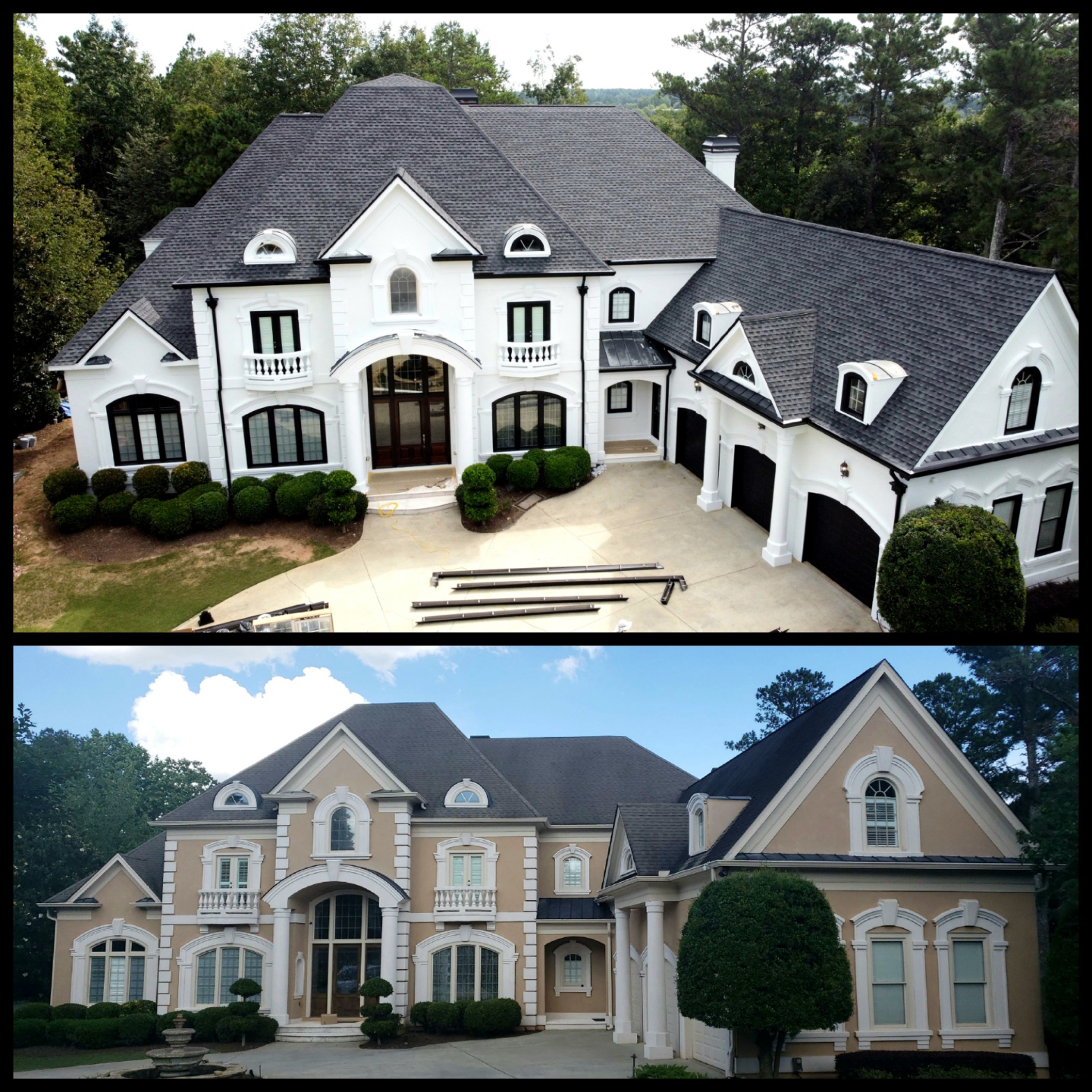
Two luxury Atlanta estates with completed Charcoal shingle roof replacements — aerial drone photography by 1 Source Roofing
Charcoal architectural shingle replacements on luxury Atlanta estates — drone documentation by 1 Source Roofing

Certified by Industry-Leading Manufacturers

GAF Certified Contractor
CertainTeed Certified Contractor
BBB A+ Accredited
GAF Silver Pledge
10+
Years Experience
24/7
Emergency Response
4.9
Star Rating

Your roof is the single most protective system on your home — and in Georgia, it works harder than almost anywhere else in the country. Between the hail storms that roll through the Atlanta metro each spring, the brutal humidity that accelerates shingle aging from May through September, and the occasional severe windstorm that follows warm fronts north, Georgia roofs take a lot of punishment. The question isn't whether your roof will eventually show wear — it's whether you'll recognize the warning signs before a $400 repair becomes a $15,000 emergency.

This guide walks through the ten most common indicators that a roof is failing — not from a sales angle, but from the perspective of a contractor who has inspected thousands of homes across metro Atlanta. Some of these signs point clearly toward full roof replacement. Others might indicate a targeted repair. Knowing the difference saves you money and protects your home.

How Long Should a Roof Last in Georgia's Climate?

The roofing industry's standard answer — "20 to 25 years for architectural shingles" — is based on moderate climates. Georgia is not a moderate climate. The combination of high UV exposure, summer heat that routinely pushes surface temperatures on dark shingles above 160°F, and the freeze-thaw cycling that occurs during Georgia's mild but real winters puts Georgia roofs on a shorter clock.

In practical terms, an architectural shingle roof installed in the late 1990s or early 2000s is now approaching or past its functional lifespan — even if it hasn't been damaged by a specific storm. NOAA data shows that the Atlanta metro receives an average of six to eight significant hail events per year, with the highest concentration occurring during the March through May and August through September storm seasons. Each of those events degrades shingles incrementally, even when no individual impact is visible to the naked eye from the ground.

Three-tab shingles, which were common on homes built before 2005, have an even shorter effective lifespan — typically 15 to 18 years in this region. If your Alpharetta subdivision was developed in the early 2000s and your roof has never been replaced, the age factor alone warrants a professional inspection, regardless of whether you've seen any obvious symptoms from the ground.

Sign #1: Your Shingles Are Curling, Cracking, or Missing

Walk to the edge of your property and look up at the roof at a low angle. Shingles should lie flat and consistent, with clean horizontal lines across each course. What you're watching for: tabs that have lifted at the edges or corners (called "cupping"), shingles where the center has domed upward while the edges stay flat (called "clawing"), visible cracks across the surface of individual shingles, or gaps where a shingle has blown off entirely.
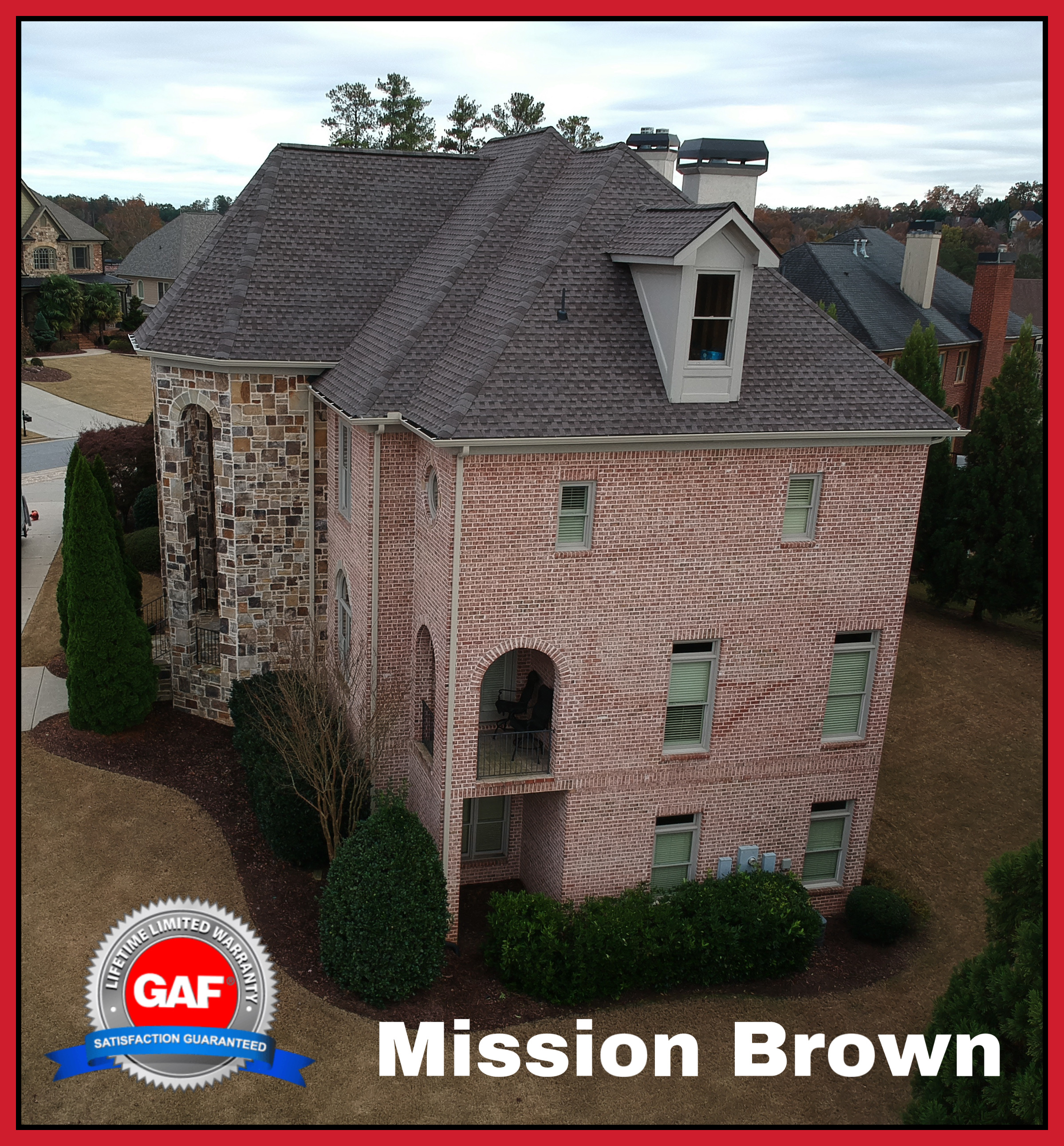
Mission Brown roof on large luxury home — aerial drone photography
Mission Brown luxury installation — premium quality

Curling happens for two reasons. On older roofs, it's the natural result of the asphalt losing volatiles as it ages — the organic mat beneath the asphalt contracts, pulling the shingle out of flat. On newer roofs, curling is frequently caused by improper attic ventilation: when heat and moisture build up in the attic space and can't escape, they create upward pressure that distorts the shingles from below. This distinction matters because ventilation-driven curling can damage a relatively new roof that might otherwise have years of life remaining.

Missing shingles are the most immediate concern because they expose the underlayment — the felt or synthetic membrane beneath the shingles — to direct weather. Underlayment is not designed to be a permanent weather barrier; it's an emergency backup. Once it's exposed, water can work its way under the adjacent shingles and into the roof deck within one or two rainstorms. If more than a few shingles are missing across the roof, or if they keep blowing off in ordinary storms, the nailing pattern was likely inadequate — a full replacement is typically more cost-effective than repeated repairs.

Sign #2: You're Finding Granules in Your Gutters

The ceramic granules embedded in the surface of asphalt shingles serve two purposes: they protect the asphalt layer from UV degradation, and they add fire resistance to the assembly. When a roof is new, some loose granules wash off in the first few rainstorms — this is normal. When a roof has been in place for ten years or more and granules are filling your gutters or collecting in downspout splash pads, it means the shingles are shedding their protective coating at an accelerating rate.

Check the gutters directly below roof valleys and at downspout outlets. Run your hand along the inside of the gutter channel after a rainstorm. Granule accumulation that looks like coarse sand or fine gravel — dark gray, brown, or green depending on your shingle color — indicates significant surface wear. On the shingles themselves, bare or thin spots where the black asphalt is visible underneath are called "bald spots." They look darker than the surrounding granule surface and are often most visible in morning light from certain angles.

Hail also strips granules, but with a distinct pattern: hail impacts leave roughly circular bare spots with a slightly depressed center, while age-related granule loss tends to be more diffuse. The difference matters for insurance purposes. If your granule loss shows clear impact patterns consistent with a recent hail event, you may have a valid insurance claim — contact a licensed contractor before filing to document the damage properly.

Sign #3: Your Roof Is Sagging or Has Visible Dips

A healthy roof should show straight, even lines along every ridge and every horizontal course of shingles. Sagging — where sections of the roof deck appear to bow downward between the rafters — is one of the most serious conditions a homeowner can find. It indicates structural compromise, not just surface wear.
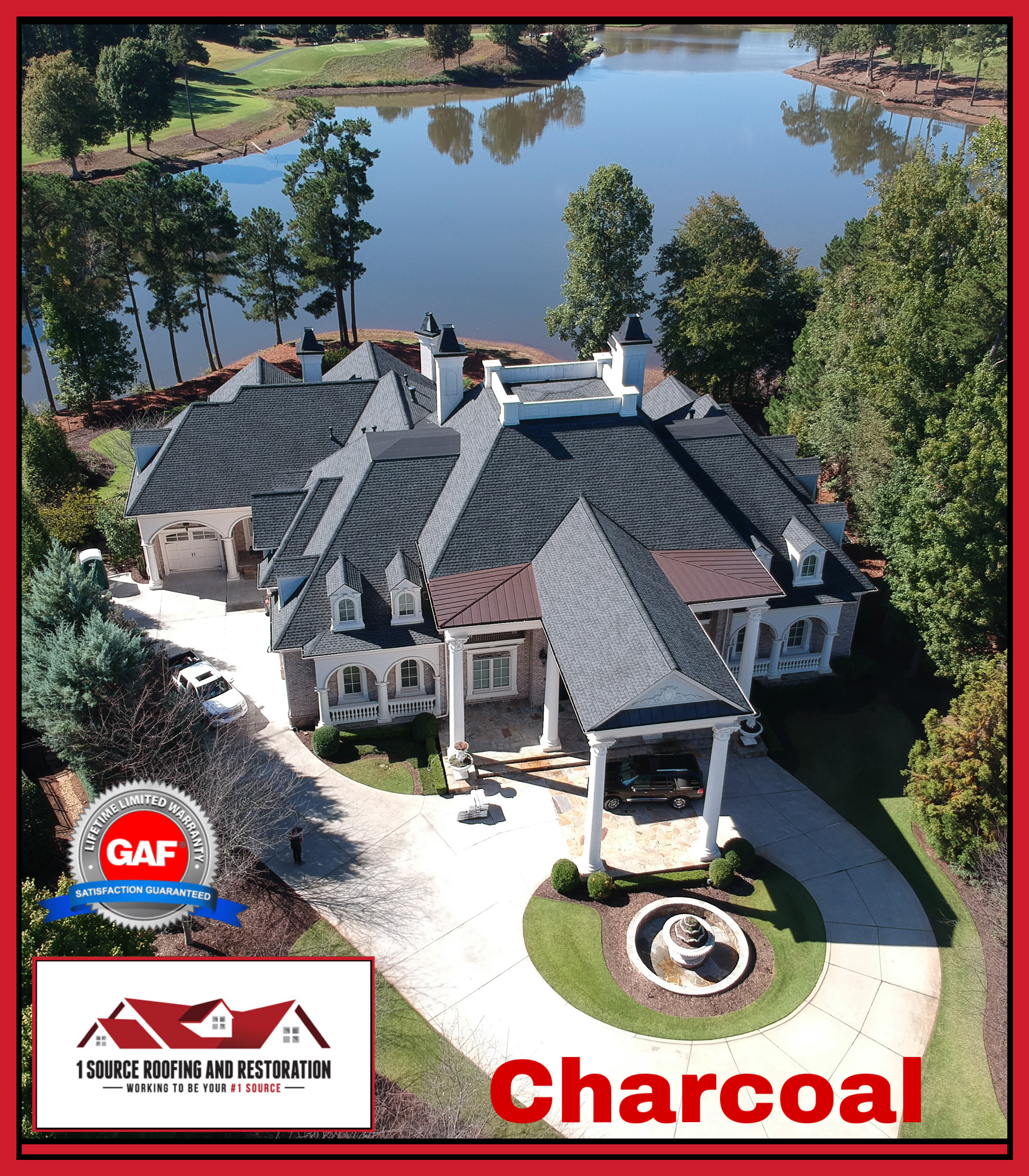
Charcoal shingle roof on upscale residential home — aerial view
Quality Charcoal shingle installation — 1 Source Roofing

The most common cause of sagging in Georgia is long-term moisture intrusion that has rotted the roof decking (the plywood or OSB boards that sit beneath the underlayment and shingles). When water enters through any breach — a failed flashing joint, a cracked shingle, a punctured underlayment — and sits against wood for extended periods, the wood absorbs moisture, swells, and eventually begins to deteriorate. Once the deck has lost structural integrity, the weight of the roofing materials causes it to deflect between the supporting rafters.

In severe cases, sagging can also indicate failing rafters or trusses, which is a structural repair that goes beyond the scope of roofing alone. If you see significant sag — more than one or two inches of deflection in any section — the structural assessment should happen before any roofing work begins. This is not a situation where repairs to the surface shingles will resolve the underlying problem. Storm damage restoration teams assess both the surface and structural components when they inspect a roof in this condition.

Sign #4: Daylight Is Visible Through Your Attic

On a clear day, go up into your attic and let your eyes adjust to the low light for a few minutes. Then look up toward the roof deck. You should not see any pinpoints or shafts of natural light coming through. If you do, you have gaps in the roof assembly — at a failed flashing joint, a cracked or missing shingle, a deteriorated pipe boot, or a separated ridge cap. Every gap that lets light in also lets water in.

Beyond visible light, look for signs of moisture that have already occurred: dark staining on the underside of the roof deck (the plywood or OSB visible from below), soft or spongy spots when you press on the decking, or active wet areas after a rainstorm. Daylight is the easy finding — the staining tells you how long the problem has been ongoing and how much damage has accumulated.

Georgia's humidity compounds this issue. Even without a specific water intrusion point, an attic with inadequate ventilation will show condensation on cold surfaces during winter, leading to moisture damage on the decking and rafters without any rain ever having entered. This is why ventilation inspection is a standard part of any thorough roof assessment — the two systems work together. If the ventilation is inadequate, fixing the shingles alone doesn't prevent ongoing moisture damage.

Sign #5: Your Energy Bills Have Climbed Unexpectedly

A roof that is performing properly contributes to a reasonably sealed, ventilated thermal envelope for your home. When the roofing assembly begins to fail — when shingles lose their reflective granule surface, when ventilation pathways are blocked, when the underlayment degrades and no longer provides a secondary air barrier — the thermal performance of the whole assembly drops. This shows up on your energy bills before it shows up in obvious water damage.

In Georgia's climate, the most common symptom is a significant increase in summer cooling costs. When the roof deck overheats — surface temperatures on a dark shingle in July can exceed 160°F — that heat radiates into the attic space. If the attic isn't properly ventilated, the insulation on the attic floor becomes less effective and the living spaces below run warmer. A properly functioning roofing system includes intake ventilation at the soffits and exhaust ventilation at the ridge, creating a continuous airflow that pulls excess heat out of the attic before it can transfer into the house.

If your cooling bills have risen noticeably in the past two or three summers without a change in your habits or HVAC equipment, and your roof is more than 15 years old, the roof system's contribution to the problem is worth evaluating. A ventilation assessment takes about 20 minutes during a standard inspection and can identify whether ridge vents are blocked, whether soffit screens are clogged, or whether the ventilation ratio is inadequate for the attic square footage.

Schedule Your Free Roof Inspection

Not sure if you need repair or replacement? We inspect roofs across metro Atlanta at no charge — and we give you a written report, not just a verbal opinion.

Call (404) 277-1377 — Free Inspection

Sign #6: You're Seeing Water Stains on Ceilings or Walls

Brown or yellowish rings on interior ceilings are the most visible evidence of active or past water intrusion through the roof. The stain itself forms when water wicks into the drywall or plaster, carries mineral deposits and organic matter with it, and then dries — leaving a ring-shaped outline at the perimeter of the wet area. The stain doesn't always appear directly below the leak point, because water can travel along ceiling joists, rafters, or top plates before dripping down.

In a Buckhead estate or Lawrenceville neighborhood home with a finished attic or bonus room, these stains can be difficult to trace back to their source without a thorough inspection that includes the attic space. In homes where the attic is accessible, a contractor can identify the water travel path and find the actual entry point — which is almost always at a penetration, flashing joint, or damaged shingle section, not in the middle of an open field of shingles.

Do not assume that a stain that has dried means the problem has resolved. Water intrusion through a roof is intermittent — it happens during specific rain events based on wind direction, rain intensity, and whether the roof deck is already saturated. A dry stain this week can become an active leak again next month. The wood that was wetted during the intrusion event may already be harboring mold growth, which is an additional remediation concern beyond the roofing repair itself.

Not sure if you need repair or replacement? We inspect roofs across metro Atlanta for free and provide a written report with photographs — so you have the information to make an informed decision. Call (404) 277-1377 or schedule online.

Sign #7: Moss, Algae, or Dark Streaks Have Appeared

Black or dark gray streaks running down the slope of a roof are almost always caused by Gloeocapsa magma, a cyanobacterium that establishes on asphalt shingles and feeds on the limestone filler in the shingle substrate. The streaks appear first on north-facing slopes and in shaded areas, where moisture lingers longest after a rainstorm. The discoloration itself is the dead and living bacterial cells, not physical damage to the shingles — but the presence of the bacteria creates conditions where moss and lichen follow, and those organisms do cause physical damage.

Moss is a more serious concern than algae streaks. Moss holds moisture against the shingle surface and its root-like structures (rhizoids) work their way under the shingle tabs, lifting them and breaking the factory seal that holds tabs down in wind. Once tabs are lifted, wind can get underneath and remove shingles during a storm. Moss growth is particularly common in areas with heavy tree canopy — many Alpharetta properties and wooded lots in the northern suburbs have this condition on at least some roof sections.

The treatment for algae streaks is roof washing with a low-pressure sodium hypochlorite solution, which kills the organisms without damaging the shingles. Moss removal requires more careful work because aggressive pressure washing can strip granules from the shingles. Some shingle manufacturers offer algae-resistant products with copper-infused granules — these are worth specifying if you are replacing a roof on a shaded property. If moss has been present for several years, inspect the underlying shingles carefully for tab lifting and edge damage before deciding whether cleaning or replacement is the right path forward.

Sign #8: Your Flashing Is Cracked, Rusted, or Missing

Flashing is the thin metal (usually galvanized steel or aluminum) that seals the transition between the roofing surface and vertical elements: chimneys, skylights, dormer walls, and plumbing vent penetrations. Every leak that originates at a penetration — which accounts for the majority of residential roof leaks — traces back to failed flashing. Yet flashing is the component that most homeowners and even some contractors underinspect.

Step flashing, used at the junction of a sloped roof meeting a vertical wall (like a dormer or addition), consists of individual L-shaped pieces interwoven with each course of shingles. When any one piece pulls away from the wall, lifts out of the shingle course, or corrodes through, water runs directly down the wall framing cavity. Counter flashing — the piece embedded in masonry that caps the step flashing — frequently fails at the mortar joint where it's embedded; Georgia's freeze-thaw cycles crack mortar over time even in a mild winter.

Pipe boots, the rubber or lead collars that seal around plumbing vents, are the single highest-failure-rate component on most Georgia roofs. The rubber on standard pipe boots begins to crack and split after 10 to 15 years of UV exposure. A split pipe boot is a common cause of attic moisture that homeowners misdiagnose as a shingle problem because the shingles around the vent look undamaged from the ground. Any storm damage inspection should include a hands-on evaluation of every pipe boot and flashing joint on the roof.

Sign #9: You've Had Multiple Repairs in the Past Few Years

A single repair — one damaged section from a fallen branch, one failed flashing joint — is a normal maintenance event. When repairs have been needed two or three times in a rolling five-year window, the pattern itself becomes the signal. Roofs don't fail at isolated points on systems that have years of remaining life. Widespread failure happens when the whole assembly has reached the point where the materials are degraded enough that the next storm or the next heavy rain finds a new weak point.

This pattern is financially significant. Each repair costs between $300 and $1,500 depending on scope. Three repairs over five years equals $900 to $4,500 spent without reducing the eventual cost of the full replacement — you've simply deferred the inevitable while the underlying assembly continues to deteriorate. The deck damage, the moisture accumulation in the insulation, the degraded underlayment — these problems grow between the repairs and add cost to the eventual replacement.

The calculation changes if the roof is relatively young and damage has come from identifiable external events (storm damage, equipment damage). In that case, repairs are appropriate. The concern is a pattern of "general leaking" or "shingles failing" on a roof that is in the 15- to 20-year range — that pattern is telling you the system as a whole is past its design life, and the next repair is unlikely to be the last.

Sign #10: Your Roof Is 20+ Years Old

Age alone doesn't mandate replacement — a well-maintained roof on a properly ventilated home with no storm damage history can sometimes push past 25 years. But age puts every other condition on this list in a different context. A small area of granule loss on a 5-year-old roof is a localized issue. The same condition on a 22-year-old roof is the leading edge of system-wide failure. Age amplifies every other sign.

For homes in Atlanta's older suburbs — Marietta neighborhoods developed in the 1970s and 1980s, Decatur bungalow districts, established Roswell subdivisions — the original roof may have already been replaced once, making the installation date sometimes difficult to determine. Georgia real estate disclosure requirements don't always capture exact roof replacement dates. If you're unsure of your roof's age, an experienced contractor can often estimate it from the shingle profile (tab size, texture, thickness), the underlayment type visible at a drip edge, and the condition of the decking if any vents are accessible.

If your home is 20+ years old and the roof has never been replaced, schedule a professional inspection before the next storm season. Finding that the roof has five years of life remaining is useful information. Finding that it needs replacement now — and documenting the condition before a storm — positions you to pursue an insurance claim if a storm event damages an already-compromised roof.

When to Call a Professional vs. DIY

Some roof maintenance tasks are reasonable for a competent homeowner: cleaning gutters, applying roof sealant around a cracked pipe boot collar, replacing a single lifted shingle tab in a low-slope area. These are surface-level tasks that don't require walking a steep slope or evaluating structural conditions.

Most roof work should not be DIY for three reasons. First, safety: steep slopes, wet surfaces, and proximity to power lines make roof access genuinely dangerous without proper equipment and training. Second, scope: what looks like a small problem from the ground is frequently a symptom of a larger one — a contractor who inspects the whole roof finds the real problem, not just the visible one. Third, warranties and insurance: manufacturer warranties on shingles and underlayment typically require installation by a certified contractor. DIY repairs can void warranty coverage and create documentation problems if you file an insurance claim later.

Call a professional when: you've seen any of the ten signs listed above, you're preparing to sell the home and need accurate condition information, you've had a hail or wind event and want damage documented, or your roof is 15+ years old and hasn't been inspected in the past two years. The inspection itself is diagnostic, not a commitment to any specific repair path. Lawrenceville-area homeowners and customers across the Alpharetta corridor can call 1Source for a free written inspection with no obligation.

What Happens During a Free Roof Inspection?

A professional roof inspection is a systematic evaluation of every component in the roofing assembly — not just a quick look at the shingles from the ground. When 1Source performs an inspection, the process covers the following areas:

Following the inspection, you receive a written report with photographs identifying every finding, categorized by severity. This report is useful regardless of what decision you make — it gives you a factual baseline for the condition of your roof that you can compare against future inspections, share with a home buyer during a sale, or use as documentation when filing an insurance claim after a storm.

Frequently Asked Questions

Straight answers to the questions Atlanta homeowners ask most often.

When should I replace vs. repair my roof? +

If damage is isolated to a small area — a few missing shingles or a single flashing failure — repair is usually sufficient. When damage covers more than 30% of the roof surface, when the system is 20+ years old, or when you've had three or more repairs in the past five years, full replacement typically costs less over time than continued patching. A professional inspection gives you the data to make this call with confidence.

How long does a roof inspection take? +

A thorough roof inspection by a licensed contractor takes 45 minutes to 90 minutes for a typical single-family home. The inspector walks the roof surface, examines flashing at every penetration, checks gutters for granule accumulation, and inspects the attic for moisture intrusion and ventilation issues. 1Source provides a written inspection report with photographs at no charge.

Does homeowners insurance cover roof replacement? +

Most Georgia homeowners insurance policies cover sudden, accidental damage — hail, wind, fallen trees — but not gradual deterioration from age or lack of maintenance. If a storm caused the damage, you likely have a valid claim. Document the damage with photographs immediately after the storm, and call a licensed contractor before signing anything with the insurance company.

What is the best roofing material for Georgia? +

Architectural asphalt shingles (also called laminated or dimensional shingles) are the dominant choice in Georgia for their balance of cost, durability, and wind resistance. Impact-resistant Class 4 shingles provide added protection against Georgia's frequent hail events and may qualify for a homeowners insurance discount. For steep-slope luxury roofs in areas like Buckhead or Alpharetta, standing seam metal and synthetic slate are strong long-term options.

How do I know if storm damage is covered by insurance? +

Storm damage is generally covered when the cause is a named peril in your policy — most commonly hail, wind, or falling trees. Signs that adjusters look for include hail impact marks on soft metals (gutters, vents, AC fins), bruised or granule-stripped shingles, and wind-lifted tab seals. Having a licensed contractor present during the adjuster visit ensures that all damage is properly documented. 1Source attends every adjuster inspection for our customers at no charge.

Ready to Know Where Your Roof Stands?

1Source performs free written roof inspections across metro Atlanta — Buckhead, Alpharetta, Lawrenceville, and 20+ surrounding communities. No sales pressure. Just facts.

Schedule Your Free Inspection — (404) 277-1377