Georgia's climate is unforgiving on roofing systems. With roughly 50 inches of annual rainfall, summer heat index readings that regularly climb to 105–115°F, persistent humidity levels above 70 percent, and a documented hail season that makes metro Atlanta one of the busier hail corridors in the Southeast, the materials protecting your home face compounded stressors that simply don't exist in milder climates. Choosing the wrong roofing material — or the right material installed without regard for Georgia's specific demands — leads to premature failure, elevated utility bills, and costly repair cycles.
This guide examines every major roofing material relevant to metro Atlanta homeowners: standard and impact-resistant asphalt shingles, standing seam and metal shingle systems, natural slate, synthetic slate, clay and concrete tile, and flat/low-slope commercial membranes. Each section addresses Georgia's specific climate challenges, product specifications that matter here, and the types of homes each material serves best.
1. Georgia's Roofing Climate: Heat, Humidity, Hail, and Wind
Understanding what your roof actually endures in Georgia is the starting point for any material decision. The state's climate sits at an uncomfortable intersection of multiple roof-damaging forces, and metro Atlanta amplifies several of them due to the urban heat island effect.
Thermal stress is relentless. Roofing surfaces in Georgia regularly reach 160–180°F on summer afternoons — temperatures that accelerate bitumen oxidation in asphalt shingles, cause dimensional instability in poorly-installed materials, and stress the fastener systems holding everything together. The daily temperature swings between morning lows and afternoon peaks create expansion-contraction cycles that, over decades, work fasteners loose and open seams.
Moisture is the secondary enemy. Georgia's 50 inches of annual rainfall is one thing; the sustained humidity — particularly along river corridors and in low-lying neighborhoods — creates conditions where moisture infiltration can occur even without direct rain. Organic mat asphalt shingles, rarely used today but still found on older Atlanta homes, absorb moisture and develop algae growth quickly in Georgia's humidity. Fiberglass mat shingles are dimensionally stable in moisture but still susceptible to the algae and moss growth that shortens their effective life without protective treatments.
Hail frequency is measurable and consequential. NOAA storm data places metro Atlanta in a zone that receives moderate-to-significant hail events multiple times per year. While Georgia doesn't see the golf ball-sized hail common to Texas or Oklahoma, the 1–2 inch hail that hits the Atlanta corridor regularly causes functional damage — granule loss, impact fractures, and compromised waterproofing membranes — that is often invisible to untrained eyes but documented in subsequent insurance claims.
Wind events associated with thunderstorms are the fourth factor. Georgia's convective storm systems regularly produce straight-line wind gusts of 60–80 mph. Properly installed roofing systems with adequate fastening patterns handle these events well; older systems installed to minimum code or with improper nail patterns are vulnerable at seams and perimeter edges.
2. Asphalt Shingles: The Reliable Standard for Georgia Homes
Asphalt shingles remain the most widely installed roofing material in metro Atlanta — and for good reason. When properly specified and professionally installed, modern architectural asphalt shingles handle Georgia's climate challenges well, offer a broad range of aesthetics, and carry warranty structures that protect the homeowner investment over 25–30 years.
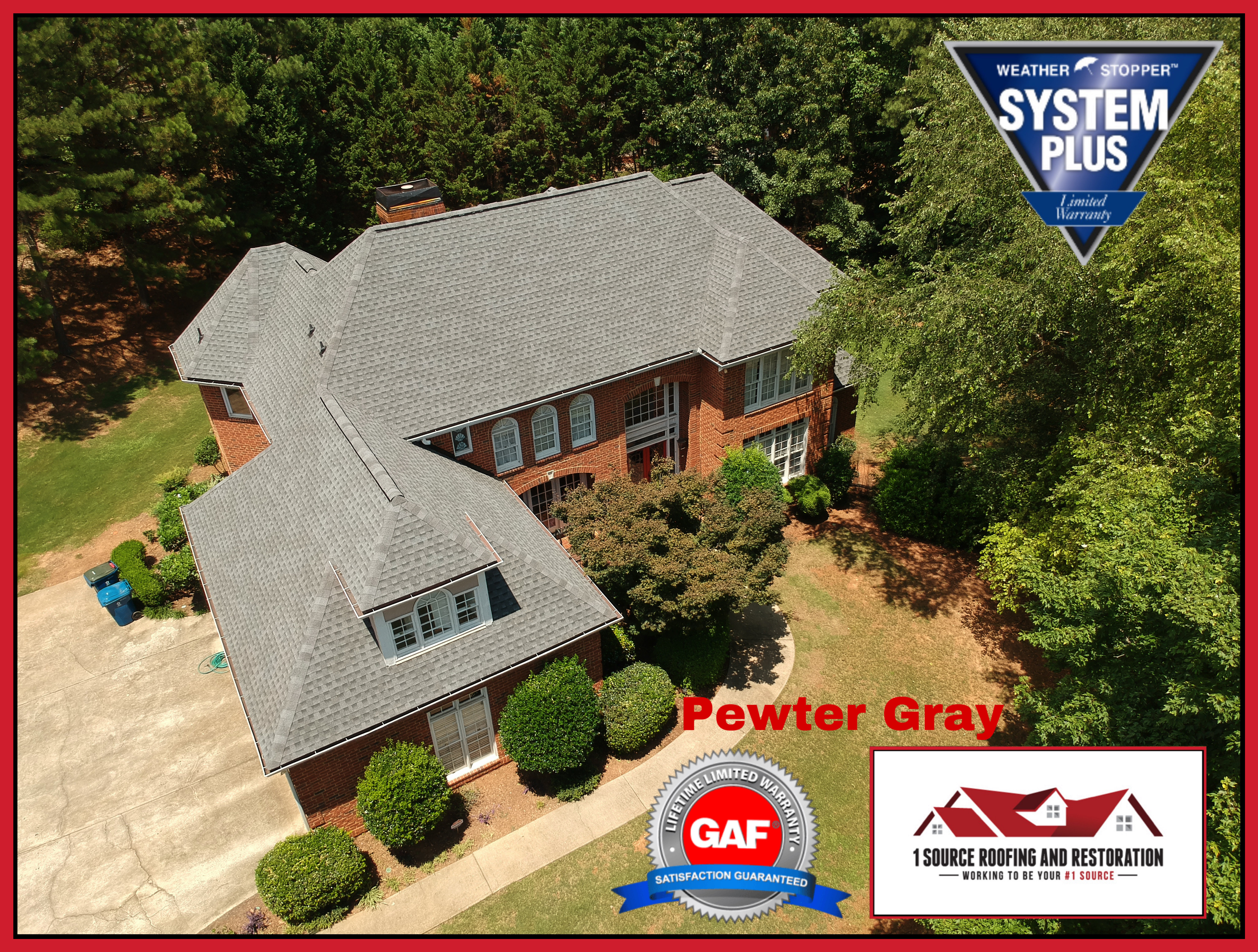
The key distinction homeowners need to understand is the difference between fiberglass mat and organic mat construction. Virtually all modern asphalt shingles use fiberglass mat as their base layer. Fiberglass mat is dimensionally stable in Georgia's humidity, does not absorb moisture, and maintains its shape through the thermal cycling common in Georgia summers. Organic mat shingles — distinguishable by their heavier weight and the fact they predate the 1980s — are still encountered on older homes and should be replaced proactively given their poor performance in high-humidity environments.
Within modern fiberglass-mat asphalt shingles, three performance tiers matter for Georgia homeowners: standard 3-tab, architectural (dimensional), and impact-resistant. Standard 3-tab shingles are the lightest and least expensive, with a flat profile and limited wind resistance ratings (typically 60–70 mph). They have largely fallen out of favor in metro Atlanta, where architectural shingles represent the minimum sensible specification for new installations. Architectural shingles, also called dimensional or laminate shingles, use two bonded layers of fiberglass mat to create a textured, wood-shake appearance with significantly improved wind resistance (typically 110–130 mph). They account for the majority of residential installations in Atlanta today. For hail-prone areas of metro Atlanta, impact-resistant shingles represent the highest-performance asphalt option — discussed in the next section.
Algae resistance is a non-negotiable specification for Georgia installations. Products incorporating copper-based Scotchgard technology (available on GAF and 3M-licensed products) or zinc-treated granules (CertainTeed StreakFighter) resist the algae growth that produces the black streaking common on Atlanta roofs within 5–10 years of installation. Without this treatment, algae growth is cosmetically damaging and, over time, contributes to granule loss and reduced shingle performance.
3. Architectural vs. 3-Tab Shingles: Why the Difference Matters
The distinction between architectural and 3-tab shingles extends well beyond aesthetics. For Georgia homeowners evaluating a roof replacement, understanding this difference is foundational to specifying the right system.
A 3-tab shingle is a single-layer product with cutouts that create the appearance of three separate shingles. The single-layer construction means less material mass, lower impact resistance, and reduced wind uplift performance. The uniform flat profile is also more susceptible to wind-driven rain infiltration at the tabs. In Georgia's storm environment, 3-tab shingles are consistently the first to show failure after significant wind events.
Architectural shingles are laminated — two separate fiberglass-mat layers bonded together with a larger, heavier base layer and a smaller overlying layer that creates the dimensional, shadow-line appearance. This laminated construction delivers meaningful performance advantages: higher mass resists granule displacement in hail events, the dimensional profile sheds water more aggressively, and the two-layer bond creates resistance to wind uplift that single-layer shingles cannot match. Most architectural shingles are rated for 110 mph wind resistance; premium lines from GAF (Timberline HDZ), CertainTeed (Landmark PRO) (Duration) achieve 130 mph ratings.
Warranty structures also differ substantially. Standard 3-tab warranties typically cover 25 years with pro-rated coverage after year 10. Premium architectural shingles carry lifetime limited warranties (covering the period a homeowner owns the home), with non-prorated coverage periods of 10–15 years — and enhanced coverage when installed by certified contractors. For homes in metro Atlanta's premium neighborhoods, architectural shingles are the baseline specification; 3-tab shingles are not an appropriate choice for a quality replacement project.
4. Impact-Resistant Shingles: Worth It in Georgia's Hail Belt?
Impact-resistant (IR) shingles are one of the most consequential upgrades available to Atlanta homeowners, and the calculus is more favorable in Georgia than in many other markets. The case rests on three distinct factors: physical protection, insurance economics, and warranty performance.
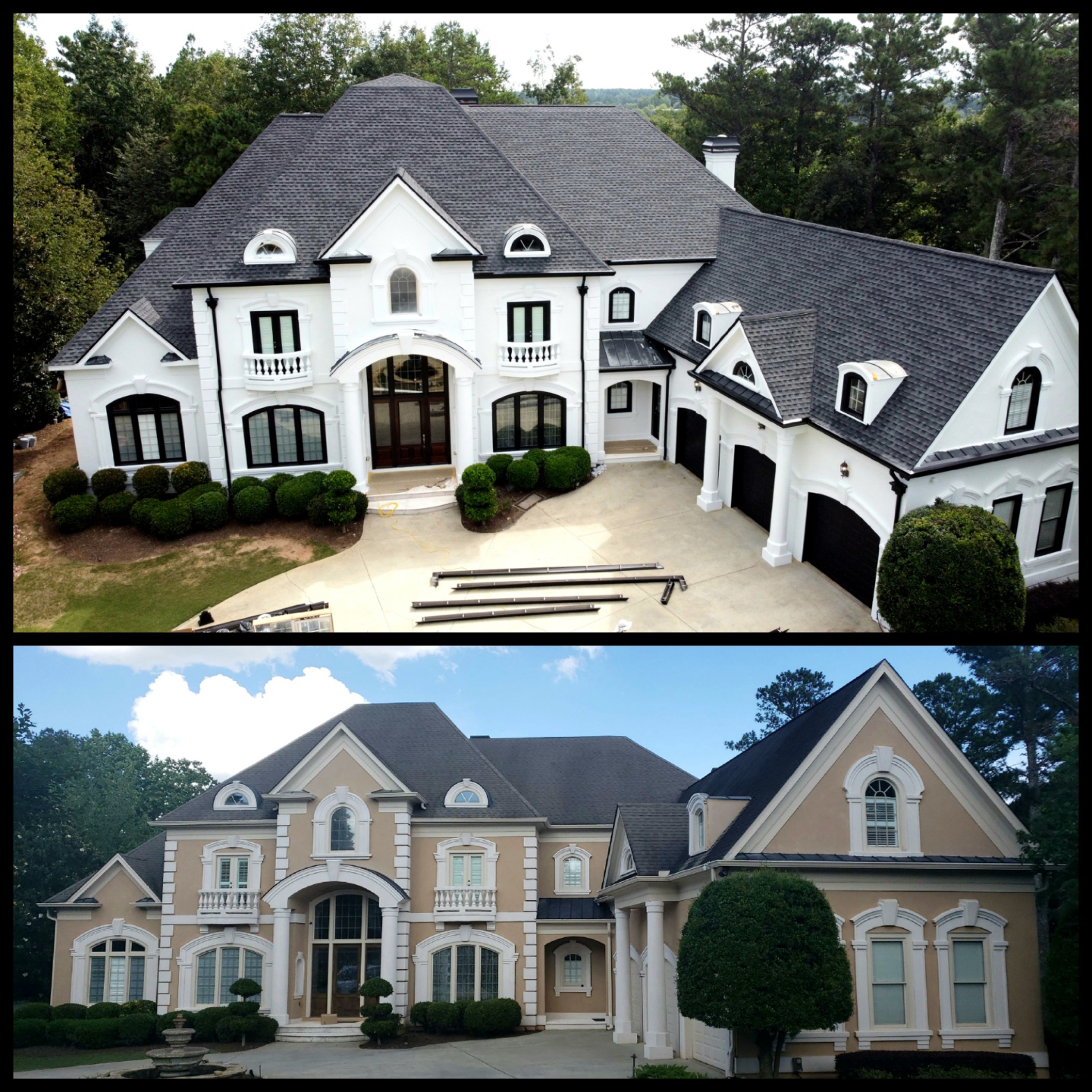
Impact resistance in roofing shingles is rated under UL 2218, a standard that classifies products by the size of steel ball dropped from a defined height onto the shingle surface. Class 3 products withstand a 1.75-inch ball impact without fracturing; Class 4 products withstand a 2-inch ball impact — the highest rating. In practical terms, Class 4 shingles resist functional damage from the 1–1.75 inch hail events that metro Atlanta experiences most frequently. They are not hail-proof in extreme events, but they dramatically reduce granule loss and mat fracturing from the hail sizes most common in the region.
The insurance economics in Georgia are compelling. Many Georgia homeowners insurance carriers offer premium discounts of 15–30% for Class 4 impact-resistant roofing. These discounts, applied annually, can offset the incremental project investment of IR shingles within 5–8 years, and the shingles continue to deliver savings for the life of the roof. Confirm the specific discount with your carrier before specifying materials — discounts vary by insurer.
Leading Class 4 products available through certified Atlanta contractors include GAF Timberline ArmorShield II, which uses a polymer-modified asphalt formulation for enhanced flexibility; CertainTeed Landmark IR, which carries both Class 4 UL 2218 and Class A fire ratings; and Duration Storm, which combines SureNail Technology (a woven fabric reinforcement strip in the nailing zone) with polymer-modified construction. All three products carry manufacturer lifetime limited warranties when installed by certified contractors.
5. Metal Roofing: The Premium Choice for Georgia Heat and Storms
Metal roofing has become an increasingly common choice for premium homes across metro Atlanta, and the reasons are rooted in Georgia's specific climate challenges. For homeowners planning to remain in their homes for 15 or more years — or for those seeking a single-installation-for-life solution — metal roofing delivers performance advantages that asphalt cannot match.
The thermal performance case is particularly strong in Georgia. Metal roofing with reflective finishes — available in Energy Star-rated coatings from manufacturers including Sherwin-Williams Coil Coatings and Valspar — reflects 60–70% of solar radiation that asphalt absorbs. In Georgia's long summers, this solar reflectance translates directly to lower attic temperatures, reduced air conditioning loads, and meaningful energy savings. Studies from the Oak Ridge National Laboratory document cooling energy savings of 7–15% in hot-humid climates with reflective metal roofing — relevant for Georgia homes running central air conditioning from April through October.
Metal roofing's wind performance is exceptional. Properly installed standing seam systems carry wind resistance ratings of 130–160 mph — well beyond what Georgia's thunderstorm corridor typically produces. Unlike shingle systems where wind uplift works at individual tabs and seams, standing seam metal's concealed fastener system distributes wind loads across the entire panel structure. For homes in more exposed locations — ridge-top homes in North Fulton, lakeshore properties in Forsyth County, or estate homes on larger lots — this wind performance difference is a meaningful consideration.
When considering a metal roof replacement for your Atlanta home, the project investment is 2–3x that of architectural asphalt shingles on an upfront basis. The correct financial framework is cost-per-year of service: a metal roof at $30,000 lasting 50 years represents $600/year, compared to an architectural shingle roof at $18,000 lasting 28 years at $643/year — comparable on a per-year basis, with the metal roof delivering superior storm performance throughout its life.
6. Standing Seam vs. Metal Shingles: Which Metal Option Fits Your Home?
Not all metal roofing is the same. The two primary residential metal roofing categories — standing seam panels and metal shingles/shake profiles — perform differently and suit different architectural contexts. For Georgia homeowners, the choice between them has practical implications beyond aesthetics.
Standing seam metal roofing uses continuous vertical panels that run from ridge to eave, with concealed fasteners and raised seams that interlock to form a watertight surface. The concealed fastener system eliminates the leak points common to exposed-fastener metal roofing — a critical advantage in Georgia's high-rainfall environment. Standing seam is the appropriate specification for homes with longer roof planes, lower pitches (3/12 or greater is typical; some profiles work on 1/12), and modern or transitional architectural styles.
In Georgia's heat, thermal expansion gap requirements are critical for standing seam installation. Steel expands approximately 0.0000065 inches per inch per degree Fahrenheit; a 20-foot steel panel experiences roughly 0.6 inches of movement over a 50°F temperature swing. Proper installation requires floating clips that allow panel movement without buckling or fastener pullout. Installers who use fixed clips on steel panels in Georgia's climate will see panel distortion and fastener stress within years. This is a quality-of-installation issue that is invisible to the homeowner at time of installation but reveals itself over time.
Metal shingles and shake profiles — available from manufacturers including DECRA, Matterhorn, and Edco — replicate the appearance of traditional roofing materials (wood shake, slate, tile) in a steel or aluminum format. They use exposed fasteners in the nailing zone, covered by the overlapping course above. Metal shingles are an appropriate choice for homes where the standing seam panel aesthetic conflicts with traditional architecture, and they deliver comparable longevity to standing seam when installed correctly. In Georgia's humid climate, use aluminum or Galvalume steel with full coil-coated finishes rather than bare metal to prevent the oxidation that compromises exposed-fastener systems over time.
7. Slate Roofing: The Gold Standard for Luxury Atlanta Homes
Natural slate is the only roofing material that can legitimately claim indefinite lifespan when properly maintained. Historic homes in Buckhead with original slate installations from the 1920s and 1930s remain structurally sound today — nearly a century after installation. For the right home, with the right structure, and the right installation team, natural slate represents the pinnacle of residential roofing.
The structural prerequisite is non-negotiable: natural slate weighs 9–12 pounds per square foot, compared to 2–3 pounds for asphalt shingles. Standard residential roof sheathing and framing — designed for asphalt — cannot support slate without engineering assessment and, in many cases, structural reinforcement. This is not a deterrent for serious estate homes in Buckhead, Sandy Springs, or Alpharetta, where structural upgrades are factored into the project scope as a matter of course. It is, however, a critical discovery step before any slate project is quoted.
Slate's performance in Georgia's climate is outstanding across all relevant metrics. It is completely impervious to moisture infiltration, immune to the algae and moss growth that affects organic and even fiberglass shingles in Georgia's humidity, and resists thermal cycling without the material degradation that affects asphalt over time. Slate does not oxidize, rot, or lose protective coatings. Its primary vulnerability is physical impact — very large hail can crack individual slates, requiring targeted replacement rather than full system replacement.
Sourcing matters. Vermont slate (Glendyne, Hilltop) and Virginia slate (Buckingham) are the most common domestic grades used in Atlanta installations. Spanish and Chinese slate are available at lower price points but vary more in quality and consistency. A qualified installer will specify the geological grade and origin of slate for any project, and the warranty structure will reflect that sourcing. Expect natural slate project investments to begin around $35,000 for a standard residence and scale significantly for complex roof geometries, larger homes, or historic restoration work.
Get a Material Recommendation from a GAF Certified Contractor
Our inspectors assess your structure, slope, HOA requirements, and ownership goals before recommending any material. No obligation.
Call (404) 277-13778. Synthetic Slate: Performance Without the Weight
Synthetic slate occupies a compelling middle ground for Atlanta homeowners who want the aesthetic authority of natural slate without the structural demands. Modern synthetic slate products — manufactured from polymer composites, recycled rubber and plastic, or fiber-cement compounds — have improved dramatically over the past decade and now deliver genuine performance advantages in Georgia's specific climate.
The weight advantage is decisive for many homes. Synthetic slate products typically weigh 1.5–3.5 pounds per square foot — within the structural capacity of most residential framing systems without modification. This eliminates the engineering assessment and potential structural reinforcement that natural slate requires, simplifying the project scope and timeline considerably.
Leading products in this category include DaVinci Roofscapes Bellaforte Slate (a polymer composite with Class 4 impact rating and Class A fire rating), CertainTeed NaturalSlate (a fiber-cement product with exceptional dimensional accuracy and a 50-year limited warranty), and Boral TruDefinition Slate (recycled content with strong color stability in UV-intensive environments). All three carry Class 4 impact ratings — critical in Georgia's hail corridor — and dimensional stability in temperature extremes that polymer-modified products manage well.
Color stability in Georgia's UV environment is worth examining. Synthetic slate exposed to Georgia's intense UV radiation will fade if manufactured without UV-stabilized pigment packages. Specify products with UV-stabilized formulations and review available fade warranties — the better manufacturers offer 50-year color warranties that mean something in Georgia's high-UV climate. For homes in Lawrenceville and surrounding Gwinnett County communities, synthetic slate has become a popular upgrade specification precisely because it delivers the aesthetic of natural materials at a manageable project scope.
9. Clay and Concrete Tile: Mediterranean Style in the Georgia Heat
Clay and concrete tile roofing is less common in metro Atlanta than in the Southwest, but it appears regularly on Mediterranean-style and Spanish Colonial homes — particularly in communities designed around that architectural vocabulary. Understanding tile roofing's Georgia-specific performance profile helps homeowners with existing tile systems or those considering tile on new construction make informed decisions.
Clay tile's thermal performance in Georgia is genuinely strong. The mass of clay tiles buffers heat transfer, and the barrel profile creates natural ventilation channels between the tile surface and the roof deck — reducing heat transmission to the building interior. In Georgia's summer heat, this thermal mass effect has real utility. Clay tile also handles Georgia's rainfall volume well; the overlapping barrel or flat tile profile sheds water aggressively and provides redundant drainage paths.
The structural concern is similar to natural slate: clay and concrete tiles weigh 9–12 pounds per square foot. Existing tile homes have already been built or retrofitted to carry this load; homes converting to tile from asphalt require engineering assessment. Concrete tile — slightly lighter than clay at 8–10 lbs/sq ft — is more common in Georgia for this reason.
Tile's primary vulnerability in Georgia is freeze-thaw cycling. North Georgia and higher-elevation areas around Blue Ridge can experience meaningful freeze events; tile products specified for Georgia should carry a freeze-thaw rating appropriate for the installation location. In metro Atlanta proper, where hard freezes are relatively infrequent, this is a lesser concern — but it remains a specification detail that distinguishes quality installations from inadequate ones.
10. Flat and Low-Slope Roofing Systems for Commercial Properties
Commercial and mixed-use properties in metro Atlanta typically feature flat or low-slope roof sections — defined as roofs with a pitch below 2/12 — that require fundamentally different roofing systems than steep-slope residential applications. The primary systems used in the Atlanta commercial market are TPO membrane, EPDM rubber membrane, modified bitumen, and built-up roofing (BUR).
TPO (Thermoplastic Polyolefin) has become the dominant commercial roofing membrane in Atlanta over the past decade. TPO's white reflective surface is highly effective in Georgia's summer heat — the Energy Star-rated white TPO membranes reflect 70–80% of solar radiation, delivering significant HVAC savings in large commercial buildings. TPO is heat-welded at seams, creating a watertight bond that outperforms mechanically fastened or glued seam systems under Georgia's thermal cycling. TPO thicknesses range from 45 to 80 mil; in Georgia's high-UV, high-temperature environment, 60 or 80 mil is the appropriate specification.
EPDM (Ethylene Propylene Diene Monomer) is a synthetic rubber membrane with a long track record in Georgia. EPDM handles UV exposure and ozone well, and the material's flexibility at temperature extremes makes it durable through Georgia's winter freeze events. Traditional black EPDM absorbs heat — a disadvantage in Georgia's summer climate — though white-faced and reflective EPDM options now address this. EPDM is often preferred for retrofit applications where the existing roof deck configuration makes TPO heat-welding impractical.
Modified bitumen systems, applied either in two-ply torch-down or cold-adhesive configurations, remain common on older commercial buildings throughout metro Atlanta. Torch-applied modified bitumen requires experienced installation teams — Georgia's hot summers mean the ambient conditions already stress the asphalt compound, making temperature management during application critical.
11. The Role of Roof Ventilation in Georgia's Climate
Ventilation is not a roofing material selection, but it is so consequential to material performance in Georgia that any serious discussion of roofing systems must address it. Inadequate ventilation is one of the most common contributors to premature roofing system failure in Atlanta — and one of the most frequently overlooked factors when homeowners evaluate material options alone.
The physics are straightforward: in Georgia's summer, unventilated attic spaces can reach 150–170°F. This extreme heat drives thermal degradation of the roofing materials above and creates a heat load that significantly increases the air conditioning demand below. Proper ventilation — a balanced system of intake vents (soffit) and exhaust vents (ridge, power) — reduces attic temperatures by 30–50°F, extending roofing material life and reducing cooling costs simultaneously.
In winter, the concern shifts to moisture. Georgia's combination of relatively mild winters and occasional freeze events creates conditions where warm, humid interior air can infiltrate poorly sealed attic spaces and condense on cold roof decking. This condensation, repeated through enough cycles, leads to decking rot that compromises the structural substrate regardless of what roofing material is installed on top of it. Proper attic air sealing and ventilation rate management — typically 1 square foot of net free vent area per 150 square feet of attic floor — prevent this failure mode.
Any quality roof replacement project in Georgia should include a ventilation assessment. A contractor who quotes shingle replacement without examining or discussing the ventilation system is skipping a critical performance variable. The better certifications — GAF's Master Elite and Certified Contractor programs — require ventilation assessment as part of their installation standards.
12. GAF, CertainTeed: Why Certification Matters
The three dominant residential roofing manufacturers in North America — GAF, CertainTeed — all operate contractor certification programs that distinguish professionally trained installers from general roofing contractors. Understanding what these certifications mean helps Atlanta homeowners evaluate contractor qualifications with precision.
GAF's Timberline HDZ is the most-installed shingle in North America, with over 8 million squares installed annually. The HDZ designation refers to the LayerLock adhesive strip technology that bonds shingle layers on installation, providing enhanced wind resistance from the moment of installation rather than requiring months of thermal cycling to activate. A GAF Certified contractor has met training requirements and background checks, and can offer the GAF Golden Pledge Limited Warranty — which covers both materials and workmanship for up to 25 years, backed by GAF rather than the contractor alone. This is the warranty that matters: it survives contractor business changes and provides direct manufacturer recourse.
CertainTeed's Landmark warranty — available at its fullest through ShingleMaster-certified contractors — covers installed shingles against manufacturing defects for the warranty period with SureStart Plus non-prorated coverage for the first 10 years. The SureStart period means CertainTeed pays for replacement at current material costs, not depreciated value, during the most critical post-installation years. CertainTeed's ShingleMaster certification requires training in installation technique, ventilation assessment, and substrate preparation — skills directly relevant to Georgia's demanding climate conditions.
's Duration shingle carries a 130 mph wind warranty — among the highest in the architectural shingle category — when installed per manufacturer specifications by a Preferred Contractor. The Duration's SureNail Technology (the woven fabric reinforcement strip in the nailing zone that accepts fasteners without tearing) directly addresses one of the most common installation failures: overpowered nail guns that drive fasteners through the shingle rather than flush. In Georgia's wind environment, this fastening integrity is a performance-critical detail.
13. How to Choose the Right Material for Your Home
After examining every major roofing material option, the practical decision framework for Georgia homeowners comes down to four variables: structural capacity, ownership horizon, HOA/historic requirements, and project scope relative to home value.
Structural capacity is the first filter. If your home was built for asphalt shingles, the framing system is designed for a 2–3 lb/sq ft load. Upgrading to tile or natural slate requires engineering assessment before any other decision is made. Synthetic slate, metal shingles, and architectural asphalt shingles all fall within standard framing capacity. Standing seam metal is also within standard framing capacity — the panels are lightweight despite their durability.
Ownership horizon shapes the investment calculus. Homeowners planning to sell within 5 years have different optimal specifications than those planning multi-decade ownership. A quality architectural shingle replacement appeals broadly to buyers and delivers strong return on investment in resale scenarios. Metal roofing or synthetic slate is more compelling for long-term owners who will capture decades of energy savings and elimination of future replacement cycles.
HOA and historic overlay requirements constrain material choices in many Atlanta communities. Before any material decision is finalized, obtain your HOA's approved materials list and any relevant architectural review board requirements. In historic preservation districts — Roswell's Canton Street corridor, Buckhead's established residential streets — specific material and color restrictions apply. A reputable contractor will review these requirements before recommendation.
Project scope relative to home value informs the appropriate material tier. For a $2.5 million estate in Sandy Springs, specifying standard 3-tab asphalt would be mismatched to the property. For a $350,000 home in a standard subdivision, natural slate would be difficult to recoup in resale. The appropriate material tier is one that protects and complements the property appropriately — not the most expensive option available, but certainly not the least capable material that technically meets code.
Not sure which material fits your home? Our inspectors assess your structure, slope, and HOA requirements before making a recommendation. We never specify a material without understanding the full picture of your home's conditions and your ownership goals.
Materials Comparison: Georgia Climate Performance
| Material | Lifespan | Cost Range (per square) | Impact Rating | Georgia Heat Performance | Best For |
|---|---|---|---|---|---|
| 3-Tab Asphalt | 15–20 yrs | $90–$140 | Class 1–2 | Adequate; oxidizes faster in UV | Entry-level replacements |
| Architectural Asphalt | 25–30 yrs | $130–$200 | Class 2–3 | Good; specify algae-resistant | Most Georgia homes |
| Impact-Resistant Asphalt | 30+ yrs | $180–$280 | Class 4 | Very good; insurance discount eligible | Hail-zone homes; insurance savings |
| Standing Seam Metal | 40–70 yrs | $600–$1,200+ | Excellent | Excellent; reflective coatings reduce cooling load | Premium homes; long-term ownership |
| Metal Shingles | 40–50 yrs | $400–$800 | Class 4 | Very good; profile-dependent ventilation | Traditional aesthetic + metal durability |
| Synthetic Slate | 40–50 yrs | $400–$700 | Class 4 | Good; UV-stabilized formulations essential | Luxury aesthetic; standard framing |
| Natural Slate | 75–150+ yrs | $1,000–$2,500+ | High (brittle) | Excellent; impervious to moisture | Estate homes; structural assessment required |
| Clay / Concrete Tile | 50–100 yrs | $800–$1,600 | Moderate | Good; thermal mass buffers heat | Mediterranean-style architecture |
Certified by Industry-Leading Manufacturers